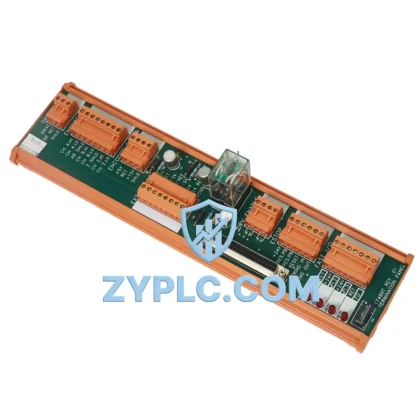
GE DS200SDCCG4AGD System-Ready Signal Conditioner for Mark V Architecture: Control System Architecture and Upstream-Downstream Synergy
In modern industrial automation, no component operates in isolation. The GE DS200SDCCG4AGD signal conditioning board is engineered as an integral node within the GE Mark V turbine control architecture — a platform renowned for its layered redundancy, deterministic signal processing, and long-term serviceability across power generation, oil & gas, and heavy industrial environments. Understanding this module’s role requires examining the full control system hierarchy: from the field instrument layer through the I/O conditioning tier, into the controller core, and outward to the communication and supervisory layers. This board’s value lies not in isolation, but in its Contextual Integration across every tier of the Mark V control architecture.
The DS200SDCCG4AGD occupies a critical position in the Mark V’s signal conditioning layer. It receives raw analog and discrete signals from field devices — thermocouples, RTDs, pressure transmitters, and proximity probes — and conditions them into clean, noise-filtered, range-validated signals suitable for the Mark V’s processor boards. Without reliable signal conditioning, even the most sophisticated CPU architecture cannot deliver accurate turbine protection or control. This board ensures that signal integrity is maintained from the field terminal to the control algorithm, forming the backbone of safe and stable turbine operation.
Architecture Specification Table
| Parameter |
Specification |
| Part Number |
DS200SDCCG4AGD |
| Manufacturer |
GE (General Electric) |
| Series |
Mark V Turbine Control System / DS200 |
| Module Type |
Signal Conditioning Board |
| System Role |
Analog & Discrete Signal Conditioning — I/O Layer, Mark V Architecture |
| Input Signal Types |
Thermocouple, RTD, 4–20 mA Analog, Discrete (24 VDC) |
| Output Interface |
Conditioned signals to Mark V processor boards (TCCA, TCDA, TCQA) |
| Electrical Supply |
+5 VDC / ±15 VDC (supplied via Mark V backplane) |
| Communication Capability |
Backplane-integrated; compatible with Mark V IONET and ARCNET topology |
| Installation Environment |
Panel-mounted within Mark V control cabinet; card-cage format |
| Operating Temperature |
0°C to +60°C (standard industrial range) |
| Humidity |
5% to 95% non-condensing |
| Compliance |
CE, UL (GE Mark V platform standards) |
| Contextual Integration |
Fully compatible with Mark V simplex and TMR panel architectures; backplane plug-and-play replacement |
| Warranty |
12-Month Warranty — covers functional defects under normal operating conditions |
| Condition |
Tested, inspected, and system-verified prior to dispatch |
Coordinated Control System Design
The GE Mark V control system is a multi-board, multi-layer architecture where each module’s performance depends on the coherence of the entire assembly. The DS200SDCCG4AGD does not function as a standalone device — it is part of a tightly integrated signal chain that begins at the field terminal block and ends at the turbine control algorithm, embodying true Contextual Integration across the control hierarchy.
At the processor level, the Mark V relies on boards such as the DS200TCQAG1BGF (TCQA) and DS200TCCAG1BHH (TCCA) to execute turbine protection logic and sequencing. These processor boards depend entirely on clean, conditioned inputs from the signal conditioning layer — a dependency that makes the DS200SDCCG4AGD indispensable to system accuracy. Any signal drift or noise introduced before conditioning reaches the processor will propagate directly into control decisions, potentially triggering spurious trips or masking genuine fault conditions.
Power integrity is equally critical. The Mark V’s power distribution board, typically the DS200PCCAG1ABB (PCCA), supplies regulated voltages to all card-cage modules. The DS200SDCCG4AGD draws its operating power from this backplane supply, meaning that power quality directly affects signal conditioning accuracy. Engineers commissioning or maintaining a Mark V system should verify PCCA output stability before diagnosing signal conditioning anomalies.
On the I/O side, the DS200IOCAG1A (IOCA) I/O controller board manages the routing of conditioned signals between the field terminal boards and the processor core. Working in concert with the DS200SDCCG4AGD, the IOCA ensures that signal assignments are correctly mapped and that channel-level diagnostics are available to the operator. For systems with expanded I/O requirements, the DS200SDCIG1A and related DS200-series signal conditioning variants can be deployed in parallel racks to extend channel capacity without architectural redesign.
Communication architecture in the Mark V is handled through the DS200DSPCH1A (DSPC) communication processor and the IONET/ARCNET network topology, which links the Mark V panels to the operator HMI — typically a GE Cimplicity HMI workstation or Mark V Operator Interface Terminal (OIT). The signal conditioning layer feeds real-time process values into this communication chain, enabling operators to monitor turbine health, alarm states, and trend data from the supervisory level. Accurate signal conditioning is therefore not only a protection function but also a data quality function for the entire SCADA and historian infrastructure.
For relay output and actuator interfacing, the Mark V architecture incorporates relay output boards such as the DS200RTBAG1A (RTBA), which translate processor commands into discrete switching actions for solenoid valves, contactors, and trip relays. The integrity of these output actions depends on the quality of the input signals processed upstream by the DS200SDCCG4AGD — completing the closed-loop signal chain from field sensor to final control element. In TMR configurations, the DS200TCDAG1AAA (TCDA) diagnostic board further validates signal consistency across all three redundant lanes, reinforcing the system’s fault-tolerant architecture.
Application in Layered Automation Systems
The DS200SDCCG4AGD finds its primary application in gas turbine and steam turbine control systems across power generation facilities, where the Mark V platform has been the industry standard for decades. In combined-cycle power plants, the board supports continuous monitoring of exhaust gas temperatures, compressor inlet conditions, and vibration signals — all of which must be accurately conditioned before the Mark V’s protection algorithms can make reliable trip or load-shedding decisions.
In oil and gas processing environments, the Mark V with DS200-series signal conditioning is deployed on gas compression trains, LNG liquefaction units, and pipeline booster stations. Here, the signal conditioning board must handle signals from hazardous-area field instruments, often routed through Zener barriers or galvanic isolators before reaching the control panel. The DS200SDCCG4AGD’s robust input architecture accommodates these signal conditioning chains without introducing additional latency or accuracy loss.
For petrochemical and refinery applications, the board supports process control loops where thermocouple and RTD signals from reactor vessels, heat exchangers, and distillation columns must be conditioned with high accuracy. In these environments, signal drift or channel failure can result in product quality deviations or safety system activations, making the reliability of the DS200SDCCG4AGD a direct contributor to plant availability and regulatory compliance.
In mining and metals processing facilities operating large rotating equipment — ball mills, crushers, and kiln drives — the Mark V platform is adapted for motor protection and process control. The DS200SDCCG4AGD’s ability to condition vibration and temperature signals from heavy machinery makes it suitable for these demanding environments, where signal noise from variable-frequency drives and high-current switchgear is a persistent challenge.
In water treatment and municipal utility applications, where continuous process availability is mandated by regulatory frameworks, the Mark V’s redundant architecture — supported by reliable signal conditioning from the DS200SDCCG4AGD — provides the fault tolerance required for pump station control, chemical dosing systems, and SCADA-integrated monitoring. The board’s standardized form factor ensures that maintenance teams can execute rapid replacements during scheduled outages, minimizing process interruption.
Across all these industries, the board’s value extends beyond initial commissioning. Its standardized form factor and backplane compatibility mean that maintenance teams can replace a failed signal conditioning board during a planned outage without requiring system reconfiguration or software changes — a critical advantage in facilities where unplanned downtime carries significant financial and safety consequences. Every unit dispatched by ZYPLC is covered by a 12-Month Warranty, ensuring confidence in long-term spare parts management.
Architecture Engineering FAQ
Q1: Is the DS200SDCCG4AGD compatible with all Mark V panel configurations, including TMR (Triple Modular Redundant) systems?
The DS200SDCCG4AGD is designed for the GE Mark V DS200-series card cage architecture and supports Contextual Integration with both simplex and TMR Mark V configurations. In TMR systems, three independent signal conditioning channels process the same field signal in parallel, with the Mark V’s voting logic selecting the median value for control decisions. Each TMR lane requires its own DS200SDCCG4AGD or equivalent signal conditioning board, so TMR panel upgrades or replacements typically involve three boards per signal group. Always verify the specific panel drawing and I/O assignment list before ordering replacement boards to confirm the correct revision suffix (G4AGD) matches the installed configuration.
Q2: What commissioning steps are required when installing a replacement DS200SDCCG4AGD in an operational Mark V system?
Replacement of a signal conditioning board in an operational Mark V system should follow a structured commissioning sequence. First, confirm that the replacement board’s revision and hardware configuration match the original — mismatched revisions can cause calibration offsets or diagnostic faults. After physical installation into the card cage, perform a channel-by-channel signal verification using the Mark V’s built-in diagnostic tools or an external signal simulator. Verify that all thermocouple, RTD, and analog input channels read within the expected accuracy band before returning the system to automatic control. For TMR systems, confirm that the voting logic is functioning correctly across all three lanes before releasing the turbine to load. Document all commissioning results for the plant’s maintenance records.
Q3: What does the 12-Month Warranty cover, and what support is available for long-term spare parts management?
The 12-Month Warranty covers functional defects in the DS200SDCCG4AGD under normal operating conditions, including failures attributable to component-level faults identified during the warranty period. The warranty does not cover damage resulting from incorrect installation, overvoltage events, or environmental conditions outside the module’s rated specifications. For long-term spare parts management, we recommend maintaining at least one spare DS200SDCCG4AGD per Mark V panel in facilities where turbine availability is critical. Our inventory is sourced from tested, decommissioned Mark V systems and undergoes functional verification before dispatch, ensuring that spare boards are ready for immediate installation. Contact our technical team for volume pricing on multi-board spare packages and for guidance on cross-referencing compatible DS200-series signal conditioning variants for your specific panel revision.
© 2026 ZYPLC. All rights reserved.
Original Source: https://zyplc.com
Contact: +86 19859288691 | [email protected]