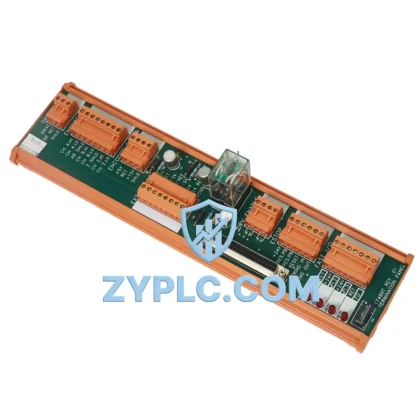
GE IS200TPROH1BCB System-Ready Turbine Protection for Mark VI Architecture
The GE IS200TPROH1BCB is a turbine protection printed circuit board engineered specifically for deployment within the GE Mark VI Speedtronic turbine control system architecture. Rather than functioning as a standalone component, this board occupies a critical position within a layered, multi-tier control hierarchy — one that spans the control layer, I/O layer, network layer, power layer, human-machine interface layer, and the final execution layer. Understanding its role within this full-stack architecture is essential for engineers responsible for system integration, long-term maintenance, and capacity planning in gas turbine, steam turbine, and combined-cycle power generation facilities.
Within the Mark VI control platform, the IS200TPROH1BCB operates as part of the protection I/O subsystem, receiving and processing critical turbine signals — including overspeed detection, flame detection, vibration thresholds, and emergency shutdown triggers — and relaying processed outputs to the core controller modules. Its integration with the UCSC or UCCE controller cards ensures that protection logic is executed with deterministic timing, maintaining system safety margins even under abnormal operating conditions. The board is designed to slot into the Mark VI VME-based I/O rack, sharing the backplane with companion boards such as the IS200TBAIH1B analog input terminal board and the IS200TBCIH1B contact input terminal board, forming a tightly coordinated I/O assembly.
From a signal flow perspective, field-level sensors — thermocouples, RTDs, proximity probes, and pressure transmitters — connect through marshalling panels and terminal boards before their signals reach the IS200TPROH1BCB for conditioning and protection logic evaluation. The board communicates upstream to the Mark VI controller via the IONet Ethernet-based I/O network, a deterministic communication backbone that also links other I/O boards including the IS200TREGH1B voltage regulator board and the IS200TTURH1B turbine I/O board. This network architecture ensures that all protection events are communicated to the controller with minimal latency, supporting the sub-millisecond response requirements of turbine overspeed and emergency shutdown functions.
System redundancy is a core design consideration in Mark VI deployments, and the IS200TPROH1BCB supports TMR (Triple Modular Redundancy) configurations where three independent controller channels — designated R, S, and T — each receive identical protection signals. In a TMR architecture, the IS200TPROH1BCB is typically installed in triplicate, with each instance connected to its respective controller channel. This voting architecture ensures that a single board failure does not compromise turbine protection integrity, and allows hot-swap maintenance without process interruption. For simplex configurations, a single IS200TPROH1BCB instance is used, with the understanding that planned maintenance windows must be scheduled for board-level servicing.
Power supply integrity is equally important to the reliable operation of the IS200TPROH1BCB. The board draws regulated DC power from the Mark VI power distribution assembly, which typically includes IS200EPSCG1A or equivalent power supply modules. These modules provide conditioned 28 VDC or 5 VDC rails to the I/O rack backplane, ensuring that protection boards maintain operational stability even during grid disturbances or auxiliary power fluctuations. Engineers specifying replacement boards should verify that the existing power supply modules are within their rated capacity before commissioning the IS200TPROH1BCB in an expanded or reconfigured rack.
At the human-machine interface layer, operators interact with the Mark VI system through GE’s Toolbox software environment or through connected HMI workstations running ControlST or WorkstationST. Alarm and trip events detected by the IS200TPROH1BCB are surfaced through these interfaces, providing operators with real-time visibility into protection system status. Integration with plant-level DCS or SCADA systems is typically achieved via the Mark VI’s Modbus TCP or OPC DA/UA communication interfaces, allowing protection events to be logged and trended in historian platforms such as GE’s Plant Applications or third-party systems.
Architecture Specification Table
| Parameter |
Specification |
| Part Number |
IS200TPROH1BCB |
| Manufacturer |
GE (General Electric) |
| Series / Platform |
Mark VI Speedtronic Turbine Control System |
| Board Type |
Turbine Protection Printed Circuit Board |
| System Role |
Protection I/O — Overspeed, Flame, Vibration, ESD Logic |
| Rack Compatibility |
Mark VI VME-based I/O Rack |
| Communication Interface |
IONet (Deterministic Ethernet-based I/O Network) |
| Redundancy Support |
TMR (Triple Modular Redundancy) and Simplex |
| Power Supply Requirement |
Regulated DC via Mark VI Power Distribution Assembly |
| Operating Temperature |
0°C to 60°C (typical industrial control cabinet environment) |
| Installation Environment |
Control cabinet / Mark VI I/O enclosure |
| Origin |
United States |
| Warranty |
12-Month Warranty — covers functional defects under normal operating conditions |
| Contextual Integration |
Fully compatible with Mark VI TMR and simplex control architectures |
Coordinated Control System Design
The IS200TPROH1BCB does not operate in isolation — its value is realized through coordinated interaction with the full suite of Mark VI system components. In a typical turbine control cabinet, the board shares rack space with the IS200TBAIH1B analog input terminal board, which conditions thermocouple and RTD signals before they are evaluated by the protection logic. The IS200TBCIH1B contact input terminal board handles discrete field signals such as valve position feedback and manual trip inputs, feeding these into the protection decision matrix alongside the IS200TPROH1BCB outputs.
The UCSC simplex controller card or UCCE TMR controller card serves as the central processing unit of the Mark VI architecture, receiving protection outputs from the IS200TPROH1BCB via the IONet backbone and executing the configured protection logic sequences. In TMR systems, the IS200TTURH1B turbine I/O board works in parallel with the IS200TPROH1BCB to provide comprehensive coverage of turbine operating parameters, while the IS200TREGH1B voltage regulator board manages generator excitation control within the same rack environment.
At the execution layer, the Mark VI system interfaces with hydraulic servo valves, fuel control valves, and inlet guide vane actuators through dedicated output boards. The IS200TPROH1BCB’s trip relay outputs connect to these actuator circuits, ensuring that protection events result in immediate, deterministic mechanical responses. The IS200EPSCG1A power supply module provides the stable DC power rails required by all boards in the rack, and its health status is monitored continuously by the Mark VI controller to detect power supply degradation before it can affect protection system availability.
Application in Layered Automation Systems
The IS200TPROH1BCB finds its primary application in gas turbine and steam turbine power generation facilities, where it forms the backbone of the turbine protection system within the Mark VI control architecture. In combined-cycle power plants, the board is deployed across multiple turbine trains, with each unit’s Mark VI system operating independently while sharing plant-level data through the facility’s DCS or SCADA network. The deterministic protection response of the IS200TPROH1BCB is critical in these environments, where turbine trips must be executed within defined time windows to prevent mechanical damage.
In the petrochemical and refinery sector, the IS200TPROH1BCB is used in compressor train control systems, where gas turbine drivers require the same level of protection system integrity as in power generation applications. The board’s compatibility with the Mark VI TMR architecture makes it particularly well-suited for SIL-rated applications where functional safety standards demand redundant, voted protection logic.
Water treatment and pumping stations that employ gas turbine-driven pumps also benefit from the IS200TPROH1BCB’s robust protection capabilities. In these applications, the Mark VI system’s ability to interface with plant-level SCADA systems via Modbus TCP allows protection events to be integrated into the facility’s overall operational monitoring framework. Mining and minerals processing operations that rely on turbine-driven compressors and generators similarly depend on the IS200TPROH1BCB to maintain continuous protection system availability in harsh environmental conditions.
For metallurgical and steel production facilities, where process continuity is directly tied to turbine availability, the IS200TPROH1BCB’s support for TMR redundancy ensures that planned maintenance activities can be conducted without requiring full turbine shutdown. Packaging and continuous process production lines that use turbine-driven utilities also benefit from the board’s long service life and the availability of tested replacement units with 12-Month Warranty coverage, minimizing unplanned downtime risk.
Architecture Engineering FAQ
Q1: Is the IS200TPROH1BCB compatible with both TMR and simplex Mark VI configurations?
Yes. The IS200TPROH1BCB is designed to operate in both TMR (Triple Modular Redundancy) and simplex Mark VI system architectures. In TMR configurations, three boards are installed — one per controller channel (R, S, T) — and the system uses a two-out-of-three voting logic to determine protection actions. In simplex configurations, a single board is used, and the system relies on scheduled maintenance windows for board-level servicing. Engineers should confirm the specific Mark VI configuration at their site before ordering replacement boards to ensure the correct quantity and revision level are procured.
Q2: What installation and commissioning steps are required when replacing the IS200TPROH1BCB in a live Mark VI system?
Board replacement in a live Mark VI system should follow GE’s documented hot-swap procedures for TMR configurations, or require a planned turbine shutdown for simplex systems. Prior to installation, engineers should verify that the replacement IS200TPROH1BCB carries the correct hardware revision (H1BCB) and that the Mark VI Toolbox software configuration matches the board’s firmware version. After physical installation, the board must be commissioned through the Toolbox environment, including I/O calibration verification, protection setpoint confirmation, and a functional trip test. All commissioning activities should be documented in the site’s maintenance management system.
Q3: What does the 12-Month Warranty cover, and how does Contextual Integration support long-term system maintenance?
The 12-Month Warranty covers functional defects in the IS200TPROH1BCB under normal operating conditions, including failures attributable to manufacturing defects or component-level issues that manifest during the warranty period. It does not cover damage resulting from incorrect installation, overvoltage events, or environmental conditions outside the board’s rated specifications. Contextual Integration refers to the board’s verified compatibility with the broader Mark VI system architecture — including its IONet communication interface, VME rack backplane, and TMR voting logic — ensuring that replacement units integrate seamlessly into existing system configurations without requiring architectural modifications. For long-term maintenance planning, maintaining a stocked spare of the IS200TPROH1BCB is recommended for all sites operating Mark VI turbine control systems, given the board’s critical role in the protection architecture.
—
© 2026 ZYPLC. All rights reserved.
Original Source: https://zyplc.com
Contact: +86 19859288691 | plc.sales@zyplc.com