GE IS200TVIBH2BCC System-Ready Vibration Terminal Board for Mark VI Architecture: Control System Architecture and Upstream-Downstream Coordination
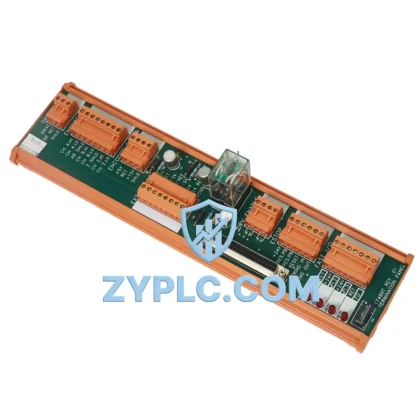
The GE IS200TVIBH2BCC is a dedicated Vibration Terminal Board engineered for seamless integration within the GE Mark VI and Mark VIe turbine control system architecture. Rather than functioning as a standalone component, this board occupies a critical position in the signal acquisition layer of a multi-tier industrial automation hierarchy — bridging raw mechanical vibration data from rotating machinery to the digital processing core of the Mark VI controller platform. Understanding its role demands a system-level perspective that spans the control layer, I/O layer, network layer, power layer, human-machine interface layer, and the execution layer where turbines, compressors, and generators operate under continuous supervisory control.
In a fully deployed Mark VI turbine control system, the IS200TVIBH2BCC serves as the primary termination point for proximity probes, accelerometers, and velocity transducers mounted on turbine shafts, bearing housings, and casing structures. These sensors generate analog signals that must be conditioned, filtered, and routed with precision before they reach the vibration monitoring and protection modules within the controller rack. The terminal board provides the physical and electrical interface that makes this signal path reliable, repeatable, and maintainable across the full operational lifecycle of the turbine unit — from initial commissioning through decades of continuous service.
Architecture Specification Table
| Parameter |
Specification |
| Part Number |
IS200TVIBH2BCC |
| Manufacturer |
GE (General Electric) |
| Compatible Platform |
Mark VI / Mark VIe Turbine Control System |
| System Role |
Vibration Signal Termination and Conditioning Board |
| Signal Types Supported |
Proximity Probe (Eddy Current), Velocity Transducer, Accelerometer |
| Electrical Interface |
Terminal block field wiring termination, shielded cable compatible |
| Communication Capability |
Hardwired analog signal routing to Mark VI I/O modules (e.g., IS200VVIBH1B) |
| Installation Environment |
Control cabinet / marshalling panel, DIN rail or rack-mount compatible |
| Operating Temperature |
0°C to 60°C (standard industrial control enclosure) |
| Origin |
United States |
| Warranty |
12-Month Warranty — covers functional integrity and signal path performance |
| Contextual Integration |
Fully supports Contextual Integration within Mark VI/VIe multi-module architectures |
Coordinated Control System Design
The IS200TVIBH2BCC does not operate in isolation. Its value is realized only when it is correctly positioned within a coordinated Mark VI control system architecture. In a typical turbine protection and control cabinet, this terminal board interfaces directly with the IS200VVIBH1B vibration monitor module, which processes the conditioned analog signals and applies protection logic — including high-vibration trip thresholds — before passing status data upstream to the IS215UCVEH2A or IS215UCVEH2B controller modules that serve as the computational core of the Mark VI platform.
Power integrity for the entire I/O and termination layer is maintained by the IS200EPCTG1A power distribution board, which ensures stable, filtered DC supply to all terminal and I/O boards within the rack. Redundant power architectures — common in critical turbine applications — rely on dual power supply modules such as the IS200PSCDG1A to eliminate single points of failure at the power layer, directly protecting the signal conditioning function of the IS200TVIBH2BCC.
At the network and communication layer, the Mark VI system typically employs the IS200STCIH2A or IS200STCIH2B communication interface boards to connect the controller core to plant-level DCS networks, historian systems, and SCADA platforms via IONet or Ethernet-based protocols. The vibration data acquired through the IS200TVIBH2BCC ultimately flows through this communication architecture to reach operator workstations and condition monitoring systems.
For human-machine interface, the Mark VI platform integrates with GE’s Cimplicity HMI environment or third-party SCADA systems, where vibration trend data, alarm states, and protection trip logs are visualized in real time. The accuracy and reliability of this HMI data depends entirely on the signal integrity maintained at the termination layer — precisely the function delivered by the IS200TVIBH2BCC.
In TMR (Triple Modular Redundant) configurations — standard for critical turbine protection applications — three parallel signal paths are maintained simultaneously. The IS200TVIBH2BCC supports this redundancy architecture by providing consistent termination geometry and electrical characteristics across all three voting channels, ensuring that the IS200VVIBH1B modules in each redundant leg receive equivalent, comparable signals for accurate majority-vote protection logic.
Additional components commonly deployed alongside the IS200TVIBH2BCC include the IS200TBCIH1C contact input terminal board for discrete signal marshalling, the IS200TBAIH1C analog input terminal board for process variable acquisition, and the IS200TRLYH1B relay output terminal board for trip and alarm actuation. Together, these terminal boards form the complete field-wiring interface layer of the Mark VI I/O architecture, with each board assigned to a specific signal category and protection function.
Application in Layered Automation Systems
The IS200TVIBH2BCC finds application across a broad range of industries where rotating machinery protection is a safety-critical requirement. In power generation facilities — including gas turbine, steam turbine, and combined-cycle plants — this terminal board is deployed in turbine protection panels where shaft vibration monitoring is mandated by API 670 and ISO 10816 standards. The board’s ability to terminate multiple proximity probe channels within a compact, organized layout reduces wiring complexity and improves signal traceability during commissioning and maintenance audits.
In petrochemical and refinery environments, the IS200TVIBH2BCC supports continuous monitoring of compressor trains, pumps, and expanders where unplanned downtime carries significant safety and financial consequences. The Mark VI platform’s integration with plant DCS systems — enabled through the communication layer described above — allows vibration data to be correlated with process variables such as suction pressure, discharge temperature, and flow rate, enabling condition-based maintenance strategies that extend equipment life and reduce unplanned outages.
In LNG and offshore applications, where environmental conditions are demanding and maintenance access is limited, the IS200TVIBH2BCC’s robust terminal block design and compatibility with shielded, armored cable installations ensures reliable signal transmission even in high-EMI environments. The 12-Month Warranty provides procurement teams with the assurance needed to justify spare parts inventory investment in remote or offshore locations.
For industrial manufacturing and heavy process industries — including steel, cement, pulp and paper, and mining — the Mark VI platform with IS200TVIBH2BCC termination boards is deployed on large rotating equipment such as kiln drives, mill motors, and fan systems. The modular architecture of the Mark VI system allows the vibration monitoring function to be expanded or reconfigured without replacing the entire control system, protecting capital investment over the full equipment lifecycle.
Architecture Engineering FAQ
Q1: Is the IS200TVIBH2BCC compatible with both Mark VI and Mark VIe control systems?
Yes. The IS200TVIBH2BCC is designed for use within the GE Mark VI and Mark VIe turbine control platforms. Both systems share a common I/O and termination board architecture, and the IS200TVIBH2BCC is electrically and mechanically compatible with the standard Mark VI rack and wiring infrastructure. When integrating into a Mark VIe system, verify the specific I/O module pairing — typically the IS200VVIBH1B — to confirm signal path compatibility before installation.
Q2: How does the IS200TVIBH2BCC support TMR redundancy, and what are the installation requirements?
In a TMR (Triple Modular Redundant) Mark VI architecture, three IS200TVIBH2BCC boards are installed in parallel, each terminating an independent set of field sensor cables from the same physical measurement points. Each board feeds a dedicated IS200VVIBH1B vibration monitor module in its respective redundant controller leg. Proper installation requires matched cable lengths, consistent shield grounding practices, and verified sensor calibration across all three channels to ensure accurate majority-vote protection logic. The 12-Month Warranty covers all three boards when purchased as a set from verified stock.
Q3: What is the recommended maintenance and replacement strategy for the IS200TVIBH2BCC in long-term turbine control applications?
GE Mark VI terminal boards such as the IS200TVIBH2BCC are designed for long service life, but proactive spare parts management is essential for critical turbine protection systems. Best practice is to maintain at least one spare IS200TVIBH2BCC per turbine unit, stored in a controlled environment consistent with IEC 60068 storage standards. During scheduled outages, inspect terminal block connections for corrosion, verify shield continuity, and confirm signal path integrity using loop calibration procedures. The 12-Month Warranty on new stock provides a defined quality baseline for spare parts procurement, supporting both planned maintenance programs and emergency replacement scenarios.
© 2026 ZYPLC. All rights reserved.
Original Source: https://zyplc.com
Contact: +86 19859288691 | plc.sales@zyplc.com