GE IS200VVIBH1CAC System-Ready Vibration Monitor for Mark VI Architecture: Control System Architecture and Upstream-Downstream Coordination
The GE IS200VVIBH1CAC is a dedicated vibration monitoring card engineered for seamless integration within the GE Mark VI turbine control system architecture. Rather than functioning as a standalone instrument, this module occupies a critical position within a layered automation hierarchy — bridging the gap between rotating machinery dynamics and the deterministic control logic that governs gas turbine, steam turbine, and combined-cycle power plant operations. Understanding its role requires examining the full control system stack: from the field sensor layer through the I/O acquisition tier, the controller backplane, the communication network, and ultimately the operator interface and supervisory systems.
In a complete Mark VI control architecture, the IS200VVIBH1CAC resides in the I/O layer, mounted within the or I/O pack enclosure on the Mark VI VME-based backplane. It receives raw vibration signals from proximity probes, velocity transducers, or accelerometers installed on turbine bearing housings, compressor stages, or generator end-shields. These analog signals are conditioned, digitized, and passed via the IONet communication backbone to the or main controller boards, where the Mark VI executive software processes alarm thresholds, trip logic, and trend data in real time. This signal flow — from field transducer through IS200VVIBH1CAC to the CPU module — forms the foundation of machinery protection in compliance with API 670 standards.
The IS200VVIBH1CAC does not operate in isolation. Its contextual integration within the Mark VI platform means that configuration, calibration, and diagnostics are all managed through the GE ToolboxST engineering workstation software, ensuring that vibration channel assignments, trip setpoints, and alarm hysteresis values are synchronized with the broader turbine control logic. Changes to vibration monitoring parameters propagate through the same configuration database that governs fuel control, inlet guide vane positioning, and exhaust temperature management — a unified architecture that eliminates the risk of parameter mismatch between protection and control layers.
From a system redundancy perspective, the IS200VVIBH1CAC supports the Mark VI’s TMR (Triple Modular Redundancy) architecture. In TMR configurations, three independent IS200VVIBH1CAC cards — one per control path (R, S, T) — simultaneously monitor the same vibration channels. The turbine I/O terminal board distributes field wiring to all three paths, and the Mark VI voter logic compares outputs across all three modules before issuing a trip or alarm command. This 2-out-of-3 voting mechanism ensures that a single card failure or sensor fault does not cause a spurious turbine trip, dramatically improving plant availability while maintaining the highest level of machinery protection integrity.
At the network layer, vibration data acquired by the IS200VVIBH1CAC is made available to plant-level systems via the Mark VI’s Ethernet-based IONet and the upstream or communication interface boards. This enables integration with GE’s data archiving platform, third-party SCADA systems using OPC-DA or OPC-UA protocols, and condition monitoring platforms that perform spectral analysis, orbit plot generation, and bearing wear trending. The ability to export high-resolution vibration waveform data from the IS200VVIBH1CAC through the standard Mark VI communication stack eliminates the need for a separate, standalone vibration monitoring system — reducing panel space, wiring complexity, and long-term maintenance overhead.
Power supply integrity is equally important to the IS200VVIBH1CAC’s reliable operation. The module draws regulated DC power from the Mark VI or equivalent power supply module mounted within the same VME chassis. In redundant power configurations, dual power supply modules with automatic switchover ensure that a power supply failure does not interrupt vibration monitoring continuity. This power architecture, combined with the module’s onboard signal conditioning circuitry, provides the electrical isolation and noise immunity required in high-voltage turbine hall environments where electromagnetic interference from excitation systems, bus ducts, and variable frequency drives can otherwise corrupt sensitive vibration measurements.
For maintenance engineers and spare parts planners, the IS200VVIBH1CAC’s compatibility with the broader Mark VI ecosystem is a significant operational advantage. A single engineering team familiar with ToolboxST can configure, replace, and verify this module without engaging a separate vibration specialist. Replacement procedures follow the standard Mark VI hot-swap protocol: the failed card is extracted from the VME backplane, the replacement IS200VVIBH1CAC is inserted, and the controller automatically downloads the stored configuration — restoring full vibration monitoring capability within minutes. This maintainability, combined with a 12-Month Warranty on every unit supplied by ZYPLC, ensures that procurement teams can plan spare parts strategies with confidence.
Architecture Specification Table
| Parameter |
Specification |
| System Role |
Vibration Monitoring I/O Module — Mark VI Turbine Control System |
| Full Part Number |
IS200VVIBH1CAC |
| Brand / Platform |
GE Energy / Mark VI TMR & Simplex |
| Series |
Mark VI (IS200 Series I/O) |
| Module Type |
Vibration Monitoring Card (Proximity Probe / Velocity / Accelerometer Inputs) |
| Input Channels |
Up to 4 vibration input channels per module |
| Signal Types Supported |
Eddy-current proximity probes (Bently Nevada compatible), velocity transducers, accelerometers |
| Communication Interface |
IONet (Mark VI proprietary high-speed I/O network) |
| Backplane Compatibility |
Mark VI VME-based I/O chassis (VCMI / VTUR enclosures) |
| Redundancy Support |
TMR (Triple Modular Redundancy) — R/S/T path deployment |
| Power Supply |
Regulated DC from Mark VI chassis power module (IS200EPSMH1A or equivalent) |
| Operating Temperature |
0°C to +60°C (32°F to 140°F) |
| Humidity |
5% to 95% RH, non-condensing |
| Mounting |
VME backplane card slot — front-access extraction |
| Configuration Tool |
GE ToolboxST Engineering Workstation Software |
| Standards Compliance |
API 670 Machinery Protection, CE, UL |
| Warranty |
12-Month Warranty (supplied by ZYPLC) |
| Country of Origin |
United States |
Coordinated Control System Design
The IS200VVIBH1CAC achieves its full potential only when viewed as one component within a coordinated Mark VI control system architecture. In a typical gas turbine installation, the vibration monitoring subsystem interfaces with the following co-located modules and components:
The IS215UCVEH2A Main Controller Board serves as the computational core, executing the Mark VI application software that processes vibration trip logic, alarm management, and data logging. Vibration data from the IS200VVIBH1CAC is delivered to this controller via IONet at scan rates sufficient to detect transient vibration events during turbine startup and shutdown transients — the periods of highest mechanical stress.
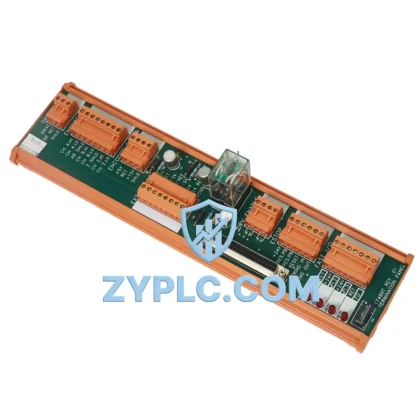
The IS200VTURH1B Turbine I/O Terminal Board provides the field wiring termination point for proximity probe cables routed from bearing housings. This terminal board distributes the raw sensor signals to all three IS200VVIBH1CAC cards in a TMR configuration, ensuring that each control path receives identical field inputs without signal splitting losses.
The IS200EPSMH1A Power Supply Module provides the regulated DC power rail that feeds the IS200VVIBH1CAC and other I/O modules within the same VME chassis. In redundant power configurations, a second IS200EPSMH1A operates in hot-standby mode, with automatic bumpless transfer ensuring uninterrupted module operation during power supply maintenance or failure events.
The IS420UCSBH3A Communication Interface Board bridges the Mark VI IONet to the plant Ethernet network, enabling vibration data from the IS200VVIBH1CAC to be accessed by GE Historian, third-party SCADA platforms, and remote monitoring centers. This communication path supports OPC-DA and OPC-UA protocols, making the IS200VVIBH1CAC’s data available to modern Industrial IoT and predictive maintenance platforms without additional hardware.
The IS200VSVOH1B Servo Output Module and IS200TREGH1B Voltage Regulator Module operate in parallel within the same Mark VI chassis, managing fuel valve positioning and generator excitation respectively. The tight integration between these modules and the IS200VVIBH1CAC ensures that a vibration trip command from the monitoring card is immediately acted upon by the fuel control and excitation subsystems — achieving turbine protection response times measured in milliseconds.
At the human-machine interface layer, the GE Cimplicity HMI or third-party SCADA displays vibration trend data, alarm histories, and orbit plots derived from IS200VVIBH1CAC measurements. Operators can monitor bearing vibration levels in real time, acknowledge alarms, and review historical trends — all from a unified operator workstation that also displays combustion dynamics, exhaust temperatures, and load management data from the same Mark VI controller.
Application in Layered Automation Systems
The IS200VVIBH1CAC finds application across a wide range of industrial sectors where rotating machinery protection is critical to operational continuity and personnel safety.
In power generation — including gas-fired combined-cycle plants, steam turbine generators, and industrial cogeneration facilities — the IS200VVIBH1CAC provides the vibration monitoring backbone required by insurance underwriters, grid operators, and regulatory bodies. Its integration within the Mark VI TMR architecture ensures that machinery protection does not introduce single points of failure into an otherwise redundant control system.
In oil and gas processing facilities, including offshore platforms, LNG liquefaction trains, and pipeline compressor stations, the IS200VVIBH1CAC monitors gas compressor and expander vibration levels in environments where unplanned shutdowns carry enormous financial and safety consequences. The module’s compatibility with API 670 machinery protection standards makes it the preferred choice for facilities subject to international safety audits.
In petrochemical and refinery applications, the IS200VVIBH1CAC is deployed on critical rotating equipment including charge pumps, reactor feed compressors, and steam turbine-driven process pumps. Its ability to operate within the Mark VI’s unified control and protection architecture eliminates the need for separate, standalone vibration monitoring panels — simplifying control room layouts and reducing the number of engineering interfaces that maintenance teams must manage.
In mining and minerals processing operations, where large grinding mills, conveyor drives, and slurry pumps operate continuously under high mechanical loads, the IS200VVIBH1CAC provides early warning of bearing deterioration and rotor imbalance — enabling condition-based maintenance strategies that extend equipment life and reduce unplanned downtime.
In water and wastewater treatment infrastructure, the IS200VVIBH1CAC monitors high-capacity pumping stations and blower systems, where vibration-induced failures can disrupt municipal water supply or environmental compliance obligations. Its long-term reliability and 12-Month Warranty make it a trusted component for utility operators managing aging infrastructure with constrained maintenance budgets.
Architecture Engineering FAQ
Q1: Is the IS200VVIBH1CAC compatible with both TMR and Simplex Mark VI configurations?
Yes. The IS200VVIBH1CAC is designed for deployment in both TMR (Triple Modular Redundancy) and Simplex Mark VI architectures. In TMR systems, three cards are installed — one per control path — and the Mark VI voter logic manages 2-out-of-3 decision making for trip and alarm outputs. In Simplex configurations, a single IS200VVIBH1CAC provides vibration monitoring without redundancy. The module’s configuration is managed entirely through ToolboxST, and the same hardware part number is used in both architectures, simplifying spare parts inventory management.
Q2: Can the IS200VVIBH1CAC be replaced without shutting down the turbine control system?
In TMR configurations, the IS200VVIBH1CAC supports online replacement on a per-path basis. With two of the three control paths (R, S, T) remaining active, the failed card on the third path can be extracted and replaced while the turbine continues to operate under 2-out-of-3 protection. The replacement card automatically receives its configuration download from the Mark VI controller upon insertion. In Simplex configurations, replacement requires a planned outage window. ZYPLC recommends maintaining at least one IS200VVIBH1CAC as a certified spare to minimize mean time to repair. All units supplied by ZYPLC carry a 12-Month Warranty covering manufacturing defects and functional failures.
Q3: What long-term support and supply chain considerations apply to the IS200VVIBH1CAC?
As GE’s Mark VI platform transitions toward the Mark VIe architecture, the IS200VVIBH1CAC remains in active use across thousands of installed turbine units worldwide, and aftermarket supply of tested, certified replacement cards is essential for operators who are not yet ready to undertake a full control system upgrade. ZYPLC maintains stock of IS200VVIBH1CAC modules that have been functionally tested and verified for Contextual Integration within the Mark VI architecture. Each unit is supplied with a 12-Month Warranty and full traceability documentation, supporting the procurement and quality assurance requirements of power generation, oil and gas, and process industry customers globally. For pricing, availability, and technical consultation, contact ZYPLC at +86 19859288691 or [email protected].
© 2026 ZYPLC. All rights reserved.
Original Source: https://zyplc.com
Contact: +86 19859288691 | [email protected]