GE UR-RHH Universal Relay Output Module: Industrial Data Link for Smart Substation & Factory Connectivity
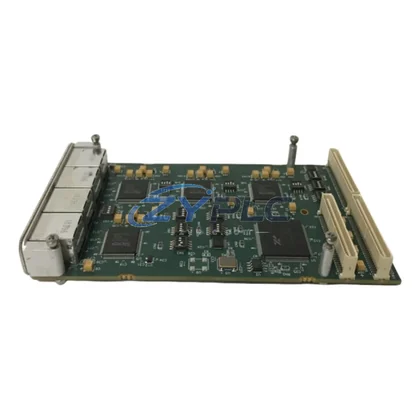
The GE UR-RHH is a high-density relay output module engineered for the GE UR Series Universal Relay platform — one of the most widely deployed protection and control architectures in power utilities, industrial substations, and smart factory environments worldwide. Designed to extend the output capability of UR Series relay chassis, the UR-RHH delivers reliable hardwired trip and control signals across critical automation networks, bridging the gap between digital protection logic and physical field devices.
In modern industrial sites, the integrity of the data link between protection relays, SCADA systems, RTUs, and field switchgear is non-negotiable. The UR-RHH module slots directly into the UR Series modular chassis — alongside communication modules such as the GE UR-7SH (IEC 61850 GOOSE/MMS Ethernet module) and the GE UR-7SS (dual-port fiber Ethernet module) — enabling a fully integrated protection, control, and communication architecture. This modular design allows engineers to configure relay output density precisely to match the I/O demands of each bay, feeder, or motor control application without over-engineering the panel.
Compatibility & Integration Notes
| Attribute |
Specification |
| Supported Protocols |
IEC 61850 (GOOSE / MMS), DNP3 (Serial & TCP/IP), Modbus RTU / Modbus TCP, IEC 60870-5-103, IEC 60870-5-104 |
| Interface Type |
Relay Output (Form-A / Form-C contacts), hardwired I/O integration |
| Transmission Capability |
High-speed trip signal output; compatible with direct intertripping and GOOSE-based fast protection schemes |
| Network Compatibility |
Integrates with IEC 61850 station bus and process bus architectures; compatible with IEC 61968/61970 enterprise data models |
| System Applications |
Power substation protection, motor feeder control, industrial switchgear automation, smart factory MCC integration, SCADA/EMS/DMS connectivity |
| Platform |
GE UR Series Universal Relay Chassis (T35, T60, L90, D60, C60, F60, G60, M60, B30, B90) |
| Warranty |
warranty terms confirmed during quotation — all units ship after full functional and communication testing |
Connected Automation Data Flow
The UR-RHH sits at the intersection of digital protection logic and physical field actuation — a critical node in the industrial automation data chain. In a typical smart substation or industrial power distribution application, the data flow begins at the primary equipment level: current transformers (CTs) and voltage transformers (VTs) feed analog signals into the UR Series relay chassis, where the main CPU module processes protection algorithms in real time. When a fault condition is detected, the relay’s output logic drives the UR-RHH module to assert its relay contacts, issuing a hardwired trip command to the circuit breaker or contactor within milliseconds.
Simultaneously, the relay communicates upstream via the GE UR-7SH IEC 61850 Ethernet module, publishing GOOSE messages across the station LAN to peer relays — such as the GE T60 Transformer Protection Relay or the GE L90 Line Differential Relay — enabling high-speed busbar protection and inter-relay coordination without additional hardwiring. The IEC 61850 MMS protocol carries event records, disturbance data, and setting changes to the substation HMI and SCADA gateway, where operators using platforms such as GE GridIQ Insight or third-party SCADA systems (including Wonderware, Ignition SCADA, or ABB Ability Symphony) can monitor real-time status, acknowledge alarms, and initiate remote control operations.
For legacy integration, the UR Series supports DNP3 over serial RS-485 and Modbus TCP over Ethernet, allowing the UR-RHH-equipped relay to communicate with older RTUs, DCS controllers, and energy management systems without protocol conversion hardware. In industrial motor control applications, the relay chassis — fitted with the UR-RHH output module — interfaces directly with GE PowerFlex-compatible motor control centers, variable frequency drives (VFDs), and soft starters, providing both protection trip outputs and status feedback to the plant DCS or PLC layer. Remote I/O modules and edge gateways can further aggregate relay status data for transmission to cloud-based asset management platforms, completing the data chain from field device to enterprise dashboard.
Solving Data Isolation in Industrial Sites
One of the most persistent challenges in industrial power and automation environments is protocol fragmentation: legacy Modbus RTU devices on the plant floor cannot natively communicate with modern IEC 61850 station bus architectures, and proprietary relay communication formats create data silos that prevent unified SCADA visibility. The GE UR-RHH, as part of the UR Series modular platform, directly addresses this by supporting multiple communication protocols within a single relay chassis. Engineers can configure the relay to simultaneously publish IEC 61850 GOOSE messages for fast protection, report DNP3 data objects to the SCADA master, and respond to Modbus TCP polling from the plant historian — all without external protocol converters or additional network hardware.
Remote monitoring and diagnostics are equally critical in large industrial sites where physical access to switchgear rooms is restricted or hazardous. The UR Series relay, equipped with the UR-RHH output module and a fiber Ethernet communication module, enables full remote access to relay settings, event logs, oscillography records, and self-test diagnostics via IEC 61850 MMS or DNP3. Maintenance teams can retrieve fault records, verify relay output contact status, and perform remote setting changes from the control room or from off-site engineering workstations — dramatically reducing mean time to repair (MTTR) and eliminating unnecessary field visits.
Production line transparency is achieved by integrating relay output status data into the plant SCADA or MES layer. Each operation of the UR-RHH relay contacts — whether a protective trip, a manual control command, or a supervisory interlock — is time-stamped and logged with millisecond resolution, providing a complete audit trail for post-fault analysis, regulatory compliance, and predictive maintenance programs. As industrial sites expand, the modular UR Series chassis architecture allows additional output modules, input modules, and communication modules to be added without replacing the existing relay platform, protecting the capital investment and simplifying system-wide upgrades.
Industrial Connectivity FAQ
Q1: What communication protocols does the GE UR-RHH support, and is it compatible with existing SCADA systems?
The UR-RHH is a relay output module that operates within the GE UR Series chassis. The chassis supports IEC 61850 (GOOSE and MMS), DNP3 (serial and TCP/IP), Modbus RTU, Modbus TCP, IEC 60870-5-103, and IEC 60870-5-104 — making it compatible with virtually all major SCADA, EMS, DMS, and DCS platforms used in power utilities and industrial facilities. Protocol selection is configured via the relay’s EnerVista UR Setup software.
Q2: How does the UR-RHH ensure network stability and minimize communication latency in protection applications?
The UR Series platform is designed for deterministic, low-latency communication. IEC 61850 GOOSE messaging — used for inter-relay tripping and interlocking — achieves typical end-to-end latency of less than 4 ms over a properly configured station LAN, well within the requirements of Class P2/P3 protection applications. The relay’s dual-port Ethernet option supports ring topology (HSR/PRP) for network redundancy, ensuring communication continuity even in the event of a single network link failure.
Q3: Can the GE UR-RHH module be integrated into an existing UR Series chassis without replacing the entire relay?
Yes. The UR-RHH is a hot-swappable modular output module designed for the UR Series universal chassis. It can be installed into available module slots in existing T35, T60, D60, C60, F60, G60, M60, L90, B30, or B90 relay chassis without replacing the main CPU or communication modules. This modular expandability is one of the key advantages of the UR Series platform for system upgrades and capacity expansion.
Q4: What pre-shipment testing is performed, and what does the warranty terms confirmed during quotation cover?
All GE UR-RHH modules supplied by ZYPLC undergo full functional testing prior to shipment, including relay output contact verification, insulation resistance testing, and communication interface checks where applicable. The warranty terms confirmed during quotation covers manufacturing defects and functional failures under normal operating conditions. ZYPLC maintains ready stock of UR Series modules to support export shipping options available, minimizing downtime for urgent replacement and maintenance requirements.