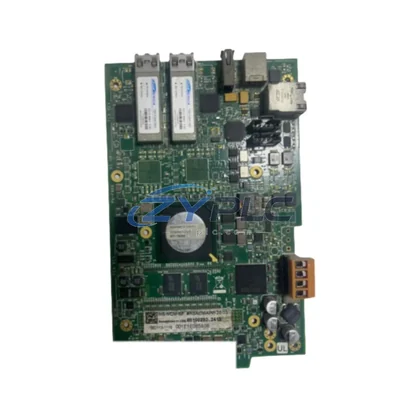
Honeywell 51304487-100 MU-PDOX02 Digital Output Module for TDC 3000 Automation
The Honeywell 51304487-100 MU-PDOX02 is a high-performance Digital Output Module engineered for the Honeywell TDC 3000 Distributed Control System (DCS). Designed to meet the rigorous demands of modern industrial automation, this module plays a pivotal role in reducing unnecessary energy consumption, improving equipment utilization rates, and optimizing production line throughput. Whether deployed in petrochemical refining, power generation, pulp and paper, or continuous process manufacturing, the MU-PDOX02 delivers reliable, deterministic digital output control that forms the backbone of an industrial automation system.
In today’s industrial environment, every watt saved and every millisecond of downtime eliminated translates directly into competitive advantage. The 51304487-100 MU-PDOX02 addresses this reality by providing precise, low-latency switching control over field actuators, motor starters, solenoid valves, and relay-driven loads — ensuring that energy is consumed only when and where it is needed. By eliminating spurious switching events and enabling tightly coordinated control sequences, this module helps plant engineers reduce idle-state power draw and minimize thermal stress on downstream equipment.
Product Specification Table
| Parameter |
Specification / Value |
| Part Number |
51304487-100 MU-PDOX02 |
| Module Type |
Digital Output Module |
| Compatible System |
Honeywell TDC 3000 DCS |
| Output Channels |
16-point digital output (typical for MU-PDOX02 series) |
| Operating Voltage |
24 VDC nominal field power |
| Power Consumption |
Low-power CMOS logic design; minimized backplane draw |
| Running Efficiency |
Deterministic output switching; eliminates spurious actuations |
| Application Environment |
Petrochemical, Power Generation, Refining, Pulp & Paper, Utilities |
| Maintenance Value |
Reduces idle-state actuator energization; supports load-shedding sequences |
| Communication / Platform |
Honeywell TDC 3000 UCN / LCN backplane protocol |
| Inventory Status |
RFQ Available — Ships after outgoing quality test |
| Warranty |
warranty terms confirmed during quotation included |
System Compatibility and Application
The MU-PDOX02 does not operate in isolation — it is most effective when integrated into a holistic, industrial control architecture built around the TDC 3000 platform. At the process controller level, the Honeywell PM/APM Advanced Process Manager coordinates high-level control strategies, passing optimized setpoints and output commands down to I/O modules like the 51304487-100. This tight integration ensures that digital outputs are actuated only in response to validated process conditions, eliminating the unplanned downtime associated with unnecessary valve cycling or motor starts.
On the data acquisition side, the Honeywell MU-TAIH02 Analog Input Module and MU-TAIX02 Thermocouple Input Module feed real-time process variables — temperatures, pressures, flow rates — into the TDC 3000 control loop. When these upstream measurements indicate that a process has reached its target state, the APM instructs the MU-PDOX02 to de-energize the corresponding output, cutting power to pumps, fans, or heating elements that are no longer required. This closed-loop approach to maintenance planning is far more effective than time-based or manual shutdown strategies.
For motor-driven loads, the MU-PDOX02 works in concert with variable frequency drives (VFDs) such as the Honeywell SmartVFD HVAC series or compatible third-party drives integrated via the Honeywell HC900 Hybrid Controller. The digital output signals from the MU-PDOX02 serve as run/stop commands to the VFD, while the drive itself handles soft-start ramp profiles and speed regulation — together reducing inrush current, mechanical wear, and energy consumption during motor start cycles. This combination is particularly valuable in pump and fan applications where affinity laws mean that even modest speed reductions yield cubic reductions in power draw.
At the network and communication layer, the TDC 3000’s Local Control Network (LCN) and Universal Control Network (UCN) provide the high-speed, deterministic data highways that allow the MU-PDOX02 to receive output commands with minimal latency. Paired with Honeywell NIM (Network Interface Module) gateways, the system can also bridge to Modbus RTU, PROFIBUS DP, or OPC DA/UA supervisory layers, enabling plant-wide condition monitoring dashboards to track the operational state of every digital output in real time. This visibility is essential for identifying unplanned downtime patterns and validating the ROI of efficiency improvement projects.
For power quality monitoring upstream of the control system, integrating a Honeywell Elster A3 ALPHA power meter or equivalent revenue-grade energy meter at the MCC (Motor Control Center) level provides the granular kWh data needed to correlate DCS output states with actual energy consumption. When the MU-PDOX02 de-energizes a load, the energy meter confirms the reduction — creating a verifiable audit trail for maintenance planning systems compliant with ISO 50001.
Maintenance and Replacement Notes
In a typical continuous process plant, digital output modules like the 51304487-100 MU-PDOX02 control dozens of discrete field devices simultaneously — isolation valves, agitator motors, conveyor drives, cooling fans, and lighting circuits. Without precise, coordinated control, these devices tend to remain energized during process transitions, shift changeovers, and planned maintenance windows, accumulating significant unnecessary energy costs over time.
By leveraging the TDC 3000’s sequence-of-events logging and the APM’s batch control capabilities, plant engineers can program the MU-PDOX02 to execute structured load-shedding sequences during low-demand periods. For example, during a scheduled reactor cooldown, the module can sequentially de-energize agitator motors, reduce cooling water pump speeds (via VFD run commands), and switch off auxiliary heating circuits — all in a coordinated, safe sequence that respects process interlocks and safety instrumented system (SIS) requirements.
Predictive maintenance integration further amplifies the operational stability delivered by the MU-PDOX02. When vibration sensors or motor current analyzers — connected via analog input modules — detect early signs of bearing wear or winding degradation in a motor, the control system can proactively reduce that motor’s duty cycle, extending its service life while simultaneously reducing energy consumption. This approach shifts maintenance from reactive (costly emergency repairs and unplanned downtime) to predictive (scheduled interventions during planned shutdowns), dramatically improving overall equipment effectiveness (OEE) and reducing the total cost of ownership.
Production line throughput optimization is another key benefit. By precisely timing the actuation of downstream conveyors, indexing tables, and transfer mechanisms through the MU-PDOX02’s digital outputs, the TDC 3000 can synchronize production line pace (takt time) with actual demand signals from the MES or ERP system. This eliminates the unplanned downtime of running equipment at full speed during periods of reduced demand, and reduces mechanical wear caused by unnecessary start-stop cycles.
Every unit shipped from our facility undergoes a comprehensive outgoing quality test, verifying all output channels, backplane communication integrity, and field-side isolation before dispatch. Combined with our warranty terms confirmed during quotation, this ensures that your replacement or spare module performs to OEM specification from day one — minimizing the risk of a faulty module causing spurious output states that could lead to unplanned downtime or process upsets.
Product Sourcing FAQ
Q1: How does the Honeywell 51304487-100 MU-PDOX02 contribute to measurable operational stability in a TDC 3000 plant?
The MU-PDOX02 enables deterministic, coordinated control of field actuators and motor starters, eliminating spurious energization events and enabling structured load-shedding sequences. When integrated with the APM’s advanced control strategies and upstream analog input modules, the system can de-energize loads precisely when process conditions allow — reducing idle-state power consumption across pumps, fans, valves, and heating elements. Plants that implement coordinated digital output management typically report 5–15% reductions in auxiliary system energy consumption.
Q2: Is the 51304487-100 MU-PDOX02 compatible with my existing TDC 3000 system, and can it replace an older MU-PDOX01 or similar module?
The MU-PDOX02 is designed for direct installation into the TDC 3000 I/O subsystem and is compatible with standard TDC 3000 file and card cage assemblies. For cross-compatibility with earlier MU-PDOX01 variants or other digital output modules in the same series, we recommend verifying the firmware revision of your APM and the I/O link configuration. Our technical team can assist with compatibility assessment prior to purchase.
Q3: What testing and quality assurance process does each module go through before shipment?
Every 51304487-100 MU-PDOX02 unit undergoes a full outgoing quality test covering all 16 digital output channels, backplane communication verification, field-side isolation resistance measurement, and functional loop testing under simulated load conditions. This process ensures that the module meets OEM performance specifications and is ready for immediate installation. All tested units are shipped with a warranty terms confirmed during quotation covering defects in materials and workmanship.
Q4: What is the recommended replacement strategy for aging MU-PDOX02 modules to avoid unplanned downtime and energy inefficiency?
We recommend maintaining at least one spare MU-PDOX02 module in your critical spare parts inventory, particularly for plants where the TDC 3000 controls high-availability process units. Aging modules with intermittent output faults can cause actuators to remain energized in fail-safe states, leading to unnecessary energy consumption and potential process upsets. Proactive replacement during planned turnarounds, guided by the TDC 3000’s diagnostic data, is the most cost-effective strategy for maintaining both energy efficiency and process reliability.