Honeywell 51304672-150 Analog Output for TDC 3000: Compatibility and Replacement Notes
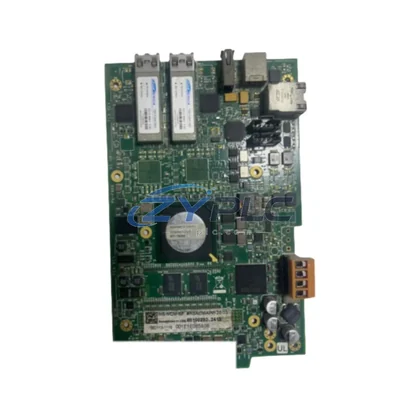
The Honeywell 51304672-150 UCN Analog Output Card is a precision-engineered field output module designed for seamless integration within the Honeywell TDC 3000 Distributed Control System (DCS) architecture. Rather than functioning as a standalone component, this card occupies a critical position in the signal flow hierarchy — translating digital control commands from the process controller into calibrated 4–20 mA analog signals that drive field actuators, control valves, variable frequency drives, and positioners across the plant floor. Its role within the TDC 3000 platform makes it indispensable for maintaining signal integrity, loop stability, and system-wide operational consistency in demanding industrial environments.
In a fully layered TDC 3000 control architecture, the 51304672-150 sits at the I/O layer, receiving setpoint data from the High-Performance Process Manager (HPPM) or the Advanced Process Manager (APM) via the Universal Control Network (UCN). This UCN-based communication backbone ensures deterministic, high-speed data exchange between the controller layer and the I/O subsystem, eliminating the latency and signal degradation risks associated with legacy point-to-point wiring schemes. The card’s native UCN compatibility means it integrates without protocol conversion overhead, preserving the architectural coherence of the TDC 3000 platform.
From a system design perspective, the 51304672-150 is typically installed within a standard TDC 3000 I/O Link chassis or compatible card rack, alongside complementary modules such as the Honeywell 51304672-100 Analog Input Card, the 51304453-150 Digital Output Module, and the 51304453-100 Digital Input Module. This co-location within the same rack minimizes field wiring complexity, simplifies loop commissioning, and supports structured maintenance workflows where technicians can address multiple I/O types within a single cabinet zone. The card’s slot-based installation also supports hot-swap capability in redundant rack configurations, reducing planned maintenance windows and unplanned downtime risk.
Product Specification Table
| Parameter |
Specification |
| Part Number |
51304672-150 |
| Brand |
Honeywell |
| Series / Platform |
TDC 3000 DCS |
| Module Type |
UCN Analog Output Card |
| System Role |
I/O Layer — Field Signal Output |
| Output Signal Type |
4–20 mA Analog Current Loop |
| Communication Interface |
Universal Control Network (UCN) |
| Compatible Controllers |
HPPM, APM, PM (TDC 3000 Series) |
| Installation Method |
Card Rack / I/O Link Chassis (Slot-Based) |
| Operating Temperature |
0°C to 60°C (Standard Industrial Range) |
| Power Supply Compatibility |
TDC 3000 Rack-Integrated DC Bus |
| Redundancy Support |
Compatible with Redundant I/O Configurations |
| system integration |
Full TDC 3000 system integration Support |
| Warranty |
warranty terms confirmed during quotation |
| Condition |
Tested, Inspected, shipment arranged after confirmation |
System Compatibility Notes
The 51304672-150 achieves its highest value when deployed as part of a coordinated TDC 3000 control system rather than as an isolated replacement part. In a typical refinery or petrochemical process unit, the card works in concert with the Honeywell HPPM (High-Performance Process Manager) at the control layer, which executes PID algorithms and generates output setpoints. These setpoints are transmitted over the UCN to the 51304672-150, which converts them into precise analog signals for downstream field devices.
At the power layer, the TDC 3000 system relies on dedicated power supply modules — such as the Honeywell 51190076-100 Power Supply Unit — to deliver stable DC voltage to the card rack. Voltage stability directly affects analog output accuracy; any ripple or transient at the power layer propagates as signal noise at the output terminals. Pairing the 51304672-150 with a properly rated and maintained power supply is therefore a fundamental system design requirement, not an optional consideration.
At the network layer, the UCN Gateway Module (such as the Honeywell 51401642-150 UCN/LCN Gateway) bridges the I/O subsystem with the Local Control Network (LCN), enabling supervisory data flow to the Honeywell GUS (Global User Station) or the Application Module (AM). This multi-tier network architecture ensures that the analog output commands generated at the engineering workstation level are faithfully executed at the field level through the 51304672-150, with full audit trail and alarm management support.
For human-machine interface integration, the TDC 3000 platform connects the 51304672-150’s output loops to operator displays via the GUS or the Universal Station (US), where process engineers can monitor loop performance, adjust setpoints, and acknowledge alarms in real time. This HMI-to-field continuity is a defining characteristic of the TDC 3000 architecture and is fully preserved when the 51304672-150 is correctly installed and configured.
In redundant system designs, the 51304672-150 can be paired with a redundant analog output card in a primary/backup configuration, supported by the TDC 3000 redundancy management firmware. This arrangement ensures that a single card failure does not interrupt process control — the backup card assumes output responsibility within milliseconds, maintaining loop integrity without operator intervention. Complementary modules such as the Honeywell 51304453-150 Digital Output Module and the 51309218-175 Analog Input Card are often deployed in the same redundant rack to provide comprehensive I/O coverage across all signal types.
Industrial Application Notes
The Honeywell 51304672-150 finds application across a broad spectrum of process industries where the TDC 3000 platform has been deployed as the primary control infrastructure. In petroleum refining, the card drives control valves on crude distillation units, fluid catalytic cracking (FCC) units, and hydrocracker reactors, where precise analog output control is essential for maintaining product quality and process safety. The card’s stable 4–20 mA output ensures that valve positioners receive accurate setpoint signals even under high-noise electrical environments typical of refinery control rooms.
In power generation facilities — including coal-fired, gas turbine, and combined-cycle plants — the 51304672-150 is used to control boiler feedwater flow, turbine governor setpoints, and burner management system outputs. The card’s integration with the TDC 3000 UCN ensures that control commands are executed with the determinism required for safe boiler and turbine operation, where response time and signal accuracy are directly linked to plant safety and efficiency.
In chemical and petrochemical plants, the card supports continuous process control for reactor temperature regulation, distillation column reflux ratio control, and compressor anti-surge systems. Its compatibility with the TDC 3000 Advanced Process Manager (APM) enables advanced control strategies such as model predictive control (MPC) and cascade control loops, where the analog output card serves as the final execution element in a multi-layer control hierarchy.
Water and wastewater treatment facilities operating TDC 3000 systems use the 51304672-150 to control chemical dosing pumps, aeration blowers, and filtration system actuators. The card’s long-term reliability and availability of replacement stock make it a preferred choice for utilities that require extended system lifecycles without platform migration. Mining and metallurgical operations similarly rely on the card for conveyor speed control, flotation cell level regulation, and smelter process management, where the TDC 3000 platform’s proven stability justifies continued investment in compatible I/O modules.
Product Compatibility FAQ
Q1: Is the Honeywell 51304672-150 compatible with both HPPM and APM controllers in the TDC 3000 architecture?
Yes. The 51304672-150 communicates via the Universal Control Network (UCN), which is the standard I/O communication protocol for both the High-Performance Process Manager (HPPM) and the Advanced Process Manager (APM) within the TDC 3000 platform. No protocol adapters or gateway modules are required for integration with either controller type. The card is recognized natively by the TDC 3000 system configuration software, and its I/O points can be assigned to control loops managed by either controller variant. This cross-compatibility simplifies spare parts management and supports mixed-controller architectures common in large-scale process plants.
Q2: Can the 51304672-150 be installed in a redundant I/O configuration, and what is required for redundancy switchover?
The 51304672-150 supports redundant analog output configurations when paired with a matching redundant card in a dual-slot rack arrangement supported by the TDC 3000 redundancy management subsystem. Redundancy switchover is managed automatically by the TDC 3000 firmware, with switchover times typically under 100 milliseconds — fast enough to prevent process upsets in most control loop applications. To implement redundancy, both the primary and backup cards must be of the same part number and firmware revision, and the rack must be configured for redundant I/O operation in the system database. No additional hardware gateways are required; the UCN handles redundancy arbitration natively.
Q3: What does the warranty terms confirmed during quotation cover, and how does it support long-term maintenance planning for TDC 3000 systems?
The warranty terms confirmed during quotation covers manufacturing defects, functional failures under normal operating conditions, and verified compatibility issues identified during installation and commissioning. For TDC 3000 systems operating in extended lifecycle environments — where original Honeywell factory support may be limited — this warranty provides a critical assurance layer for maintenance engineers and procurement teams. It enables facilities to plan spare parts budgets with confidence, knowing that replacement modules are backed by a defined support commitment. The warranty also supports IEC 61511 functional safety lifecycle documentation requirements, where traceability of replacement components and their support status is a compliance consideration.