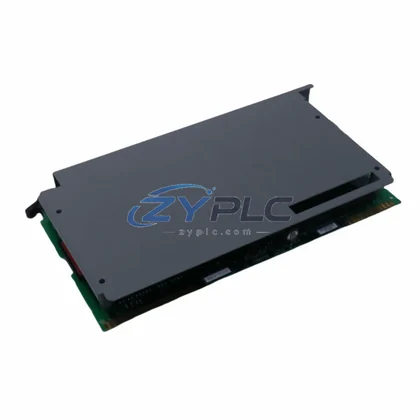
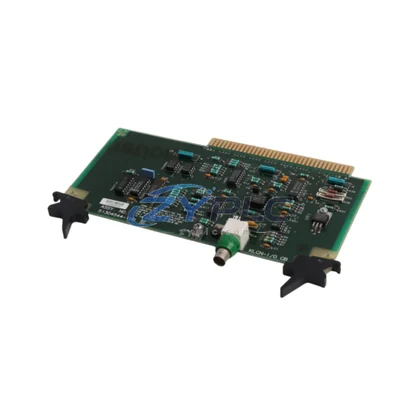
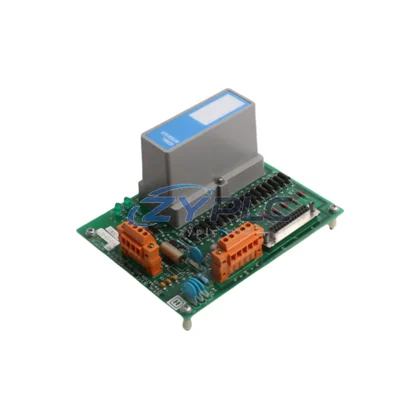
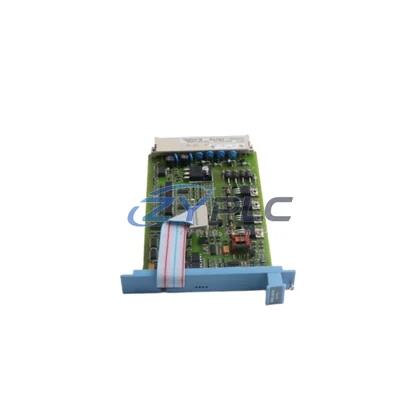
Honeywell 621-1100RC Industrial Network Interface for Series 620 Systems
The Honeywell 621-1100RC is a high-performance Discrete Input Module engineered for the Series 620 programmable controller platform. Designed to serve as a critical data acquisition node in industrial automation architectures, the 621-1100RC captures digital field signals from sensors, limit switches, push-button stations, and proximity detectors, converting them into structured data streams that feed directly into the Series 620 CPU for real-time decision-making. In smart factory environments where data latency and signal integrity are non-negotiable, this module delivers the reliable discrete input handling that keeps production lines transparent, responsive, and continuously optimized.
At ZYPLC, every 621-1100RC unit is sourced from verified supply channels, subjected to pre-shipment functional testing, and backed by a warranty terms confirmed during quotation — ensuring that your automation infrastructure receives a component ready for immediate deployment without compromise.
Compatibility & Integration Notes
| Parameter |
Specification |
| Module Type |
Discrete Input Module |
| Platform / Series |
Honeywell Series 620 |
| Input Channels |
16-point discrete digital input (24 VDC / 120 VAC compatible) |
| Protocol Support |
Series 620 backplane bus; compatible with SCADA/DCS via Series 620 CPU gateway |
| Interface Type |
Rack-mount backplane I/O slot interface |
| Network Compatibility |
Integrates with Modbus RTU, RS-232/RS-485 via Series 620 communication modules |
| System Application |
PLC discrete I/O, DCS field input, SCADA signal acquisition, process control |
| Operating Environment |
Industrial: 0–60°C, humidity 5–95% non-condensing |
| Warranty |
warranty terms confirmed during quotation — ZYPLC Certified |
Connected Automation Data Flow
In a fully integrated Series 620 control system, the 621-1100RC sits at the front end of the data acquisition chain. Field-level devices — including inductive proximity sensors, photoelectric detectors, and mechanical limit switches — feed their binary status signals into the module’s 16 discrete input channels. These signals are then passed across the Series 620 backplane to the Honeywell 621-0020 CPU Module, which executes ladder logic and relay-equivalent control programs in real time.
For facilities running multi-rack configurations, the Honeywell 621-6550 Remote I/O Scanner extends the reach of the Series 620 system across production zones, allowing the 621-1100RC to operate as a distributed input node without sacrificing scan cycle performance. Communication between the local rack and remote I/O drops is handled through the Honeywell 621-6940 Communication Module, which supports RS-485 serial links and enables data exchange with upstream SCADA platforms such as Honeywell Experion PKS or third-party systems via Modbus RTU.
At the operator interface layer, the Honeywell HC900 HMI Station or compatible third-party HMI panels receive real-time discrete status data — door open/closed, motor running/stopped, valve actuated/de-actuated — sourced directly from the 621-1100RC’s input registers. This live data populates process mimics, alarm dashboards, and trend historians, giving operators full situational awareness of field device states without manual inspection.
For drive-level integration, the Honeywell SmartVFD HVAC Variable Frequency Drive receives start/stop and speed-reference commands that are conditioned by the discrete input logic processed through the 621-1100RC. When a field sensor signals an abnormal condition — such as a conveyor jam or a safety gate opening — the 621-1100RC captures the input, the CPU executes the interlock logic, and the VFD receives a controlled stop command within one scan cycle, preventing mechanical damage and unplanned downtime.
Power distribution to the Series 620 rack is managed by the Honeywell 621-9937 Power Supply Module, which provides regulated 5 VDC backplane power and 24 VDC field power to support the 621-1100RC’s input circuitry. For installations requiring edge-level data aggregation before forwarding to cloud SCADA or MES platforms, an industrial edge gateway — such as the Advantech ECU-1251 Edge Intelligence Server — can be deployed alongside the Series 620 system to collect Modbus data, apply local analytics, and push structured JSON payloads to enterprise systems over Ethernet.
Discrete output responses triggered by the 621-1100RC’s input data are executed through companion modules such as the Honeywell 621-1160 Discrete Output Module, which drives solenoid valves, motor contactors, and indicator lamps based on the CPU’s control logic. Together, these modules form a tightly coupled I/O subsystem that ensures every field event is captured, processed, and acted upon within deterministic time windows — a fundamental requirement for high-throughput manufacturing and process safety applications.
Solving Data Isolation in Industrial Sites
One of the most persistent challenges in legacy industrial facilities is data isolation — field devices generating signals that never reach the control system in a structured, actionable format. The Honeywell 621-1100RC directly addresses this problem by providing a standardized, rack-integrated discrete input interface that eliminates the need for custom signal conditioning hardware between field devices and the Series 620 CPU.
In plants where multiple control platforms coexist — Series 620 PLCs alongside newer DCS nodes or third-party SCADA gateways — the 621-1100RC’s compatibility with the Series 620 communication infrastructure allows its input data to be bridged across protocol boundaries. Through the Series 620 CPU’s Modbus RTU port, discrete input states captured by the 621-1100RC can be polled by SCADA servers, historian databases, and MES platforms, breaking down the data silos that typically fragment production visibility across departments.
Remote monitoring is another area where the 621-1100RC delivers measurable value. In geographically distributed facilities — such as water treatment plants, oil and gas substations, or multi-building manufacturing campuses — the module’s data can be forwarded via the Series 620 remote I/O architecture to a central control room, enabling operators to monitor field device states across all production zones from a single SCADA workstation. This eliminates the need for on-site inspection rounds for routine status checks, reducing labor costs and improving response times to abnormal conditions.
For production line transparency, the 621-1100RC enables cycle-accurate event logging. Every discrete input transition — a part arriving at a station, a safety door opening, a conveyor reaching end-of-travel — is timestamped at the CPU scan level and can be logged to a historian for OEE analysis, downtime root-cause investigation, and predictive maintenance modeling. This granular event data transforms the 621-1100RC from a simple I/O module into a foundational element of a data-driven manufacturing strategy.
System expansion is straightforward within the Series 620 architecture. Additional 621-1100RC modules can be added to existing racks or new remote I/O drops without reprogramming the CPU’s core logic, allowing facilities to scale their discrete input capacity as production lines grow or new equipment is commissioned. This modularity protects the initial automation investment while accommodating future operational requirements.
Industrial Connectivity FAQ
Q1: Does the Honeywell 621-1100RC support real-time data transmission to SCADA systems?
Yes. The 621-1100RC feeds discrete input data to the Series 620 CPU, which can communicate with SCADA platforms via Modbus RTU through the Series 620 communication modules. Scan cycle times are deterministic, ensuring that field events are reflected in the SCADA historian with minimal latency — typically within one to two CPU scan cycles.
Q2: Is the 621-1100RC compatible with both 24 VDC and 120 VAC field devices?
The 621-1100RC is designed for the Series 620 discrete input architecture and supports standard industrial DC and AC input voltage ranges as specified in the Honeywell Series 620 hardware documentation. For mixed-voltage field installations, verify the specific input voltage rating of your 621-1100RC variant against your field device specifications before wiring.
Q3: Can the 621-1100RC be integrated into a system alongside newer Honeywell DCS or third-party PLC platforms?
Yes, through protocol bridging. The Series 620 CPU’s Modbus RTU communication capability allows the 621-1100RC’s input data to be accessed by third-party SCADA, DCS, or MES platforms that support Modbus polling. For deeper integration with modern Honeywell Experion PKS or ControlEdge systems, a protocol gateway may be required to translate Series 620 data formats.
Q4: What warranty and testing does ZYPLC provide for the 621-1100RC?
Every Honeywell 621-1100RC supplied by ZYPLC undergoes pre-shipment functional verification testing to confirm discrete input channel integrity, backplane communication, and power consumption within specification. All units are covered by a warranty terms confirmed during quotation from the date of shipment. Availability is confirmed via RFQ for shipment arranged after confirmation with global shipping support.