Honeywell DWR06 Industrial Network Interface for DWR Series Systems: Bridging Field Devices to Smart Factory Data Links
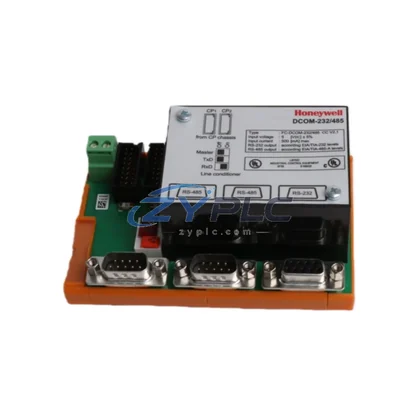
The Honeywell DWR06 is a precision-engineered industrial network interface module designed for seamless integration within the DWR Series ecosystem. Purpose-built for demanding industrial environments, the DWR06 serves as a critical communication bridge between field-level pressure sensing devices and upper-layer control and monitoring systems — including PLCs, SCADA platforms, HMI terminals, and edge computing gateways. In an era where real-time data visibility defines operational efficiency, the DWR06 delivers the connectivity backbone that modern smart factories depend on.
Whether deployed in process automation, discrete manufacturing, energy management, or building automation, the Honeywell DWR06 enables reliable signal acquisition, protocol conversion, and network-level data transmission across multi-vendor industrial architectures. Its compatibility with widely adopted industrial communication standards makes it an indispensable component for engineers seeking to eliminate data silos and achieve full-chain transparency from sensor to cloud.
Compatibility & Integration Notes
| Parameter |
Specification |
| SKU |
DWR06 |
| Brand |
Honeywell |
| Series |
DWR Series |
| Product Type |
Industrial Network Interface / Pressure Monitor Gateway |
| Communication Protocol |
Modbus RTU, Modbus TCP/IP, BACnet MS/TP, BACnet/IP |
| Interface Type |
RS-485, Ethernet RJ45, Digital I/O |
| Transmission Capability |
Real-time data polling, cyclic reporting, event-triggered alarms |
| Network Compatibility |
Industrial Ethernet, SCADA networks, BMS networks, PLC backplane bus |
| System Application |
SCADA, DCS, HMI, BMS, Edge Gateway, Remote I/O, Smart Factory MES |
| Origin |
United States |
| Warranty |
warranty terms confirmed during quotation |
| Stock Status |
RFQ Available — shipment arranged after confirmation |
| Shipping |
Global DHL / FedEx Express |
Connected Automation Data Flow
In a typical smart factory deployment, the Honeywell DWR06 sits at the intersection of physical measurement and digital intelligence. At the field level, pressure transmitters and differential pressure sensors — such as those from Honeywell’s own C7772A duct pressure sensor or the P7810C differential pressure controller — feed raw analog signals into the DWR06’s input channels. The DWR06 digitizes and encapsulates this data into structured Modbus RTU frames, which are then transmitted over RS-485 wiring to a Honeywell PLC or a third-party controller such as a Siemens S7-1200 or Allen-Bradley MicroLogix 1100.
From the controller layer, the data path extends upward through an industrial Ethernet switch — for example, a managed switch supporting IEEE 802.3 with VLAN segmentation — to the SCADA server running Honeywell’s Experion PKS or a compatible platform such as Wonderware InTouch or Ignition by Inductive Automation. At this layer, the DWR06’s Modbus TCP/IP capability allows direct polling by the SCADA historian, enabling real-time pressure trend logging, threshold-based alarm generation, and automated control loop feedback.
For facilities leveraging BACnet-based Building Management Systems (BMS), the DWR06’s BACnet MS/TP and BACnet/IP support allows it to communicate natively with BMS controllers such as the Honeywell WEBs-AX or Tridium Niagara N4 framework, eliminating the need for additional protocol gateways. This dual-protocol flexibility — Modbus and BACnet — makes the DWR06 uniquely suited for hybrid environments where HVAC control, process automation, and energy monitoring coexist on the same network infrastructure.
At the edge layer, the DWR06 can interface with industrial edge gateways — such as the Advantech WISE-5000 series or Moxa MGate protocol converters — to push aggregated pressure data to cloud-based IoT platforms or MES systems. Remote I/O modules, such as Honeywell’s own distributed I/O nodes, can be daisy-chained on the RS-485 bus alongside the DWR06, extending the network reach across large plant floors without additional cabling infrastructure. Variable frequency drives (VFDs) monitoring motor load in pump or fan systems can also be integrated into the same Modbus network segment, providing a unified view of both pressure and mechanical performance data within a single SCADA dashboard.
Solving Data Isolation in Industrial Sites
One of the most persistent challenges in industrial automation is the fragmentation of data across incompatible protocols and isolated subsystems. Legacy pressure monitoring equipment often communicates over proprietary or single-protocol interfaces, making it impossible to aggregate data with modern PLC controllers, HMI panels, or cloud-connected SCADA systems without costly custom integration work.
The Honeywell DWR06 directly addresses this challenge through its multi-protocol communication architecture. By supporting both Modbus (the de facto standard in process automation) and BACnet (the dominant protocol in building automation), the DWR06 acts as a universal translator — enabling pressure data to flow freely between previously isolated systems. A pressure reading from a field sensor can now appear simultaneously on an HMI touchscreen on the plant floor, in a SCADA historian database, and in a cloud-based analytics dashboard, all without manual data entry or custom middleware development.
For remote monitoring applications — particularly in unmanned substations, remote pump stations, or geographically distributed facilities — the DWR06’s Ethernet connectivity enables secure remote diagnostics over standard TCP/IP networks. Maintenance engineers can monitor pressure trends, acknowledge alarms, and diagnose communication faults from a central control room or even from a mobile device, dramatically reducing the need for on-site inspection visits and accelerating mean time to repair (MTTR).
Production line transparency is further enhanced by the DWR06’s event-triggered alarm reporting capability. When pressure values exceed configured thresholds, the module immediately generates alarm notifications that propagate through the network to the SCADA alarm management system, enabling operators to respond before process deviations escalate into equipment damage or production downtime. This closed-loop feedback mechanism is fundamental to achieving the real-time responsiveness that Industry 4.0 smart factory standards demand.
System scalability is another key advantage. The DWR06’s RS-485 bus supports multi-drop topologies, allowing multiple DWR Series modules to share a single communication cable run. As production capacity expands, additional monitoring points can be added to the network without redesigning the communication infrastructure — a critical consideration for facilities planning phased automation upgrades.
Every Honeywell DWR06 unit supplied by ZYPLC undergoes pre-shipment functional testing, verifying communication integrity, protocol response, and signal accuracy before dispatch. All units are covered by a warranty terms confirmed during quotation, with availability confirmed by RFQ availability ensuring rapid fulfillment for urgent project timelines.
Industrial Connectivity FAQ
Q1: What communication protocols does the Honeywell DWR06 support, and is it compatible with my existing SCADA system?
The DWR06 supports Modbus RTU (RS-485), Modbus TCP/IP (Ethernet), BACnet MS/TP, and BACnet/IP. These protocols are natively supported by the vast majority of industrial SCADA platforms — including Honeywell Experion PKS, Wonderware, Ignition, and Tridium Niagara — as well as leading PLC brands such as Siemens, Allen-Bradley, and Mitsubishi. In most cases, no additional protocol converter is required.
Q2: What is the typical communication latency of the DWR06 in a Modbus TCP/IP network?
Under standard industrial Ethernet conditions (100 Mbps, managed switch with QoS enabled), the DWR06 achieves Modbus TCP/IP response times of under 10 milliseconds per polling cycle. For RS-485 Modbus RTU at 9600 baud with a 10-device bus, typical cycle times are 50–200 milliseconds depending on register count and bus loading — well within the requirements of most pressure monitoring and HVAC control applications.
Q3: Can the DWR06 be integrated into an existing BACnet Building Management System without replacing the BMS controller?
Yes. The DWR06’s native BACnet MS/TP and BACnet/IP support allows it to present pressure data as standard BACnet objects (Analog Input, Binary Value, etc.) directly to any BACnet-compliant BMS controller. No gateway or middleware is required. The DWR06 can be added to an existing BACnet network segment as a new device node, with full object discovery supported by standard BMS commissioning tools.
Q4: What does the warranty terms confirmed during quotation cover, and what is the pre-shipment testing process?
Every Honeywell DWR06 unit supplied by ZYPLC is covered by a warranty terms confirmed during quotation against manufacturing defects and communication failures under normal operating conditions. Prior to shipment, each unit undergoes functional verification including protocol communication testing (Modbus and BACnet), signal input/output calibration check, and network interface validation. Units that do not pass testing are quarantined and not dispatched. Warranty claims are processed directly through ZYPLC with replacement or repair turnaround within agreed SLA timelines.