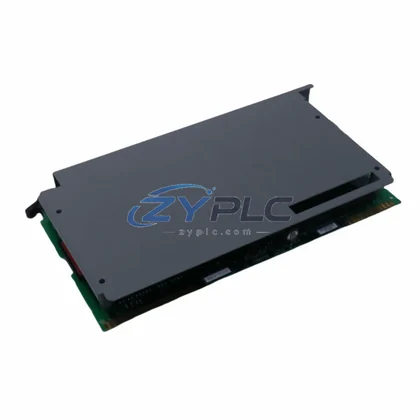
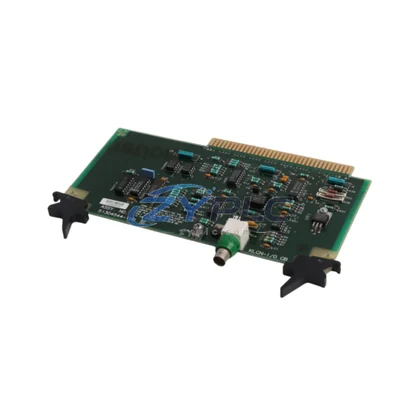
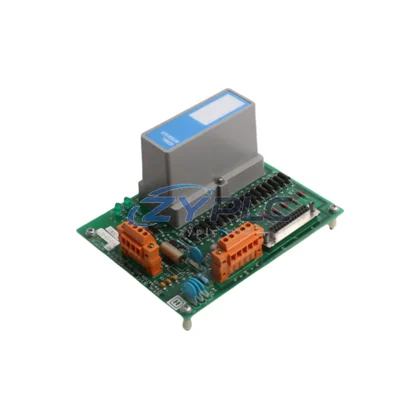
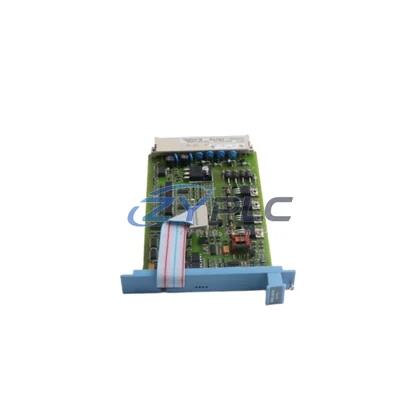
Honeywell MLI-DR64H/D1 Relay Output for MLI Series
The Honeywell MLI-DR64H/D1 is a 64-channel digital relay output module engineered for seamless integration within the Honeywell MLI Series Distributed Control System (DCS) architecture. Designed to operate as a critical node in the output layer of layered automation systems, this module bridges the control logic executed by the MLI Series CPU with field-level actuators, contactors, solenoid valves, and motor starters across demanding industrial environments. Its role within the system is not merely functional — it is architectural. The MLI-DR64H/D1 ensures that command signals generated at the controller level are faithfully translated into reliable, electrically isolated relay switching actions at the field device layer, maintaining system integrity across the full signal chain.
In a complete MLI Series control architecture, the MLI-DR64H/D1 occupies the output tier of the I/O subsystem. It interfaces directly with the MLI Series backplane, receiving digital command data from the system controller via the internal I/O bus. This tight integration with the MLI backplane infrastructure means that the module benefits from the same deterministic scan cycle, fault detection, and hot-swap capability that characterizes the broader MLI platform. Engineers deploying this module can expect consistent relay switching performance, predictable latency, and full compatibility with the MLI Series configuration and diagnostic toolset.
System architects working with the MLI Series will recognize that the MLI-DR64H/D1 is most effective when deployed alongside complementary modules that complete the control loop. The MLI Series CPU module — such as the MLI-CPU or equivalent controller card — provides the processing backbone, while analog input modules like the MLI-AI16H handle process variable acquisition from field transmitters. Digital input modules such as the MLI-DI32H/D1 complement the MLI-DR64H/D1 by capturing discrete field status signals, enabling closed-loop control sequences that depend on both input confirmation and output actuation. Power supply modules within the MLI Series chassis, including redundant PSU configurations, ensure that the relay output module receives stable, conditioned DC power even during grid disturbances or maintenance switching events.
Communication continuity is equally important in a well-designed MLI architecture. The MLI Series supports integration with Honeywell’s broader plant network via FOUNDATION Fieldbus, PROFIBUS DP, and Modbus RTU communication gateways, allowing the MLI-DR64H/D1’s output status to be monitored and logged at the supervisory level. HMI stations running Honeywell’s operator interface software can display relay output states in real time, enabling operators to verify actuation commands without leaving the control room. This system integration between the relay output layer and the supervisory network is a defining feature of the MLI architecture and a key reason why the MLI-DR64H/D1 is specified in high-availability process control applications.
Redundancy is a core design consideration for any system incorporating the MLI-DR64H/D1. In critical applications — such as emergency shutdown systems, boiler management, or turbine control — the module can be deployed in redundant I/O configurations where a standby output module mirrors the active module’s state and assumes control within milliseconds of a detected fault. This redundancy architecture, supported by the MLI Series chassis and controller, eliminates single points of failure at the output layer and satisfies the requirements of IEC 61511 functional safety standards applicable to SIL-rated control loops. Terminal modules and marshalling panels connected to the MLI-DR64H/D1 via field wiring further simplify maintenance by allowing individual relay channels to be isolated and tested without interrupting adjacent circuits.
From an engineering and commissioning perspective, the MLI-DR64H/D1 reduces project complexity. Its plug-and-play compatibility with the MLI Series backplane eliminates the need for custom wiring adapters or firmware configuration at the module level. Relay output channel assignments are managed through the MLI Series engineering workstation software, where I/O mapping, force commands, and diagnostic masking can be configured and documented. This streamlines FAT (Factory Acceptance Testing) and SAT (Site Acceptance Testing) procedures, reducing commissioning time and minimizing the risk of wiring errors that could compromise system startup.
Long-term maintenance efficiency is another advantage of specifying the MLI-DR64H/D1 within a standardized MLI Series architecture. Because the module shares a common form factor, connector standard, and firmware ecosystem with other MLI Series I/O modules, spare parts management is simplified. A single spare MLI-DR64H/D1 module can replace a failed unit in the field within minutes, without requiring specialized tools or reconfiguration. This interchangeability reduces mean time to repair (MTTR) and supports the lifecycle management strategies of facilities operating on extended maintenance intervals. All units supplied by ZYPLC are covered by a warranty terms confirmed during quotation, ensuring that replacement modules meet original factory specifications and perform reliably from the moment of installation.
Product Specification Table
| Parameter |
Specification |
| Part Number |
MLI-DR64H/D1 |
| Brand |
Honeywell |
| Series |
MLI Series DCS |
| Module Type |
Digital Relay Output Module |
| Output Channels |
64 Relay Output Channels |
| System Role |
Field Actuation Output Layer — MLI Series I/O Subsystem |
| Output Type |
Dry Contact Relay (Form A / SPST) |
| Rated Switching Voltage |
Up to 250V AC / 30V DC |
| Rated Switching Current |
2A per channel (resistive load) |
| Electrical Isolation |
Optocoupler isolation between logic and field circuits |
| Backplane Interface |
MLI Series I/O Bus (direct backplane mount) |
| Communication Compatibility |
FOUNDATION Fieldbus, PROFIBUS DP, Modbus RTU (via gateway) |
| Power Supply |
Supplied via MLI Series backplane (24V DC nominal) |
| Operating Temperature |
0°C to +60°C |
| Relative Humidity |
5% to 95% non-condensing |
| Mounting |
MLI Series chassis backplane slot (DIN rail compatible chassis) |
| Certifications |
CE, UL Listed, IEC 61131-2 compliant |
| Country of Origin |
United States |
| Warranty |
warranty terms confirmed during quotation (ZYPLC) |
System Compatibility Notes
The MLI-DR64H/D1 achieves its full potential when deployed as part of a coordinated MLI Series control system rather than as a standalone component. In a typical process control cabinet, the module occupies one or more slots in the MLI Series I/O chassis, sharing the backplane with the MLI Series CPU controller, redundant power supply modules, and a mix of analog and digital I/O cards. The MLI-AI16H analog input module acquires 4–20mA signals from pressure transmitters, flow meters, and temperature sensors, feeding process data to the CPU for control algorithm execution. The resulting digital command outputs are then dispatched to the MLI-DR64H/D1, which switches the corresponding relay channels to energize or de-energize field devices.
On the input side, the MLI-DI32H/D1 digital input module captures discrete status signals — limit switch positions, valve feedback contacts, motor run confirmations — that the CPU uses to verify that the MLI-DR64H/D1’s relay commands have been successfully executed. This input-output confirmation loop is fundamental to safe and reliable automation. Communication gateways such as the Honeywell MLI Series PROFIBUS DP gateway module extend the system’s reach to variable frequency drives (VFDs), smart motor controllers, and remote I/O panels located outside the main control cabinet, while Modbus RTU links connect to energy meters and third-party instrumentation.
At the human-machine interface layer, Honeywell operator stations running the MLI Series SCADA or DCS operator interface display the real-time status of each relay output channel managed by the MLI-DR64H/D1. Alarm management, output forcing for maintenance purposes, and historical logging of relay switching events are all handled at this layer, providing operators and maintenance engineers with full visibility into the output layer’s behavior. Terminal blocks and marshalling modules mounted adjacent to the MLI chassis provide the physical wiring interface between the MLI-DR64H/D1’s relay contacts and the field cable trays, completing the electrical path from controller to actuator.
Industrial Application Notes
The MLI-DR64H/D1 is specified across a broad range of industrial sectors where reliable digital output control is non-negotiable. In power generation and electrical substation automation, the module drives protection relay coils, circuit breaker trip and close commands, and alarm annunciator panels, where relay contact reliability and electrical isolation are critical to grid safety. In petrochemical and refinery applications, the MLI-DR64H/D1 controls solenoid-operated shutdown valves, pump motor starters, and flare ignition systems as part of emergency shutdown (ESD) and safety instrumented system (SIS) architectures.
Water and wastewater treatment facilities deploy the MLI-DR64H/D1 to manage pump sequencing, chemical dosing valve control, and UV disinfection system switching across distributed pump stations connected via PROFIBUS or Modbus networks. In mining and mineral processing, the module’s robust relay contacts handle the high-inrush switching demands of conveyor belt starters, crusher motor contactors, and ventilation fan controls in environments subject to vibration, dust, and wide temperature variation. Metallurgical and steel plant applications leverage the MLI-DR64H/D1 for furnace burner management, cooling water valve control, and rolling mill auxiliary equipment sequencing, where the module’s 64-channel density reduces cabinet footprint in space-constrained installations.
Packaging and food processing lines benefit from the MLI-DR64H/D1’s fast relay response times and high channel count, enabling precise sequencing of filling stations, labeling machines, conveyor diverters, and rejection gates within a single module. In all these applications, the module’s system integration within the MLI Series architecture — sharing diagnostics, configuration, and network connectivity with the broader control system — reduces engineering effort, simplifies validation documentation, and supports the long-term maintainability that industrial operators demand.
Product Compatibility FAQ
Q1: Is the MLI-DR64H/D1 compatible with all MLI Series chassis and backplane configurations?
The MLI-DR64H/D1 is designed for direct backplane installation in standard MLI Series I/O chassis. It is compatible with both single-controller and redundant-controller MLI architectures. Before installation, verify the chassis slot assignment and I/O bus addressing configuration using the MLI Series engineering workstation software to ensure correct channel mapping and avoid address conflicts with other I/O modules in the same chassis.
Q2: Can the MLI-DR64H/D1 be replaced online without shutting down the control system?
In MLI Series architectures configured for hot-swap I/O, the MLI-DR64H/D1 supports online module replacement provided the system controller has been configured to handle I/O module removal gracefully — typically by holding the last known output state or driving outputs to a safe de-energized state during the swap window. Consult the MLI Series system engineering guide for hot-swap configuration requirements and confirm that the replacement module carries the same firmware revision to avoid compatibility issues. All replacement modules supplied by ZYPLC under the warranty terms confirmed during quotation are tested to factory specifications prior to shipment.
Q3: What is covered under the warranty terms confirmed during quotation, and how does ZYPLC support long-term spare parts availability?
The warranty terms confirmed during quotation provided by ZYPLC covers manufacturing defects, component failures, and performance deviations from the published Honeywell MLI-DR64H/D1 specification under normal operating conditions. Warranty claims are processed via direct contact with the ZYPLC technical team at plc.sales@zyplc.com or +86 19859288691. ZYPLC maintains dedicated inventory of MLI Series modules to support long-term spare parts programs, enabling facilities to secure replacement units for systems that may no longer be in active production by the original manufacturer, thereby extending the operational life of installed MLI Series architectures without requiring costly platform migrations.