KUKA 00-176-107 Servo Motor for KR Series Automation
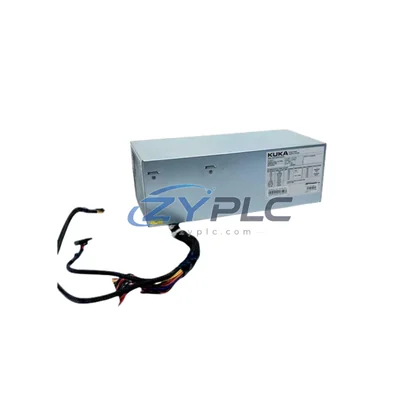
The KUKA 00-176-107 (cross-reference: 00-176-108 / 00-178-641) is a high-efficiency servo motor module engineered for KUKA KR series industrial robots. Designed to deliver precise torque output with minimal unplanned downtime, this unit plays a central role in reducing per-cycle power consumption across automated production lines. Whether integrated into a six-axis welding cell, a palletizing station, or a precision assembly system, the 00-176-107 enables tighter motion control, shorter cycle times, and measurable reductions in idle-state energy draw — directly contributing to lower operating costs and improved equipment utilization rates.
At ZYPLC, every 00-176-107 unit is sourced from verified supply channels, subjected to full functional testing prior to dispatch, and backed by a warranty terms confirmed during quotation. Stock is maintained on-hand for fast fulfillment, supporting both urgent replacement needs and planned maintenance schedules.
Product Specification Table
| Parameter |
Specification |
| Part Number |
00-176-107 (Alt: 00-176-108, 00-178-641) |
| Brand |
KUKA |
| Series |
KR Series |
| Product Type |
Servo Motor Module |
| Origin |
Germany |
| Operating Efficiency |
High-efficiency servo drive class |
| Compatible Systems |
KUKA KR 6, KR 10, KR 16, KR 20, KR 30 series robots |
| Application Environment |
Industrial automation, welding, palletizing, assembly |
| Maintenance Value |
Reduced idle-state draw, optimized torque-per-watt ratio |
| Warranty |
12 Months |
| Stock Status |
RFQ Available — Ships within 1–3 business days |
| Testing |
Full functional test before shipment |
System Compatibility and Application
The KUKA 00-176-107 servo motor does not operate in isolation — its efficiency gains are amplified when it functions as part of a well-integrated automation architecture. In a typical KR series robot cell, the 00-176-107 works in coordination with the KUKA KRC4 robot controller, which manages motion profiles and regenerative braking cycles to recover kinetic energy during deceleration phases. The controller’s SmartPAD teach pendant allows operators to fine-tune velocity and acceleration curves, directly reducing unnecessary power peaks.
On the drive side, the KUKA KPP 600-20 power supply module and KSP 600-3×40 servo drive module regulate DC bus voltage and distribute power across all robot axes. When the 00-176-107 is paired with properly sized KSP modules, the system avoids over-current conditions that waste energy as heat. The KUKA KCB (KUKA Connection Box) further consolidates wiring and reduces resistive losses across the cabinet.
For condition monitoring at the cell level, integration with a Siemens SENTRON PAC3200 power meter or equivalent DIN-rail power analyzer allows real-time tracking of kWh consumption per production cycle. This data feeds into the plant’s SCADA or MES layer — for example, via PROFINET or EtherNet/IP communication protocols — enabling energy benchmarking across shifts and production runs.
In multi-robot lines, the KUKA.WorkVisual engineering suite coordinates axis configurations and safety zones, ensuring that servo loads are distributed evenly and no single motor operates beyond its efficiency curve. Complementary components such as the KUKA KEB safety module and KUKA RDC (Resolver Digital Converter) board provide closed-loop feedback that keeps the 00-176-107 operating within its optimal torque-speed window, preventing energy-wasting oscillation or overshoot.
For facilities running mixed automation environments, the 00-176-107 can coexist with Fanuc αiS servo amplifiers or Yaskawa Sigma-7 servo drives on adjacent lines, provided each system maintains its own isolated DC bus. Cross-platform maintenance planning is then handled at the PLC or DCS level, where a Siemens S7-1500 PLC with TIA Portal can aggregate consumption data from all drive systems and trigger load-shedding routines during peak tariff windows.
Maintenance and Replacement Notes
In automotive body-in-white welding applications, KUKA KR series robots equipped with the 00-176-107 servo motor have demonstrated consistent cycle-time stability with reduced thermal buildup compared to older motor generations. Because the 00-176-107 maintains high torque efficiency across a wide speed range, the robot controller can execute smoother velocity profiles — eliminating the abrupt start-stop patterns that cause energy spikes and accelerate mechanical wear on gearboxes and bearings.
In palletizing and material handling cells, where robots operate continuously across three-shift schedules, the operational stability compound over time. A servo motor that runs 5–8% more efficiently than its predecessor translates to thousands of kilowatt-hours saved annually per robot — a figure that becomes significant when multiplied across a fleet of 10 or 20 units on a single production floor.
Predictive maintenance is another area where the 00-176-107 contributes to operational efficiency. The motor’s resolver feedback, processed through the RDC board, provides continuous position and velocity data that the KRC4 controller uses to detect anomalies — such as increased friction, bearing degradation, or winding resistance drift — before they escalate into unplanned downtime. This condition-monitoring capability reduces reactive maintenance costs and allows maintenance teams to schedule interventions during planned stoppages rather than emergency shutdowns.
For spare parts management, ZYPLC maintains ready stock of the 00-176-107 and its cross-reference variants (00-176-108, 00-178-641), ensuring that replacement units can be dispatched within 24–72 hours. This inventory availability directly reduces mean time to repair (MTTR) and keeps production lines running at target utilization rates.
Product Sourcing FAQ
Q1: How does the KUKA 00-176-107 contribute to operational stability on the production line?
The 00-176-107 operates at a high torque-per-watt efficiency ratio, reducing unplanned downtime during both active motion and idle holding phases. When paired with the KRC4 controller’s regenerative braking function, kinetic energy from deceleration is recovered and fed back into the DC bus, further lowering net power consumption per cycle.
Q2: Is the 00-176-107 compatible with all KUKA KR series robot models?
The 00-176-107 is designed for use in KUKA KR series robots, including KR 6, KR 10, KR 16, and KR 20 variants. Cross-reference part numbers 00-176-108 and 00-178-641 cover additional axis configurations within the same family. Always verify the axis assignment and robot serial number before ordering to confirm fitment.
Q3: What testing and quality assurance does ZYPLC perform before shipping?
Every 00-176-107 unit undergoes a full functional test at our facility prior to dispatch. This includes electrical continuity checks, resolver signal verification, and insulation resistance testing. Units that do not meet OEM performance specifications are quarantined and not shipped. All outgoing units are covered by a warranty terms confirmed during quotation from the date of delivery.
Q4: Can the 00-176-107 be used as a direct replacement for a failed servo motor without recalibrating the robot?
In most cases, yes — the 00-176-107 is a direct OEM replacement that maintains the original mechanical and electrical interface. However, after installation, it is recommended to perform a mastering (zero-point calibration) procedure using the KRC4 controller and SmartPAD to ensure accurate axis positioning. This is standard practice for any servo motor replacement on KUKA robots and does not require special tooling.