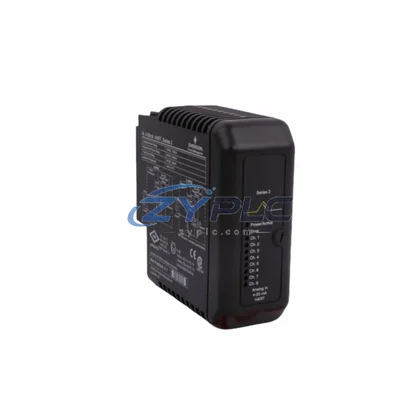
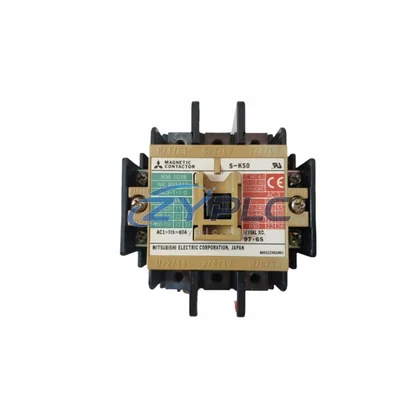
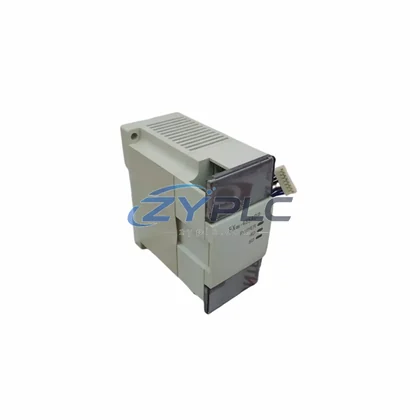
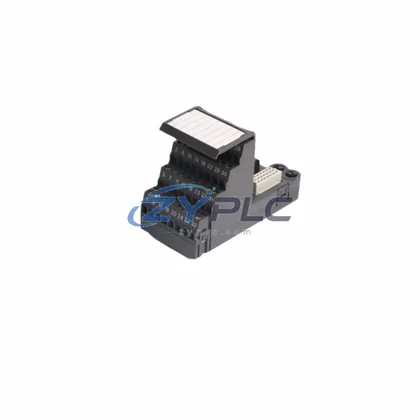
Mitsubishi G64BIF Industrial Network Interface MR-J: Precision Data Links for Smart Factory Automation
The Mitsubishi Electric G64BIF is a high-performance servo drive communication gateway engineered for the MR-J Series servo system ecosystem. Designed to bridge field-level servo drives with upper-level control platforms, the G64BIF enables seamless, high-speed data exchange across the full automation hierarchy — from motion controllers and PLCs to SCADA systems and HMI terminals. In modern industrial environments where production transparency, real-time feedback, and remote diagnostics are no longer optional, the G64BIF delivers the communication backbone that smart factories demand.
At its core, the G64BIF operates on the SSCNET III/H (Servo System Controller Network) optical fiber protocol — Mitsubishi Electric’s proprietary high-speed synchronous network that achieves communication cycle times as low as 0.222 ms. This ultra-low latency is critical in multi-axis servo coordination, where even microsecond-level timing mismatches can cause positional errors, vibration, or production rejects. By integrating the G64BIF into your servo network, you eliminate the electrical noise susceptibility of traditional copper-based communication and gain the full bandwidth of fiber-optic data transmission.
Compatibility & Integration Notes
| Parameter |
Specification |
| Communication Protocol |
SSCNET III/H (Optical Fiber) |
| Interface Type |
Servo Network Gateway / Communication Interface |
| Communication Cycle |
Min. 0.222 ms (high-speed synchronous) |
| Compatible Series |
MR-J4, MR-J3, MR-JE Series Servo Amplifiers |
| Network Compatibility |
MELSEC iQ-R, MELSEC-Q, CC-Link IE Field, SSCNET III/H |
| System Application |
Multi-axis servo control, motion coordination, SCADA integration |
| Origin |
Japan |
| Warranty |
warranty terms confirmed during quotation |
Connected Automation Data Flow
The G64BIF sits at the intersection of motion control and plant-wide data infrastructure. In a typical deployment, a Mitsubishi MELSEC iQ-R Series PLC (such as the R08CPU or R16CPU) acts as the motion controller, issuing position, speed, and torque commands through the SSCNET III/H network. The G64BIF relays these commands in real time to connected MR-J4 servo amplifiers, which in turn drive servo motors with sub-millisecond response. Encoder feedback — position, velocity, and alarm data — travels back through the same fiber link, giving the controller a continuous closed-loop view of every axis.
For plants running CC-Link IE Field Network, the G64BIF enables transparent integration between the servo layer and the broader device network. Remote I/O modules, such as the NZ2GF2B1-16T or compatible CC-Link IE Field remote I/O units, share the same network backbone, allowing the SCADA system to poll both servo status and discrete I/O states in a single scan cycle. This unified data path eliminates the protocol fragmentation that traditionally forces engineers to maintain separate communication stacks for motion and process control.
On the HMI side, a Mitsubishi GOT2000 Series terminal (e.g., GT2710-VTBA) connected via Ethernet to the MELSEC iQ-R controller can display live servo parameters — load ratio, regenerative load, encoder position, and fault codes — without any additional gateway hardware. The G64BIF’s transparent data forwarding means that every servo variable accessible to the motion CPU is equally accessible to the HMI, SCADA historian, and MES layer above it.
For multi-axis applications requiring synchronized motion — such as gantry systems, winding machines, or robotic assembly cells — the G64BIF works in conjunction with the RD77MS Motion Module, which supports up to 32 axes of SSCNET III/H-connected servo amplifiers. The motion module handles interpolation, cam profiles, and electronic gearing, while the G64BIF ensures that the communication link between the motion module and each MR-J4-B servo amplifier remains stable and deterministic even under full-load conditions.
In facilities adopting edge computing architectures, the G64BIF’s data can be aggregated by an industrial edge gateway running Mitsubishi’s MELIPC MI5122-VW or a compatible OPC UA server, translating SSCNET III/H servo data into standard IT protocols for cloud-based analytics platforms. This enables predictive maintenance algorithms to monitor motor current waveforms, detect bearing wear signatures, and schedule maintenance windows before unplanned downtime occurs.
Solving Data Isolation in Industrial Sites
One of the most persistent challenges in industrial automation is the coexistence of legacy equipment running proprietary protocols alongside modern networked devices. The G64BIF directly addresses this by providing a standardized SSCNET III/H interface that abstracts the complexity of individual servo amplifier communication. Engineers no longer need to configure point-to-point RS-422 or analog reference wiring for each axis — the fiber network carries all command and feedback data on a single cable run, dramatically reducing panel wiring density and the associated risk of wiring errors.
Data isolation — where servo drive status is visible only at the drive keypad and not in the plant SCADA — is eliminated when the G64BIF is part of the network architecture. Alarm codes, warning states, and performance metrics from every connected MR-J4 amplifier are automatically surfaced to the MELSEC iQ-R controller’s device memory, from where they can be logged to a MELSEC data logger, forwarded to a GENESIS64 SCADA system via OPC DA/UA, or displayed on the GOT2000 HMI in real time. This production-line transparency allows shift supervisors to identify underperforming axes, track energy consumption per axis, and correlate servo faults with product quality events — all from a central monitoring station.
Remote diagnostics capability is another key benefit. With the G64BIF integrated into the network, Mitsubishi’s MR Configurator2 software can access any connected servo amplifier remotely through the motion controller’s Ethernet port, enabling parameter backup, gain tuning, and fault history retrieval without physical access to the drive cabinet. This is particularly valuable in hazardous environments or geographically distributed production sites where on-site servo commissioning is costly and time-consuming.
Every G64BIF unit supplied by ZYPLC undergoes pre-shipment functional testing, verifying SSCNET III/H link establishment, data integrity under simulated load, and firmware version compatibility with current MR-J4 and MELSEC iQ-R releases. Units are shipped with full documentation and are covered by a warranty terms confirmed during quotation. ZYPLC maintains ready stock of G64BIF modules to support urgent production line repairs and new system commissioning projects worldwide.
Industrial Connectivity FAQ
Q1: What is the maximum number of servo axes the G64BIF can support on a single SSCNET III/H network?
A: When used with a compatible motion module such as the RD77MS32, the SSCNET III/H network supports up to 32 axes per network line. Multiple G64BIF interfaces can be deployed across separate network lines to scale beyond this limit in large multi-axis systems.
Q2: Is the G64BIF compatible with both MR-J3 and MR-J4 servo amplifiers?
A: The G64BIF is primarily designed for MR-J4-B and MR-JE-B series amplifiers using SSCNET III/H. Compatibility with MR-J3 (SSCNET III) amplifiers depends on the specific firmware and network configuration. We recommend confirming the exact amplifier model and firmware version before deployment. ZYPLC’s technical team can assist with compatibility verification.
Q3: How does ZYPLC ensure the G64BIF is functional before shipment?
A: Every unit undergoes a structured pre-shipment test protocol that includes SSCNET III/H link initialization, communication stability verification under simulated network load, and firmware version confirmation. Test records are available upon request. All units are backed by a warranty terms confirmed during quotation covering manufacturing defects and communication failures.
Q4: Can the G64BIF be integrated into an existing CC-Link IE Field network without replacing the current PLC?
A: Yes. The G64BIF connects to the SSCNET III/H servo network independently of the upper-level fieldbus. As long as the motion controller (e.g., MELSEC iQ-R with RD77MS module) supports CC-Link IE Field on its network interface, the servo data managed by the G64BIF can be shared across the CC-Link IE Field network to other devices without modifying the existing PLC program structure.