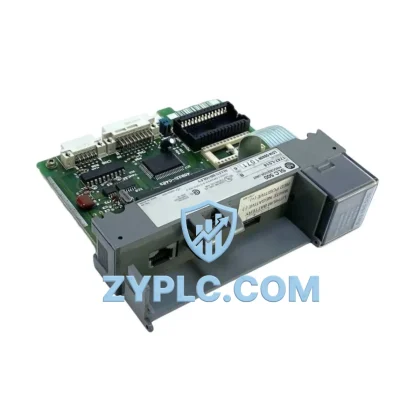
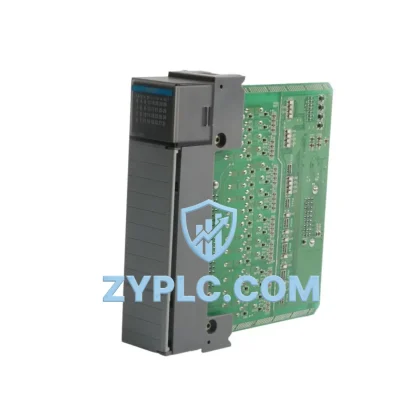
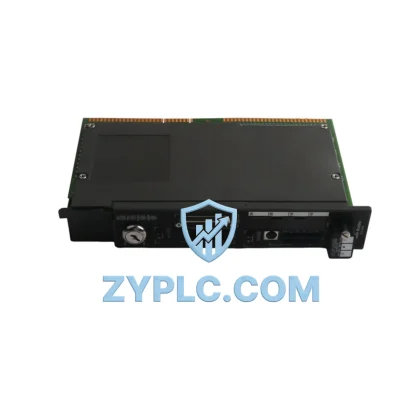
Mitsubishi MY51 System-Ready Relay Output Module for MELSEC Architecture: Control Layer Coordination and System-Wide Integration
In modern industrial automation, the reliability of a control system is never determined by a single component — it is the result of precise coordination across every layer of the architecture. The Mitsubishi MY51 relay output module occupies a critical position within the MELSEC control platform, serving as the bridge between the digital logic of the CPU and the physical actuation demands of field devices. Designed for seamless Contextual Integration within Mitsubishi’s Q Series and iQ-R Series ecosystems, the MY51 delivers consistent relay switching performance that supports the full lifecycle of a control system — from initial commissioning through long-term maintenance and expansion.
Understanding the MY51 requires viewing it not in isolation, but as a functional node within a layered automation architecture. Its role spans the I/O layer, where it receives discrete output commands from the CPU module, and the execution layer, where it drives contactors, solenoids, indicator lamps, and other field actuators. This dual-layer presence makes the MY51 an indispensable element in any MELSEC-based control cabinet design.
Architecture Specification Table
| Parameter |
Specification |
| Model / SKU |
MY51 |
| Brand |
Mitsubishi Electric |
| Series |
MELSEC Q Series / iQ-R Compatible |
| Module Type |
Relay Output Module |
| System Role |
Discrete Output — Execution Layer Interface |
| Output Type |
Relay Contact Output |
| Rated Load Voltage |
240V AC / 24V DC (typical relay output range) |
| Output Points |
16 Points (standard relay output configuration) |
| Isolation Method |
Relay mechanical isolation per output group |
| Communication Capability |
Backplane bus communication via Q Series / iQ-R base unit |
| Compatible Base Units |
Q33B, Q35B, Q38B, Q312B, R35B, R38B |
| Installation Environment |
DIN rail / base unit slot mount; IP20 enclosure recommended |
| Operating Temperature |
0°C to 55°C |
| Origin |
Japan |
| Warranty |
12-Month Warranty — Covered by ZYPLC Quality Assurance Program |
Coordinated Control System Design
The MY51 does not operate in isolation. Its performance is intrinsically linked to the architecture of the surrounding MELSEC system. At the control layer, a CPU module such as the Q06HCPU or Q13UDHCPU executes the ladder logic program and issues discrete output commands via the backplane bus. These commands are routed through the base unit — typically a Q35B or Q38B — to the MY51’s relay output channels, which then switch field-side loads with electrical isolation.
On the power supply side, the Q61P or Q62P power supply module provides stable 5V DC backplane power, ensuring that all modules — including the MY51 — receive consistent operating voltage regardless of field-side load fluctuations. This separation of control power and field power is a fundamental principle of robust MELSEC cabinet design.
For applications requiring discrete input feedback — confirming that actuators have responded to output commands — the QX41 or QX81 input modules are typically installed alongside the MY51 in the same base unit. This input-output pairing creates a closed-loop signal flow that supports both safety interlocking and process verification logic within the CPU program.
In systems where analog process variables must be monitored alongside discrete outputs, the Q64AD analog input module provides 4-channel, 16-bit resolution signal acquisition. The MY51 then acts on the CPU’s processed decisions, converting analog-derived logic into physical relay switching actions — a workflow common in temperature control, pressure regulation, and flow management applications.
Network connectivity is managed through communication modules such as the QJ71E71-100 Ethernet interface or the QJ71BR11 CC-Link master module. These modules allow the MELSEC system — including the MY51’s output status — to be monitored and controlled from SCADA platforms, MES systems, or remote engineering workstations, supporting full Contextual Integration across the plant network.
At the human-machine interface layer, a GOT2000 Series HMI (such as the GT2710-VTBA) provides operators with real-time visibility into output channel states, alarm conditions, and system diagnostics. The MY51’s relay output status can be mapped directly to HMI screen elements, enabling intuitive process monitoring without requiring additional hardware.
For systems requiring output redundancy or high-cycle switching, the QY41P transistor output module may be deployed in parallel architectures alongside the MY51, with the CPU program managing output routing based on load type — relay outputs for high-voltage AC loads, transistor outputs for high-speed DC switching. This hybrid output strategy maximizes both versatility and system longevity.
Application in Layered Automation Systems
The MY51 relay output module is deployed across a wide range of industrial sectors where MELSEC-based control systems are the platform of choice.
In manufacturing and assembly lines, the MY51 controls conveyor motor starters, pneumatic valve solenoids, and machine safety interlocks. Its relay isolation ensures that high-voltage actuator circuits remain electrically separated from the PLC’s low-voltage logic circuits, protecting both the controller and field personnel.
In power distribution and electrical substation automation, the MY51 is used to switch protection relay coils, circuit breaker trip circuits, and alarm annunciator panels. The module’s mechanical relay contacts provide the galvanic isolation required by IEC 61850-compliant substation designs.
In petrochemical and refinery process control, the MY51 interfaces with shutdown valve actuators, pump motor control circuits, and emergency depressurization systems. Its integration within a redundant MELSEC CPU architecture — using hot-standby configurations with modules such as the Q12PRHCPU — ensures that output commands are maintained even during CPU switchover events.
In water and wastewater treatment facilities, the MY51 controls pump start/stop sequences, valve position commands, and chemical dosing system actuators. The module’s compatibility with the MELSEC Q Series remote I/O network allows it to be deployed in distributed control cabinets located throughout large treatment plant sites.
In mining, metallurgy, and heavy industry, the MY51 is valued for its robust relay contact ratings and its ability to operate reliably in high-vibration, high-temperature environments when properly installed within sealed control enclosures. Its long service life and straightforward replacement procedure minimize unplanned downtime in continuous-process operations.
In packaging and material handling systems, the MY51 coordinates with servo drive enable signals, reject gate actuators, and product divert mechanisms. Its deterministic switching behavior — governed by the MELSEC CPU’s scan cycle — ensures precise timing alignment between output commands and mechanical motion.
Architecture Engineering FAQ
Q1: Is the MY51 compatible with both Q Series and iQ-R Series base units, and can it be mixed with other output module types in the same base unit?
The MY51 is designed for the MELSEC Q Series platform and is compatible with Q Series base units including the Q33B, Q35B, Q38B, and Q312B. It can be installed in any available I/O slot within these base units and mixed freely with other Q Series input and output modules, including the QX41 input module and QY41P transistor output module. For iQ-R Series systems, please verify module compatibility with the specific R Series base unit and CPU combination using Mitsubishi Electric’s GX Works3 system configuration tool before installation.
Q2: What engineering considerations apply when integrating the MY51 into a redundant CPU architecture for high-availability process control?
In redundant MELSEC configurations using hot-standby CPU pairs (such as the Q12PRHCPU), the MY51 must be installed in the extension base unit connected to the redundant system’s I/O network rather than directly on the main base unit. Output tracking between the active and standby CPUs ensures that relay output states are synchronized during normal operation and maintained seamlessly during CPU switchover. Engineers should also configure output hold/clear behavior in the CPU parameters to define the MY51’s response during switchover transitions, preventing unintended actuator movement.
Q3: What does the 12-Month Warranty cover for the MY51, and what support is available for long-term maintenance and spare parts supply?
Every MY51 supplied by ZYPLC is covered by a 12-Month Warranty against manufacturing defects and functional failures under normal operating conditions. The warranty covers full module replacement or repair at no additional cost. For long-term maintenance planning, ZYPLC maintains stock of MY51 modules and compatible MELSEC components to support both scheduled preventive replacement programs and emergency breakdown supply requirements. Our technical team is available to assist with module configuration verification, system compatibility checks, and installation guidance throughout the warranty period and beyond. Contact us at plc.sales@zyplc.com or +86 19859288691 for spare parts availability and lead time confirmation.
© 2026 ZYPLC. All rights reserved.
Original Source: https://zyplc.com
Contact: +86 19859288691 | plc.sales@zyplc.com