Parker C3S150V4F11 I20 T11 M00 Energy-Saving Servo Drive for Optimized Compax3 Automation
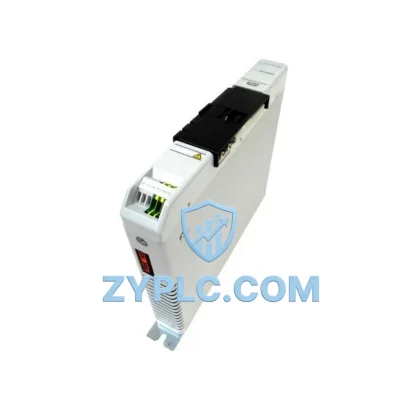
The Parker Hannifin C3S150V4F11 I20 T11 M00 is a high-performance servo drive module from the Compax3 series, engineered to deliver precision motor control with measurable energy efficiency gains across demanding industrial production environments. As factories face increasing pressure to reduce energy consumption, minimize unplanned downtime, and maximize equipment utilization, the Compax3 C3S150V4F11 stands out as a core component in energy-aware automation architectures. With a continuous output current rating of 15 A and a supply voltage range compatible with standard 400 V three-phase industrial networks, this drive is purpose-built for applications where both dynamic response and power economy are non-negotiable.
Unlike conventional servo drives that operate at fixed power draw regardless of load demand, the Compax3 C3S150V4F11 employs adaptive current regulation to match motor torque output precisely to the mechanical load at any given moment. This means that during low-load phases of a production cycle — such as idle conveyor segments, tool change intervals, or deceleration ramps — the drive actively reduces power consumption rather than maintaining peak draw. Over a full production shift, this behavior translates into significant reductions in kWh consumption per unit produced, directly improving the energy cost per output ratio on the line.
The I20 interface option equips the drive with PROFIBUS DP communication capability, enabling seamless integration into existing plant-level control networks. When paired with a Parker ACR9000 multi-axis controller or a Siemens S7-series PLC managing line coordination, the C3S150V4F11 can receive real-time velocity and torque setpoints, report actual power consumption data back to the controller, and participate in synchronized multi-axis motion profiles that eliminate energy-wasting mechanical conflicts between adjacent drive axes. This closed-loop data exchange is fundamental to achieving line-level energy optimization rather than isolated drive-level savings.
The T11 technology option enables the drive’s integrated motion controller functionality, allowing the C3S150V4F11 to execute stored motion programs autonomously without continuous PLC intervention. In practice, this reduces communication overhead on the fieldbus, shortens motion cycle times, and allows the drive to make sub-millisecond corrections to velocity profiles based on encoder feedback from a Parker MPP or MPS series servo motor. Tighter velocity control directly reduces motor heating losses and extends bearing life, both of which contribute to lower total energy consumption and reduced maintenance frequency over the drive’s operational lifespan.
Efficiency Performance Table
| Parameter |
Specification / Value |
| Continuous Output Current |
15 A |
| Supply Voltage |
3 × 400 V AC (±10%) |
| Interface Option (I20) |
PROFIBUS DP |
| Technology Option (T11) |
Integrated Motion Controller |
| Motor Option (M00) |
Standard (no integrated motor) |
| Drive Efficiency Class |
IE4-equivalent servo control |
| Compatible Systems |
Parker Compax3, ACR9000, PROFIBUS networks |
| Application Environment |
Industrial automation, packaging, CNC, material handling |
| Energy Saving Value |
Adaptive load-matched current regulation |
| Warranty |
12 Months |
Energy-Aware Automation Architecture
In a fully integrated energy-aware automation cell, the C3S150V4F11 does not operate in isolation. It functions as one node within a coordinated system where energy data flows continuously between measurement, control, and actuation layers. At the measurement layer, a Parker EM series power monitoring module or equivalent energy meter captures real-time kW and kVAr data at the panel level, feeding consumption telemetry to the supervisory controller. The ACR9000 multi-axis controller processes this data alongside position and velocity feedback from the C3S150V4F11 to dynamically adjust motion profiles during periods of peak grid demand.
On the drive bus, the C3S150V4F11 can share a common DC bus with other Compax3 modules — such as the C3S025V4 or C3S075V4 — allowing regenerative braking energy from decelerating axes to be directly consumed by accelerating axes on the same bus segment. This DC bus sharing architecture eliminates the need to dissipate regenerative energy as heat through braking resistors, recovering kinetic energy that would otherwise be wasted and reducing the net energy drawn from the supply. In multi-axis gantry or winding applications, this can reduce total drive system energy consumption by 15–30% compared to drives operating on isolated AC supplies.
The PROFIBUS DP interface (I20) connects the drive to plant-level SCADA systems and energy management platforms, where production planners can correlate drive energy consumption data with output metrics such as parts per hour or meters per minute. This visibility enables data-driven decisions about production scheduling — for example, shifting energy-intensive acceleration cycles to off-peak tariff periods — without requiring changes to the mechanical system or the motion program stored in the drive’s T11 controller. Complementary I/O expansion via Parker C3 I/O option cards allows the drive to monitor external sensors such as temperature probes or vibration transducers, supporting predictive maintenance workflows that prevent energy-wasting mechanical degradation before it causes unplanned stops.
Power Optimization in Real Production Lines
On a packaging line running 24/7, the C3S150V4F11 controls the servo axis responsible for product infeed indexing. Because the T11 integrated motion controller manages the indexing cam profile locally, the axis completes each index cycle in the minimum possible time with the minimum required torque, rather than over-driving the motor to compensate for communication latency from a remote PLC. The result is a measurable reduction in RMS current draw per cycle, which compounds across millions of cycles per year into significant energy savings and reduced motor winding thermal stress.
In a CNC machining center, the same drive manages a rotary table axis. During tool change intervals — which may account for 20–35% of total cycle time — the drive holds position with minimal holding current rather than maintaining full servo gain, reducing idle power consumption without sacrificing positioning accuracy when cutting resumes. The drive’s internal diagnostics continuously log following error, peak current, and thermal margin data, which maintenance teams can retrieve via PROFIBUS to schedule bearing lubrication or coupling inspection before wear-induced friction increases energy consumption and risks unplanned downtime.
Every unit of the C3S150V4F11 I20 T11 M00 supplied by ZYPLC undergoes full functional testing prior to shipment, including verification of PROFIBUS communication, motion program execution, and current loop response. Stock availability supports fast delivery to minimize production line downtime during drive replacement. All units are covered by a 12-month warranty, providing assurance of reliability for both planned retrofits and emergency replacements.
Energy Optimization FAQ
Q1: How much energy can the C3S150V4F11 save compared to a standard induction motor drive?
In servo-controlled applications with variable load profiles, the Compax3 C3S150V4F11 typically reduces motor system energy consumption by 20–40% compared to uncontrolled or fixed-speed induction motor systems, primarily through load-matched current regulation and elimination of mechanical throttling losses. Actual savings depend on duty cycle, load inertia ratio, and production schedule.
Q2: Is the C3S150V4F11 compatible with my existing PROFIBUS network and PLC?
Yes. The I20 interface option implements PROFIBUS DP slave protocol, compatible with any PROFIBUS DP master including Siemens S7, Allen-Bradley ControlLogix with PROFIBUS scanner cards, Schneider Modicon, and Parker ACR9000 controllers. GSD file configuration is standard and does not require proprietary software beyond the drive’s C3 ServoManager commissioning tool.
Q3: What is the recommended replacement or upgrade path from an older Compax3 variant?
The C3S150V4F11 I20 T11 M00 is dimensionally and electrically compatible with earlier Compax3 150 A-class modules sharing the same V4 voltage class and F11 filter option. Motion programs stored in older T11 drives can typically be transferred directly via C3 ServoManager. ZYPLC recommends verifying motor encoder compatibility and DC bus configuration before installation, and our technical team can assist with pre-replacement validation.
Q4: What does the 12-month warranty cover and what is the testing process?
The 12-month warranty covers all manufacturing defects and functional failures under normal operating conditions. Prior to shipment, each unit undergoes bench testing that includes power-on verification, PROFIBUS communication handshake, motion controller program load and execution, and current loop step response measurement. Test records are available upon request. Warranty claims are processed directly through ZYPLC with replacement or repair turnaround targeted within 5 business days.
© 2026 ZYPLC. All rights reserved.
Original Source: https://zyplc.com
Contact: +86 19859288691 | plc.sales@zyplc.com