Schneider MT16N1 Industrial Network Interface for Masterpact Systems: Bridging Field Devices and Smart Factory Data Flows
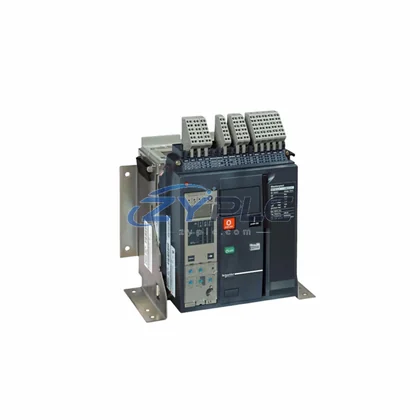
The Schneider MT16N1 is a high-performance air circuit breaker (ACB) engineered for seamless integration into modern industrial network architectures. As smart factories demand real-time visibility across every layer of the power and control infrastructure, the MT16N1 serves as a critical node in the data chain — connecting field-level switching operations to upper-level SCADA, HMI, and energy management systems through standardized communication protocols. Whether deployed in main distribution boards, motor control centers, or intelligent switchgear panels, the MT16N1 delivers the network transparency and operational reliability that Industry 4.0 environments require.
Rated for the Masterpact MT platform, the MT16N1 supports digital communication via Modbus RTU/TCP and is compatible with IEC 61850 substation automation frameworks, enabling direct integration with SCADA gateways and distributed control systems (DCS). This makes it possible to monitor breaker status, trip events, load current, and operating load in real time — without manual inspection or dedicated instrumentation loops.
Compatibility & Integration Notes
| Parameter |
Specification |
| SKU |
MT16N1 |
| Brand |
Schneider Electric |
| Series |
Masterpact MT / Compact NS |
| Protocol Support |
Modbus RTU, Modbus TCP/IP, IEC 61850, BACnet (via gateway) |
| Interface Type |
RS-485, RJ45 Ethernet (with communication module) |
| Transmission Capability |
Real-time breaker status, energy metering, trip diagnostics |
| Network Compatibility |
EtherNet/IP, Profibus DP (via protocol converter), SCADA/DCS |
| System Application |
MV/LV switchgear, MCC, intelligent distribution panels, smart factory power nodes |
| Product Type |
Air Circuit Breaker (ACB) |
| Origin |
France |
| Warranty |
12 Months |
Connected Automation Data Flow
In a typical smart factory deployment, the MT16N1 sits at the power distribution layer, but its data contribution extends far beyond switching. Signal acquisition begins at the breaker itself — current transformers and internal sensors feed real-time load data into the Micrologic 6.0A trip unit (such as the Schneider MICROLOGIC6.0A), which processes protection curves and communicates fault events upstream. This data travels via RS-485 Modbus RTU to a communication gateway or directly to a Schneider Modbus-to-Ethernet converter, bridging the field bus to the plant LAN.
At the controller level, a Schneider Modicon M340 or M580 PLC receives breaker telemetry alongside process I/O from remote modules. The MT16N1’s trip status and energy readings are mapped into the PLC’s data table, where logic routines can trigger load-shedding sequences, interlock commands, or alarm escalations. Companion breakers in the same switchboard — such as the Schneider MT08N1, MT10N1, MT25N1, and MT32N1 — share the same Modbus segment, allowing a single PLC scan to poll the entire distribution tier.
For facilities running Compact NSX feeders downstream, models like the NSX100N, NSX250N, NSX400N, and NSX630N can be integrated into the same network topology, creating a unified breaker communication backbone from the main incomer to the final distribution circuits. This architecture eliminates data silos between power management and process control, giving operators a single-pane view in their SCADA or EcoStruxure Power platform.
Variable speed drives such as the Schneider ATV930D45N4 (Altivar Process series) connect to the same Modbus/EtherNet/IP backbone, feeding motor load data back through the network. Combined with the MT16N1’s energy metering capability, plant engineers can correlate breaker load profiles with drive operating points — enabling predictive maintenance and maintenance planning without additional instrumentation. The Schneider PN072548P2 Prisma power board further extends the system’s modularity, supporting structured busbar connections that maintain network integrity as the installation scales.
Solving Data Isolation in Industrial Sites
One of the most persistent challenges in industrial power management is protocol fragmentation. Legacy switchgear often uses proprietary communication schemes or no digital interface at all, creating islands of data that cannot be accessed by modern SCADA or MES platforms. The MT16N1, with its native Modbus support and IEC 61850 compatibility (via the appropriate communication module), directly addresses this gap.
By standardizing on open protocols, the MT16N1 allows existing Profibus or DeviceNet infrastructure to be bridged through protocol converters without replacing the entire switchgear lineup. Remote monitoring becomes straightforward: trip events, overload conditions, and operating load data are pushed to the SCADA historian in real time, enabling alarm management and trend analysis from any connected HMI terminal or web dashboard. For multi-site operations, this means a central engineering team can diagnose a nuisance trip at a remote substation without dispatching field personnel — reducing mean time to repair (MTTR) and minimizing production downtime.
Production line transparency is another key benefit. When the MT16N1 is integrated into an EcoStruxure Power or equivalent energy management platform, operators gain visibility into load distribution across all feeders simultaneously. Capacity planning becomes data-driven, and system expansion — adding new production cells, welding stations, or HVAC loads — can be modeled against real measured baselines rather than design estimates. Every unit shipped from ZYPLC undergoes pre-shipment functional testing to verify communication integrity, protection settings, and mechanical operation, backed by a warranty terms confirmed during quotation.
Industrial Connectivity FAQ
Q1: What communication protocols does the Schneider MT16N1 support for SCADA integration?
The MT16N1 supports Modbus RTU over RS-485 natively, and with the appropriate Schneider communication module, it can be extended to Modbus TCP/IP and IEC 61850. Protocol conversion to Profibus DP, EtherNet/IP, or BACnet is achievable via third-party gateways, making it compatible with virtually any SCADA or DCS platform in use today.
Q2: How does the MT16N1 handle network latency in real-time monitoring applications?
Modbus RTU polling cycles on a standard RS-485 segment typically achieve sub-100ms response times for breaker status and metering data. For time-critical protection coordination, the MT16N1’s internal Micrologic trip unit operates independently of the communication network, ensuring that protection functions are never delayed by network congestion or polling overhead.
Q3: Can the MT16N1 be integrated into an existing Compact NS or NSX switchboard without replacing the entire panel?
Yes. The MT16N1 is designed for the Masterpact MT frame and can coexist on the same Modbus segment as Compact NS and NSX series breakers. A single RS-485 bus can address up to 247 Modbus devices, so adding the MT16N1 to an existing network requires only address configuration and wiring to the shared bus — no panel redesign is necessary.
Q4: What does the warranty terms confirmed during quotation cover, and how is pre-shipment testing conducted?
Every MT16N1 unit supplied by ZYPLC is tested prior to dispatch for mechanical operation, trip curve verification, and communication port functionality. The warranty terms confirmed during quotation covers manufacturing defects in materials and workmanship from the date of shipment. Availability is confirmed via RFQ for shipment arranged after confirmation; lead times for special configurations are confirmed at the time of order. Contact our team at +86 19859288691 or plc.sales@zyplc.com for availability and RFQ.
© 2026 ZYPLC. All rights reserved. | Contact: +86 19859288691 | plc.sales@zyplc.com