Schneider NSX630N Industrial Network Interface for Compact NSX Systems: Bridging Field Devices and Smart Factory Data Flows
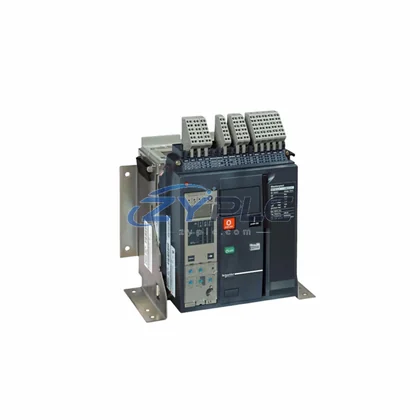
The Schneider Electric NSX630N (SKU: LV432893) is a 630A molded case circuit breaker engineered for demanding industrial power distribution environments. Far beyond simple overcurrent protection, the NSX630N integrates seamlessly into modern smart factory architectures through its compatibility with Schneider’s Modbus RTU and Ethernet-based communication modules, enabling real-time power data to flow from the switchboard level up through SCADA systems, energy management platforms, and cloud-based monitoring dashboards. In an era where every ampere of energy consumption must be accounted for and every fault event must be traceable, the NSX630N serves as a critical node in the industrial data chain.
Compatibility & Integration Notes
| Parameter |
Specification |
| SKU / Part Number |
NSX630N / LV432893 |
| Brand |
Schneider Electric |
| Series |
Compact NSX |
| Rated Current |
630A |
| Communication Protocol |
Modbus RTU, Modbus TCP/IP (via IFM module), Ethernet/IP |
| Interface Type |
RS-485, RJ45 (with communication module) |
| Trip Unit |
Micrologic 2.3 / 5.3 / 6.3 (configurable) |
| Network Compatibility |
SCADA, EMS, BMS, PowerLogic, EcoStruxure |
| Transmission Capability |
Real-time current, voltage, power, energy, fault status |
| System Application |
Industrial power distribution, smart factory, data center, infrastructure |
| Origin |
France |
| Warranty |
warranty terms confirmed during quotation — tested before shipping |
Connected Automation Data Flow
In a typical smart factory deployment, the NSX630N sits at the heart of the low-voltage power distribution panel, protecting critical loads while simultaneously feeding live electrical data into the plant’s automation backbone. When paired with the Schneider IFM (Interface Module for Modbus), the NSX630N transmits real-time current readings, trip cause codes, and energy consumption data over an RS-485 Modbus RTU network to upstream controllers and gateways.
Consider a production line where a Schneider Modicon M340 PLC manages motor drives and conveyor systems. The NSX630N, equipped with a Micrologic 5.3 trip unit, monitors the feeder circuit supplying a group of Schneider Altivar ATV630 variable frequency drives. Any overcurrent event or earth fault detected by the NSX630N is immediately reported via Modbus to the M340, which in turn triggers an alarm on the Magelis HMIGTO HMI panel, alerting the operator on the shop floor within milliseconds. This closed-loop feedback — from field device through PLC to HMI — is the foundation of transparent, responsive industrial automation.
Moving up the data hierarchy, the Modbus RTU signals from multiple NSX630N units across the distribution board are aggregated by a Schneider EGX300 Ethernet gateway, which converts the RS-485 data stream into Modbus TCP/IP packets routable over the plant’s standard Ethernet infrastructure. This data then feeds into a PowerLogic ION7650 power meter or directly into the EcoStruxure Power Monitoring Expert (PME) SCADA platform, where energy engineers can visualize load profiles, identify demand peaks, and schedule preventive maintenance based on historical trip data.
For facilities running remote I/O architectures, the NSX630N’s status signals can be wired into a Schneider TM3 remote I/O module connected to a Modicon TM251 controller, extending the monitoring reach to substations or motor control centers located hundreds of meters from the main control room. In parallel, edge computing nodes — such as the Schneider EcoStruxure Machine Advisor gateway — can collect NSX630N event logs and push them to cloud analytics platforms, enabling predictive maintenance algorithms to flag aging contacts or thermal stress patterns before a nuisance trip disrupts production.
This multi-layer data flow — from the NSX630N’s Micrologic trip unit, through Modbus RTU, across the EGX Ethernet gateway, into PowerLogic metering, and up to EcoStruxure SCADA — exemplifies how a single well-specified circuit breaker becomes a data-generating asset in the Industrial Internet of Things (IIoT) ecosystem.
Solving Data Isolation in Industrial Sites
One of the most persistent challenges in industrial power management is data isolation: switchboards full of legacy circuit breakers that protect equipment but generate no usable data. Maintenance teams rely on manual meter readings, paper logs, and reactive fault response — a model that is increasingly incompatible with the demands of lean manufacturing and energy efficiency mandates.
The NSX630N directly addresses this problem. Its Micrologic electronic trip unit captures granular electrical parameters — phase currents, neutral current, earth leakage, active power, reactive power, and power factor — that would otherwise require separate, expensive power analyzers. By adding the IFM Modbus communication module, this data becomes available to any Modbus-capable controller or SCADA system without additional instrumentation.
Protocol unification is another key benefit. Many industrial sites operate a mix of legacy serial devices and modern Ethernet-based systems. The NSX630N’s compatibility with both Modbus RTU (RS-485) and Modbus TCP/IP (via gateway) means it can be integrated into either architecture without replacing existing infrastructure. This protocol bridging capability reduces integration costs and accelerates the path to full plant digitalization.
Remote diagnostics represent perhaps the most operationally significant advantage. When an NSX630N trips in a remote substation or a hard-to-access electrical room, maintenance engineers no longer need to dispatch a technician immediately. The trip cause — whether thermal overload, short circuit, earth fault, or manual operation — is logged with a timestamp in the Micrologic trip unit’s memory and transmitted via Modbus to the SCADA system. Engineers can review the fault record remotely, assess severity, and dispatch the right personnel with the right parts, dramatically reducing mean time to repair (MTTR).
For growing facilities, the NSX630N’s network architecture supports system expansion without redesign. Additional NSX630N units can be added to the Modbus RS-485 bus (up to 32 devices per segment) and immediately appear in the SCADA topology. This scalability makes the NSX630N a future-proof choice for factories planning phased automation upgrades.
Industrial Connectivity FAQ
Q1: What communication protocols does the Schneider NSX630N support, and how does it integrate with SCADA systems?
The NSX630N supports Modbus RTU over RS-485 natively via the IFM communication module, and Modbus TCP/IP when connected through an EGX Ethernet gateway. It is fully compatible with Schneider’s EcoStruxure Power Monitoring Expert, PowerLogic ION series meters, and any third-party SCADA platform that supports standard Modbus protocol, including Ignition, Wonderware, and Siemens WinCC.
Q2: How does the NSX630N ensure network stability and minimize communication latency in high-noise industrial environments?
The RS-485 Modbus RTU interface used by the NSX630N is inherently noise-resistant, supporting cable runs of up to 1,200 meters with proper termination. The Micrologic trip unit’s communication stack is designed for deterministic response times, typically under 100ms for status polling cycles, ensuring that fault events are reported to the SCADA system with minimal delay even in electrically noisy switchboard environments.
Q3: Can the NSX630N be expanded or integrated into larger power monitoring networks without replacing existing equipment?
Yes. The NSX630N’s Modbus RS-485 bus supports up to 32 devices per segment, and multiple segments can be linked via repeaters or Ethernet gateways. This allows facilities to incrementally add NSX630N units to an existing monitoring network as production capacity expands, without modifying the SCADA configuration or replacing upstream controllers.
Q4: What quality assurance and warranty coverage is provided with the NSX630N?
Every NSX630N unit supplied by ZYPLC undergoes functional testing prior to shipment, verifying trip unit calibration, communication module response, and mechanical operation. A warranty terms confirmed during quotation is provided from the date of delivery, covering manufacturing defects and communication module functionality. Global logistics via DHL and FedEx ensures fast, trackable delivery to industrial sites worldwide.