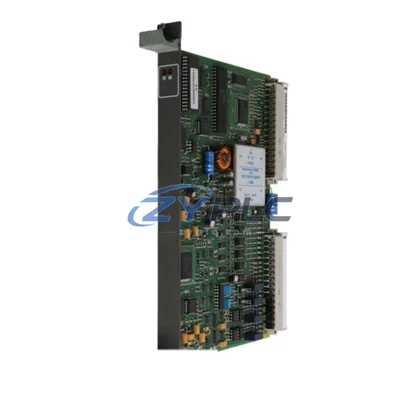
Siemens 39RTMCAN 16207-61/11 RTM Module for TELEPERM Automation
The Siemens 39RTMCAN 16207-61/11 is a high-precision Resistance Temperature Measurement (RTM) module engineered for the TELEPERM process control platform. Designed to meet the demanding requirements of industrial maintenance planning, this module delivers accurate, real-time thermal data that enables plant operators to reduce unplanned downtime risk, improve equipment utilization rates, and maintain tighter control over production line throughput. Whether deployed in power generation, chemical processing, or heavy manufacturing environments, the 39RTMCAN 16207-61/11 serves as a critical sensing node within a broader industrial automation system.
In modern industrial facilities, unmonitored thermal conditions are one of the leading causes of unplanned downtime and unplanned downtime. Motors running above optimal temperature consume excess power and degrade faster. Heat exchangers operating outside their design range reduce process efficiency. The 39RTMCAN 16207-61/11 addresses these challenges by providing continuous, high-resolution resistance temperature data directly to the TELEPERM control system, enabling closed-loop feedback that keeps every process variable within its energy-efficient operating band.
All units supplied by ZYPLC are sourced from verified inventory channels, subjected to outgoing functional testing, and covered by a warranty terms confirmed during quotation. Stock is maintained on-hand for prompt dispatch, minimizing procurement lead times for maintenance and capital project teams alike.
Product Specification Table
| Parameter |
Specification / Value |
| Part Number / SKU |
39RTMCAN 16207-61/11 |
| Module Type |
Resistance Temperature Measurement (RTM) |
| Platform / Series |
Siemens TELEPERM |
| Measurement Principle |
Resistance-based (RTD / PT100 compatible) |
| Operating Efficiency |
High-accuracy thermal sensing; minimizes control deviation and energy overshoot |
| Power Consumption |
Low-power signal conditioning circuitry; optimized for continuous 24/7 operation |
| Compatible Systems |
Siemens TELEPERM M / XP process control systems |
| Application Environment |
Power plants, chemical plants, refineries, heavy industry, utilities |
| Maintenance Value |
Enables closed-loop thermal control; reduces motor overheating, heat loss, and idle unplanned downtime |
| Country of Origin |
Germany |
| Warranty |
warranty terms confirmed during quotation (ZYPLC) |
| Stock Status |
RFQ Available — shipment arranged after confirmation |
| Testing |
Outgoing functional test performed before dispatch |
System Compatibility and Application
The 39RTMCAN 16207-61/11 does not operate in isolation — its value is fully realized when integrated into a layered automation architecture where every component contributes to system-wide energy efficiency. Within a TELEPERM-based control environment, this RTM module feeds temperature data upstream to the central process controller, which in turn coordinates with drive and actuation subsystems to maintain optimal operating conditions.
On the drive side, Siemens SINAMICS G120 and S120 variable frequency drives use thermal feedback from RTM modules like the 39RTMCAN to implement intelligent motor derating and speed adjustment. Rather than running motors at fixed speed regardless of load, the drive system modulates output frequency in response to real process conditions — a strategy that can help restore stable operation when a compatible replacement is required. The SINAMICS CU240E-2 control unit, commonly paired with G120 power modules, supports direct integration with PROFIBUS and PROFINET networks, allowing the TELEPERM controller to issue real-time speed commands based on temperature and process feedback.
At the I/O and signal conditioning layer, Siemens ET 200SP distributed I/O modules aggregate sensor data from multiple RTM channels across the plant floor. The ET 200SP’s modular architecture allows engineers to expand temperature monitoring coverage without redesigning the control cabinet, making it straightforward to add monitoring points at motors, heat exchangers, compressors, and cooling systems. This granular visibility is the foundation of any credible energy reduction program.
For human-machine interaction, Siemens SIMATIC HMI TP700 Comfort or TP1200 Comfort panels display real-time temperature trends, operating load dashboards, and alarm states derived from RTM data. Operators can immediately identify thermal anomalies — a motor running 15°C above its baseline, for example — and take corrective action before the condition escalates into a fault or unplanned shutdown. This proactive visibility directly reduces maintenance costs and improves overall equipment effectiveness (OEE).
Power quality and energy metering are handled by Siemens SENTRON PAC3200 or PAC4200 power monitoring devices, which track active power, reactive power, and operating load at the feeder and load level. When combined with temperature data from the 39RTMCAN 16207-61/11, plant energy managers gain a complete picture: not just how much energy is being consumed, but whether that consumption is thermally justified or indicative of inefficiency. The SENTRON 7KM PAC series supports MODBUS TCP and PROFIBUS communication, enabling seamless data aggregation into the TELEPERM or SIMATIC maintenance planning layer.
Communication integrity across the automation network is maintained through Siemens SCALANCE X series industrial Ethernet switches, which provide deterministic, low-latency data transport between RTM modules, controllers, drives, and SCADA systems. In high-availability plant environments, redundant ring topologies using SCALANCE X208 or X308-2 switches ensure that temperature data from the 39RTMCAN reaches the control system without interruption, even during network segment failures.
At the controller level, Siemens SIMATIC S7-400 or S7-300 PLCs — commonly deployed alongside TELEPERM systems in hybrid modernization projects — process RTM inputs alongside other process variables to execute maintenance planning strategies such as demand-side load shifting, predictive thermal derating, and coordinated startup sequencing. The S7-400H redundant CPU variant is particularly relevant in critical process applications where control continuity is non-negotiable.
Maintenance and Replacement Notes
In a typical continuous process plant — a refinery, a power station auxiliary system, or a large-scale chemical reactor — thermal management is inseparable from maintenance planning. The 39RTMCAN 16207-61/11 contributes to power optimization across several dimensions of plant operation.
Reducing Motor Energy Waste: Electric motors account for 60–70% of industrial electricity consumption. When a motor operates above its rated temperature due to overload, poor ventilation, or bearing degradation, it draws abnormal load and converts that energy into heat rather than useful mechanical work. By providing continuous, accurate temperature readings to the TELEPERM controller, the 39RTMCAN enables the control system to detect thermal drift early and respond — reducing motor speed via the connected VFD, triggering cooling system activation, or alerting maintenance personnel — before the motor reaches a condition that wastes energy or causes failure.
Optimizing Production Line Throughput: In batch and continuous manufacturing, thermal conditions directly affect production line cycle time. Processes that run too hot or too cold require longer stabilization periods, reducing effective throughput and increasing energy cost per unit of output. The 39RTMCAN’s high-resolution temperature data allows the TELEPERM system to maintain tighter process temperature bands, shortening stabilization times and improving line rhythm consistency. The result is more product per operating-hour consumed.
Predictive Maintenance and Downtime Reduction: Unplanned equipment shutdowns are among the most energy-intensive events in industrial operations. Emergency restarts, purge cycles, and reheating sequences consume disproportionate amounts of energy compared to steady-state operation. By tracking temperature trends over time, the 39RTMCAN enables predictive maintenance strategies: rising baseline temperatures in a motor or heat exchanger signal developing faults weeks before failure, allowing maintenance to be scheduled during planned downtime windows rather than in response to emergency breakdowns.
Inventory Availability and Supply Assurance: ZYPLC maintains ready stock of the 39RTMCAN 16207-61/11 to support both planned maintenance programs and emergency replacement scenarios. Rapid availability of this module means that when a temperature measurement channel fails, production can be restored quickly — minimizing the energy and productivity cost of extended downtime. Each unit undergoes outgoing functional testing and is backed by a warranty terms confirmed during quotation, providing procurement and maintenance teams with confidence in both quality and supply continuity.
Product Sourcing FAQ
Q1: How does the 39RTMCAN 16207-61/11 contribute to measurable operational stability in a production facility?
By delivering accurate, continuous temperature data to the TELEPERM control system, the 39RTMCAN enables closed-loop thermal management that prevents unplanned downtime from motor overheating, process temperature deviation, and inefficient drive operation. Plants that implement comprehensive RTM-based thermal monitoring typically report reductions in motor-related operating load and a measurable improvement in OEE, as fewer unplanned stops and thermal-related slowdowns occur.
Q2: Is the 39RTMCAN 16207-61/11 compatible with modern Siemens control platforms beyond TELEPERM?
The 39RTMCAN 16207-61/11 is designed specifically for the Siemens TELEPERM M and XP process control platforms. For integration with SIMATIC S7-300/400 or TIA Portal-based systems, signal conditioning adapters or migration gateways may be required. ZYPLC can advise on compatible interface solutions based on your specific control architecture.
Q3: What is the recommended replacement or upgrade path if the 39RTMCAN 16207-61/11 is no longer available for my system?
For TELEPERM systems still in active service, direct replacement with a tested 39RTMCAN 16207-61/11 from availability subject to RFQ confirmation — such as that maintained by ZYPLC — is the lowest-risk option. For facilities planning a control system migration, Siemens offers TELEPERM-to-SIMATIC migration packages that preserve existing I/O wiring while transitioning to current-generation controllers. ZYPLC can support both strategies depending on your maintenance and capital planning horizon.
Q4: What testing and warranty coverage does ZYPLC provide for the 39RTMCAN 16207-61/11?
Every 39RTMCAN 16207-61/11 unit dispatched by ZYPLC undergoes outgoing functional testing to verify measurement accuracy and communication integrity prior to shipment. All units are covered by a warranty terms confirmed during quotation from the date of delivery. In the event of a warranty claim, ZYPLC provides replacement or repair support to minimize disruption to your production operations.