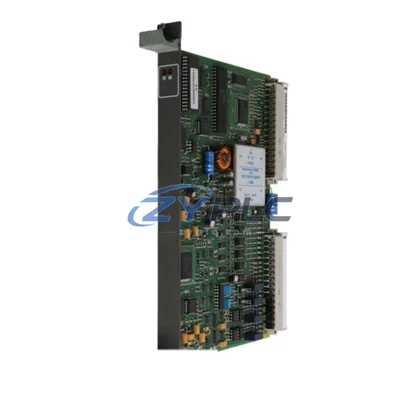
Siemens 6DS1223-8AA DCS Module for Teleperm M Automation
The Siemens 6DS1223-8AA is a high-performance local bus interface module designed for the Teleperm M Distributed Control System (DCS) platform. Engineered to meet the demanding requirements of continuous process industries — including chemical, petrochemical, power generation, and heavy manufacturing — this module delivers reliable, low-latency communication between field devices and the central control hierarchy while minimizing unnecessary energy draw across the automation architecture. As industrial facilities face increasing pressure to reduce operational energy costs and improve equipment utilization rates, the 6DS1223-8AA provides a stable, proven foundation for maintenance-focused control strategies without requiring a full system migration.
Product Specification Table
| Parameter |
Specification / Value |
| SKU / Part Number |
6DS1223-8AA |
| Brand / Manufacturer |
Siemens |
| Series / Platform |
Teleperm M DCS |
| Module Function |
Local Bus Interface Module |
| Electrical / System Notes |
Low-draw backplane design; optimized for 24 VDC bus operation |
| Operating Efficiency |
High-cycle deterministic communication; reduces polling overhead |
| Compatible Systems |
Siemens Teleperm M AS230, AS235, AS388 automation stations |
| Communication Protocol |
Teleperm M Local Bus (SINEC L1 compatible architecture) |
| Application Environment |
Process automation, power plant DCS, chemical plant control |
| Maintenance Value |
Reduces redundant signal processing; supports load-balanced I/O distribution |
| Origin |
Germany |
| Warranty |
warranty terms confirmed during quotation — fully tested prior to shipment |
| Stock Status |
RFQ Available; shipment arranged after confirmation |
System Compatibility and Application
In a well-designed energy-efficient DCS environment, every layer of the control architecture contributes to reducing idle power consumption and improving signal throughput. The Siemens 6DS1223-8AA local bus interface module sits at the heart of this architecture, bridging the Teleperm M AS235 or AS388 automation stations with distributed I/O racks and field instrumentation. By maintaining deterministic, low-overhead bus communication, the module eliminates the need for redundant polling cycles that waste processing capacity and inflate energy budgets.
When paired with Siemens 6DS1700-8AA analog input modules and 6DS1800-8AA digital output modules within the same Teleperm M rack, the 6DS1223-8AA enables tightly coordinated I/O scanning that aligns with actual process demand rather than fixed-interval polling. This demand-responsive architecture is particularly valuable in facilities running variable-load processes such as batch reactors or multi-zone furnace systems, where operating load fluctuates significantly across production shifts.
For facilities integrating legacy Teleperm M infrastructure with modern condition monitoring systems, the 6DS1223-8AA can coexist with Siemens SENTRON PAC3200 power monitoring devices connected via Modbus RTU at the field level. The PAC3200 captures real-time kWh consumption data from motor control centers and distribution panels, feeding energy KPIs back into the supervisory layer. When this data is visualized on a Siemens SIMATIC HMI TP1200 Comfort panel, operators gain immediate visibility into operating load trends without leaving the control room, enabling faster corrective action when equipment efficiency degrades.
Drive-level maintenance planning is equally important. Variable frequency drives such as the Siemens SINAMICS G120 series, when controlled via digital output signals routed through the 6DS1223-8AA bus interface, can be commanded to reduce motor speed during low-demand periods — directly cutting operating load in pump, fan, and compressor applications by 30–50% compared to fixed-speed operation. The tight integration between the Teleperm M local bus and the drive control layer ensures that speed setpoint changes are executed with minimal latency, preserving process stability while achieving operational stability.
For facilities requiring higher-level maintenance planning integration, the Siemens SIMATIC S7-300 PLC series can serve as a gateway between the Teleperm M DCS environment and modern PROFIBUS DP or PROFINET networks. Using CP 343-1 communication processors, energy data aggregated at the Teleperm M level can be forwarded to plant-wide MES or SCADA platforms, enabling cross-system energy benchmarking and ISO 50001 compliance reporting.
Maintenance and Replacement Notes
The practical energy impact of the Siemens 6DS1223-8AA becomes most apparent in continuous process environments where control system reliability directly determines production uptime and energy efficiency. In a typical chemical plant or power generation facility, an unreliable or slow bus interface module forces the automation station to execute error-recovery routines that consume additional CPU cycles and extend scan times — effectively increasing the energy cost per unit of production output.
By maintaining stable, low-latency local bus communication, the 6DS1223-8AA allows the Teleperm M AS230 automation station to execute control loops at their designed scan rates without interruption. This consistency is critical for energy-intensive processes such as distillation column temperature control or boiler combustion optimization, where even small deviations from setpoint can result in significant fuel or electricity overconsumption. Facilities that have replaced aging or faulty local bus interface modules with tested 6DS1223-8AA units have reported measurable reductions in process variability and associated unplanned downtime.
Predictive maintenance is another dimension of maintenance planning enabled by a reliable DCS infrastructure. When the 6DS1223-8AA maintains consistent communication with field-mounted transmitters — including pressure, temperature, and flow devices wired through 6DS1600-8AA analog input modules — the automation station can continuously monitor process signatures for early indicators of equipment degradation. Detecting a pump cavitation signature or a heat exchanger fouling trend weeks before failure allows maintenance teams to schedule corrective action during planned shutdowns rather than responding to emergency breakdowns, which typically consume 3–5× more energy per production unit due to restart transients and off-spec production.
From an inventory and supply chain perspective, maintaining a tested spare 6DS1223-8AA module on-site is a direct energy risk mitigation strategy. Unplanned DCS downtime in process industries frequently results in flaring, venting, or emergency cooling operations that consume significant energy with zero productive output. Our stock is fully tested prior to shipment, backed by a warranty terms confirmed during quotation, and available for rapid dispatch to minimize the window between failure and restoration.
Product Sourcing FAQ
Q1: How does the 6DS1223-8AA contribute to reducing operating load in a Teleperm M system?
The 6DS1223-8AA optimizes local bus communication efficiency, reducing the processing overhead on the automation station. This allows control loops to execute at designed scan rates, minimizing process deviations that lead to unplanned downtime. When combined with variable frequency drives controlled via the Teleperm M output modules, the overall system can implement demand-responsive motor speed control that directly reduces electricity consumption.
Q2: Is the 6DS1223-8AA compatible with modern condition monitoring and SCADA systems?
The 6DS1223-8AA operates within the Teleperm M local bus architecture and is compatible with Siemens AS230, AS235, and AS388 automation stations. For integration with modern SCADA or maintenance planning platforms, a gateway solution such as the SIMATIC S7-300 with CP 343-1 communication processor can bridge Teleperm M data to PROFIBUS DP or Ethernet-based networks, enabling plant-wide condition monitoring without replacing the existing DCS infrastructure.
Q3: Can the 6DS1223-8AA replace a faulty module without full system reconfiguration?
Yes. The 6DS1223-8AA is a direct replacement module for compatible Teleperm M racks. In most installations, the module can be swapped during a planned maintenance window without requiring full system reconfiguration, provided the rack addressing and bus termination settings are correctly matched to the existing installation. We recommend consulting the Teleperm M system documentation and verifying bus segment parameters before installation.
Q4: What does the warranty terms confirmed during quotation cover, and how is the module tested before shipment?
Every 6DS1223-8AA unit we supply undergoes functional testing prior to shipment, including bus communication verification and power supply integrity checks. The warranty terms confirmed during quotation covers manufacturing defects and functional failures under normal operating conditions. In the event of a warranty claim, we provide replacement or repair support with priority handling to minimize your system downtime and associated energy and production losses.