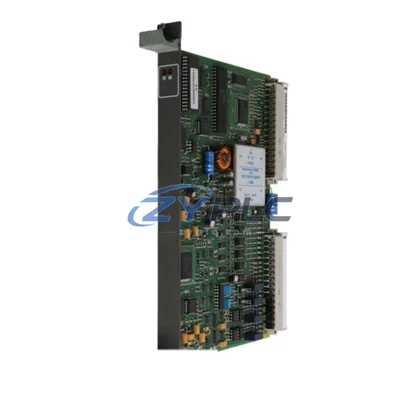
Siemens 6DS1717-8CC DCS Module for Teleperm M Automation
The Siemens 6DS1717-8CC is a binary calculation module designed for the Teleperm M Distributed Control System (DCS) platform — one of Siemens’ most enduring process automation architectures deployed across power generation, chemical processing, and heavy manufacturing facilities worldwide. In an era where industrial energy efficiency is no longer optional, this module plays a critical role in reducing unnecessary computational overhead, tightening control loop response times, and enabling smarter energy allocation across production lines.
Unlike generic replacement modules, the 6DS1717-8CC is engineered to integrate seamlessly within the Teleperm M rack architecture, executing binary logic operations with deterministic cycle times that directly support lean operating load profiles. When binary decision-making is handled locally at the DCS level — rather than routed through higher-level controllers — the result is reduced bus traffic, lower CPU load on central processing units such as the Siemens AS 235 automation station, and measurable reductions in idle-state power draw across the control cabinet.
Product Specification Table
| Parameter |
Specification |
| SKU / Part Number |
6DS1717-8CC |
| Brand / Manufacturer |
Siemens |
| Series / Platform |
Teleperm M DCS |
| Module Function |
Binary Calculation / Logic Processing |
| Power Consumption |
Low-power binary logic execution (rack-bus powered) |
| Operating Efficiency |
Deterministic cycle execution; minimizes redundant processing load |
| Compatible Systems |
Siemens Teleperm M (AS 220, AS 230, AS 235 automation stations) |
| Application Environment |
Power plants, chemical plants, steel mills, water treatment, heavy industry |
| Maintenance Value |
Reduces central CPU load; lowers idle-state cabinet power draw |
| Origin |
Germany |
| Inventory Status |
RFQ Available — shipment arranged after confirmation |
| Quality Assurance |
Pre-shipment functional test included |
| Warranty |
warranty terms confirmed during quotation |
System Compatibility and Application
The 6DS1717-8CC does not operate in isolation — its true maintenance planning value emerges when it functions as part of a coordinated Teleperm M control architecture. In a typical energy-conscious plant configuration, the module works alongside the Siemens 6DS1310-8AB analog input module to receive real-time process signals from field sensors, feeding binary decision logic that governs actuator states and motor start/stop sequences. This tight integration eliminates the latency and unplanned downtime associated with polling-based control strategies.
On the drive side, variable frequency drives such as the Siemens SINAMICS G120 series respond to binary command outputs from the 6DS1717-8CC to modulate motor speed in direct proportion to actual process demand — a strategy that can help restore stable operation when a compatible replacement is required. For legacy Teleperm M installations where the Siemens 6DS1600 series power supply modules are already in use, the low-power binary processing of the 6DS1717-8CC ensures that rack-level power budgets remain within design limits even as additional I/O modules are added.
Communication between the Teleperm M DCS and plant-level SCADA or maintenance planning systems is typically handled via Siemens SINAUT communication processors or gateway modules that translate Teleperm M internal bus signals to PROFIBUS DP or Modbus RTU. The binary status outputs from the 6DS1717-8CC are directly readable by these communication layers, enabling real-time energy dashboards to reflect actual equipment states — running, standby, fault, or operational-efficiency mode — without additional signal conditioning hardware.
For plants integrating power monitoring at the panel level, Siemens SENTRON PAC power monitoring devices can be networked alongside the Teleperm M system to provide kWh-level consumption data correlated with the binary control states managed by the 6DS1717-8CC. This creates a closed-loop energy visibility architecture: the module controls the equipment state, and the power monitor validates whether the expected energy reduction has been achieved. HMI visualization through Siemens SIMATIC WinCC or legacy Teleperm M OS operator stations allows plant engineers to monitor binary module status, alarm states, and energy KPIs from a single interface.
In servo-driven applications within the same facility, Siemens SIMOTION D motion controllers can receive coordinated binary signals from the Teleperm M system via gateway interfaces, synchronizing production line motion profiles with process control states to eliminate energy-wasting mechanical conflicts between drives and conveyors. The 6DS1717-8CC’s role in this architecture is foundational: it is the binary decision engine that determines when energy-intensive equipment should run, ramp, hold, or stop.
Maintenance and Replacement Notes
In a coal-fired power plant running a Teleperm M-based boiler control system, the 6DS1717-8CC handles binary interlocking logic for burner management, feed pump sequencing, and auxiliary fan control. By executing these decisions at the DCS module level rather than relying on the central AS 235 processor for every binary evaluation, the system reduces scan cycle overhead and allows the automation station to allocate processing capacity to more computationally intensive analog control loops — such as combustion air-fuel ratio optimization — that have a direct impact on fuel efficiency.
In a chemical plant context, the module manages binary permissive logic for reactor feed valves and agitator motors. When a batch process reaches a defined endpoint — detected via analog threshold comparison in an upstream Siemens 6DS1310 input module — the 6DS1717-8CC issues binary stop commands to the agitator drive, preventing unnecessary motor runtime and the associated operating load. Over hundreds of batch cycles per year, this type of precise binary control translates into significant reductions in kWh consumption per unit of output.
Maintenance teams benefit from the module’s deterministic behavior as well. Because the 6DS1717-8CC executes binary logic with consistent, predictable timing, deviations in equipment response — such as a valve that takes longer than expected to reach its end position — are immediately detectable through comparison of command output timing versus feedback input timing. This enables condition-based maintenance scheduling, reducing both unplanned downtime and the unplanned downtime associated with running degraded equipment at full load. All units supplied by ZYPLC are pre-tested under simulated rack conditions prior to shipment, with a warranty terms confirmed during quotation covering functional performance in the specified operating environment.
Product Sourcing FAQ
Q1: How does the 6DS1717-8CC contribute to measurable operational stability on the production line?
By handling binary logic execution locally within the Teleperm M rack, the module reduces the processing burden on the central automation station, shortens control loop response times, and enables faster, more precise start/stop commands to motors and drives. This reduces unnecessary motor runtime and eliminates unplanned downtime from delayed or missed control actions.
Q2: Is the 6DS1717-8CC compatible with all Teleperm M automation station variants?
The 6DS1717-8CC is designed for the Teleperm M platform and is compatible with AS 220, AS 230, and AS 235 automation stations. It slots into standard Teleperm M racks and communicates via the internal Teleperm M module bus. For specific rack slot and firmware compatibility, consult the Siemens Teleperm M system documentation or contact ZYPLC for pre-sales technical support.
Q3: Can this module replace a faulty 6DS1717-8CC in an existing installation without system reconfiguration?
Yes. As a direct form-fit-function replacement, the 6DS1717-8CC can be swapped into an existing Teleperm M rack without changes to the system configuration database, provided the replacement unit carries the same hardware revision. ZYPLC recommends verifying the hardware revision suffix before ordering and can assist with revision matching upon request.
Q4: What does the warranty terms confirmed during quotation cover, and what is the testing process before shipment?
Every 6DS1717-8CC unit shipped by ZYPLC undergoes pre-shipment functional testing under simulated Teleperm M rack operating conditions to verify binary I/O response, bus communication integrity, and power consumption within specification. The warranty terms confirmed during quotation covers defects in materials and workmanship under normal operating conditions. Units that fail during the warranty period are replaced or refunded — contact plc.sales@zyplc.com for warranty claims.
—