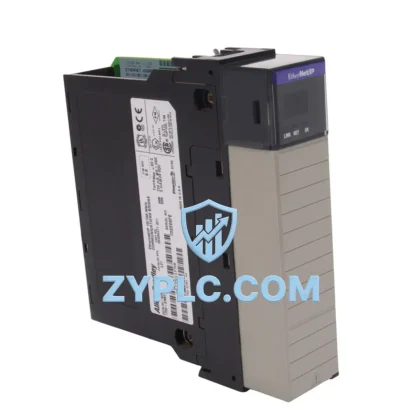
Siemens 6ES7 153-1AA03-0XB0 System-Ready Interface Module for ET 200M Control Architecture
The Siemens 6ES7 153-1AA03-0XB0 is the IM 153-1 interface module designed for the ET 200M distributed I/O station, serving as the critical communication bridge between the PROFIBUS DP fieldbus network and the modular S7-300 signal module rack. Within a layered industrial automation architecture, this component occupies the I/O layer, enabling the control layer — typically a Siemens S7-400 CPU such as the 6ES7 414-2XK05-0AB0 or a redundant S7-400H pair — to address field signals distributed across remote cabinets, junction boxes, and process skids without running individual signal cables back to the central control room. By concentrating field I/O at the point of measurement and transmitting structured data over a single PROFIBUS DP trunk, the 6ES7 153-1AA03-0XB0 reduces wiring complexity, shortens commissioning time, and improves long-term maintainability across the full system lifecycle.
Architecture Specification Table
| Parameter |
Specification |
| System Role |
ET 200M Distributed I/O Interface Module (IM 153-1) |
| Compatible Rack |
S7-300 rail with up to 8 signal modules per station |
| Fieldbus Protocol |
PROFIBUS DP (IEC 61158), up to 12 Mbit/s |
| PROFIBUS Address Range |
1 – 125 (configurable via DIP switch) |
| Supply Voltage |
24 V DC (via PS 307 or equivalent power supply module) |
| Current Consumption |
≤ 200 mA from backplane bus |
| Operating Temperature |
0 °C to +60 °C |
| Protection Class |
IP20 |
| Installation |
DIN rail, S7-300 standard mounting rail |
| Configuration Tool |
STEP 7 V5.x / TIA Portal (via GSD file) |
| Dimensions (W×H×D) |
40 × 125 × 117 mm |
| Weight |
Approx. 0.25 kg |
| Warranty |
12-Month Warranty (ZYPLC) |
Coordinated Control System Design
The 6ES7 153-1AA03-0XB0 does not operate in isolation — its value is realized through tight coordination with upstream controllers, downstream signal modules, and the supporting infrastructure that surrounds it. In a typical PROFIBUS DP segment, the IM 153-1 acts as a DP slave, receiving cyclic polling commands from a DP master such as the CP 342-5 communications processor (6GK7 342-5DA02-0XE0) installed in an S7-300 controller, or directly from the integrated DP interface of an S7-400 CPU. The backplane bus of the ET 200M station then distributes power and data to the inserted signal modules: digital input modules such as the SM 321 (6ES7 321-1BH02-0AA0), digital output modules such as the SM 322 (6ES7 322-1BH01-0AA0), and analog input modules such as the SM 331 (6ES7 331-7KF02-0AB0) for 4–20 mA process signals from transmitters and sensors.
Power to the ET 200M station is supplied by a dedicated PS 307 power supply module (e.g., 6ES7 307-1BA01-0AA0), which converts 120/230 V AC to 24 V DC and feeds both the IM 153-1 and the signal modules through the backplane. In redundant architectures, a second IM 153-1 can be inserted alongside the primary module to form an active-standby pair, ensuring that a single module failure does not interrupt process data acquisition — a configuration commonly used in power generation, petrochemical, and water treatment plants where unplanned downtime carries significant operational and safety consequences.
At the network layer, the PROFIBUS DP segment connecting the IM 153-1 to the master controller may pass through repeaters such as the RS 485 repeater (6ES7 972-0AA02-0XA0) to extend cable length beyond the 1,200-metre limit or to bridge electrical isolation between segments. Termination resistors at both ends of the segment are essential for signal integrity at higher baud rates. The ET 200M station’s PROFIBUS address, set via the DIP switches on the IM 153-1 front panel, must match the address configured in the STEP 7 hardware configuration or TIA Portal project to ensure correct GSD-based parameterisation during startup.
At the human-machine interface layer, operators interact with the process data collected through the IM 153-1 via SIMATIC HMI panels — such as the TP700 Comfort or MP377 — connected to the S7 controller over MPI or PROFINET. Alarm management, trend displays, and diagnostic screens all depend on the reliable, low-latency data delivery that the IM 153-1 provides across the PROFIBUS segment. Engineering workstations running STEP 7 or TIA Portal can perform online diagnostics on the ET 200M station, reading module status, channel-level fault information, and bus statistics without interrupting the running process.
Application in Layered Automation Systems
In continuous process industries such as petrochemical refining and natural gas processing, the ET 200M station equipped with the 6ES7 153-1AA03-0XB0 is mounted in field junction boxes located near reactors, heat exchangers, and compressor skids. The IM 153-1 aggregates analog signals from pressure transmitters, temperature elements, and flow meters, transmitting them over PROFIBUS DP to the DCS or PLC in the central control room. This architecture eliminates long individual signal cable runs, reduces the risk of ground loops and EMI interference, and allows field cabinet layouts to be standardised across multiple process units.
In discrete manufacturing — including automotive body-in-white lines, stamping presses, and assembly conveyors — the IM 153-1 connects to digital I/O modules that interface with proximity sensors, solenoid valves, and safety relays. The deterministic cycle time of PROFIBUS DP ensures that the S7-400 or S7-300 controller receives updated I/O images within the scan cycle, supporting high-speed sequencing and interlocking logic. In power distribution substations and utility switchgear panels, the ET 200M station provides a compact, rail-mounted I/O solution for monitoring breaker status, transformer temperatures, and protection relay outputs, with the IM 153-1 serving as the reliable fieldbus gateway between the substation automation system and the field devices.
Water and wastewater treatment facilities benefit from the IP20-rated, DIN-rail-mounted ET 200M station in control panels located near pump stations, filtration banks, and chemical dosing skids. The modular design of the S7-300 signal module range allows engineers to mix digital and analog I/O within a single ET 200M station, reducing the number of remote cabinets required and simplifying spare-parts inventory. Mining and minerals processing operations, where vibration, dust, and wide temperature swings are common, rely on the robust electrical design of the IM 153-1 and the proven reliability of the PROFIBUS DP protocol to maintain continuous communication between field instruments and the plant control system.
Architecture Engineering FAQ
Q1: How many signal modules can be connected to a single 6ES7 153-1AA03-0XB0 station, and what limits the expansion?
A single ET 200M station using the IM 153-1 supports up to 8 S7-300 signal modules on the backplane rail. The limiting factors are the maximum backplane bus current (typically 1.2 A at 5 V DC), the total number of I/O bytes addressable by the DP master’s configuration, and the physical rail length. When more than 8 modules are required at a single field location, a second ET 200M station with its own IM 153-1 must be added as a separate PROFIBUS DP slave address. Careful hardware configuration in STEP 7 or TIA Portal is required to assign consistent slot addresses and ensure that the GSD file parameters match the physical module arrangement.
Q2: Is the 6ES7 153-1AA03-0XB0 compatible with both S7-300 and S7-400 controllers, and can it be used in a redundant S7-400H system?
Yes. The IM 153-1 operates as a standard PROFIBUS DP slave and is compatible with any DP master, including the integrated DP interfaces of S7-300 CPUs, S7-400 CPUs, and the redundant CPU pair in an S7-400H system. In an S7-400H redundant configuration, both CPUs share the same PROFIBUS DP segment, and the IM 153-1 responds to the active master. If the active CPU fails and the standby takes over, the IM 153-1 continues operating without interruption, provided the switchover time is within the DP watchdog timeout configured in the hardware parameters. For high-availability applications, the dual-IM redundant ET 200M configuration (using two IM 153-2 modules) is recommended; however, the IM 153-1 variant remains widely used in non-redundant segments where cost optimisation is a priority.
Q3: What does the 12-Month Warranty cover, and how does ZYPLC support long-term spare-parts availability for the 6ES7 153-1AA03-0XB0?
ZYPLC’s 12-Month Warranty covers the 6ES7 153-1AA03-0XB0 against manufacturing defects and functional failures under normal operating conditions from the date of shipment. Each unit is tested prior to dispatch to verify PROFIBUS DP communication, backplane bus integrity, and LED diagnostic functions. For long-term maintenance planning, ZYPLC maintains stock of the IM 153-1 and compatible S7-300 signal modules to support plants that have standardised on the ET 200M platform and require reliable spare-parts availability beyond the original equipment manufacturer’s standard lead times. Customers requiring documentation, firmware version confirmation, or application-specific compatibility verification are encouraged to contact the ZYPLC technical team before placing orders for critical infrastructure projects.
© 2026 ZYPLC. All rights reserved.
Original Source: https://zyplc.com
Contact: +86 19859288691 | [email protected]