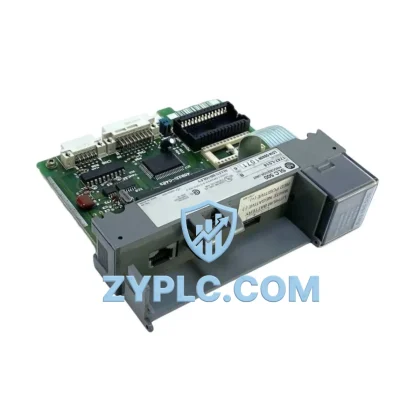
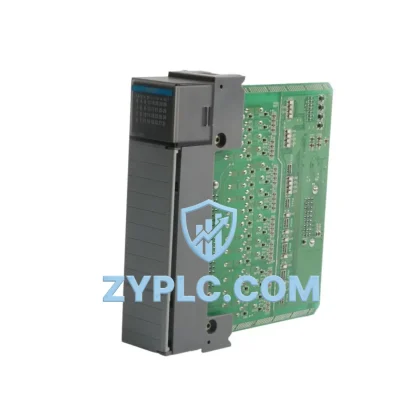
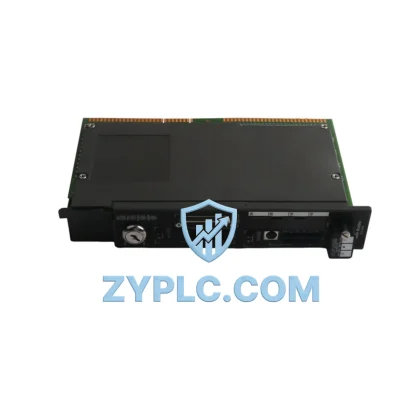
Siemens 6ES7151-8FB01-0AB0 System-Ready CPU Interface for ET 200S Architecture
The Siemens 6ES7151-8FB01-0AB0, designated as the IM151-8F PN/DP CPU Interface Module, is a fail-safe, high-performance CPU designed specifically for deployment within the ET 200S distributed I/O station family. Unlike conventional interface modules that merely relay signals, the 6ES7151-8FB01-0AB0 functions as an autonomous processing unit embedded directly at the I/O level, enabling decentralized intelligence across complex, multi-zone automation architectures. Its dual-protocol capability — supporting both PROFINET IO and PROFIBUS DP — makes it a cornerstone component for engineers designing layered control systems that demand deterministic communication, functional safety compliance, and long-term architectural scalability.
In modern industrial automation, the control architecture is rarely a single-tier structure. It spans from the enterprise MES layer down through supervisory SCADA systems, PLC control layers, distributed I/O layers, field device layers, and ultimately to actuators and sensors on the plant floor. The 6ES7151-8FB01-0AB0 occupies a critical position at the distributed I/O layer, bridging the gap between centralized SIMATIC S7-300 or S7-400 controllers and the physical process environment. By integrating CPU-level processing directly into the ET 200S station, this module reduces the communication burden on the central controller, improves response latency for safety-critical signals, and enables independent local program execution — a key advantage in architectures where network interruptions must not compromise process safety.
The fail-safe design of the 6ES7151-8FB01-0AB0 is certified to IEC 61508 SIL 3 and EN 954-1 Category 4, making it suitable for safety instrumented systems (SIS) in industries where personnel protection and process integrity are paramount. When paired with Siemens F-I/O modules such as the 6ES7138-4FA04-0AB0 (4 F-DI) or 6ES7138-4FB03-0AB0 (2 F-DO), the ET 200S station transforms into a fully certified safety node capable of executing F-programs independently. This architecture eliminates the need for dedicated safety PLCs in many applications, reducing cabinet footprint, wiring complexity, and overall system cost.
Architecture Specification Table
| Parameter |
Specification |
| Part Number / SKU |
6ES7151-8FB01-0AB0 |
| Module Designation |
IM151-8F PN/DP CPU Interface Module |
| Brand / Manufacturer |
Siemens AG |
| Product Series |
SIMATIC ET 200S |
| System Role |
Fail-Safe Distributed CPU at I/O Station Level |
| Communication Interfaces |
PROFINET IO (100 Mbit/s), PROFIBUS DP (up to 12 Mbit/s) |
| Safety Certification |
IEC 61508 SIL 3, EN 954-1 Category 4 |
| Program Memory |
256 KB work memory; 512 KB load memory |
| Processing Speed |
0.1 ms / 1000 binary instructions |
| Supply Voltage |
24 V DC (20.4 V to 28.8 V) |
| Power Consumption |
Approx. 2.5 W |
| Operating Temperature |
0 to +60 degrees C |
| Protection Rating |
IP20 |
| Installation |
ET 200S Terminal Module TM-P15S23-A0 or compatible |
| Country of Origin |
Germany |
| Warranty |
12-Month Warranty — Tested, Verified, Ready for Deployment |
Coordinated Control System Design
The 6ES7151-8FB01-0AB0 does not operate in isolation — its value is fully realized when integrated into a coherent, multi-layer control architecture. In a typical SIMATIC-based automation system, the central controller may be a Siemens CPU 315F-2 PN/DP (6ES7315-2FH13-0AB0) or a CPU 317F-2 PN/DP (6ES7317-2FK14-0AB0), both of which support F-program execution and serve as the primary PROFINET IO controllers. The 6ES7151-8FB01-0AB0 operates as an intelligent IO device on the PROFINET ring, executing its own F-program locally while reporting safety status upstream to the central CPU.
Power distribution within the ET 200S station is managed by the PM-E power module (6ES7138-4CA01-0AA0), which supplies 24 V DC to the I/O modules mounted on the same terminal module row. For applications requiring redundant power feeds, the PM-E F 24VDC (6ES7138-4CF03-0AB0) provides fail-safe power monitoring, ensuring that a single power supply failure does not compromise the safety function. This power architecture is essential in SIL 3 applications where power availability is itself a safety parameter.
On the I/O side, the ET 200S station populated around the 6ES7151-8FB01-0AB0 typically includes standard digital input modules (6ES7131-4BF00-0AA0, 8 DI x 24 V DC), standard digital output modules (6ES7132-4BF00-0AA0, 8 DO x 24 V DC / 0.5 A), and analog input modules (6ES7134-4FB01-0AB0, 2 AI x +/-10 V / 4 to 20 mA) for process variable acquisition. These standard I/O modules coexist with F-I/O modules on the same backplane, allowing a single ET 200S station to handle both standard and safety-rated signals within one compact enclosure.
For applications requiring PROFIBUS DP connectivity to legacy field devices — such as variable frequency drives, smart valve positioners, or third-party remote I/O — the 6ES7151-8FB01-0AB0’s integrated DP master port enables direct communication without an additional DP/DP coupler. This is particularly valuable in retrofit projects where existing PROFIBUS field devices must be preserved while the upper control layer migrates to PROFINET. The module’s dual-protocol capability thus provides a natural migration bridge, protecting existing field device investments while enabling modern network architectures above.
Human-machine interface integration is typically achieved through Siemens SIMATIC HMI panels — such as the TP700 Comfort (6AV2124-0GC01-0AX0) or KTP900 Basic (6AV2123-2JB03-0AX0) — connected via PROFINET to the same network segment as the 6ES7151-8FB01-0AB0. The HMI visualizes real-time process data, safety status, and diagnostic alarms sourced directly from the ET 200S station, enabling operators to monitor distributed safety nodes without navigating through multiple controller layers.
Application in Layered Automation Systems
The 6ES7151-8FB01-0AB0 finds its most demanding applications in industries where functional safety, distributed intelligence, and communication reliability are non-negotiable requirements.
In oil and gas and petrochemical processing, the module is deployed in safety instrumented systems protecting high-pressure reactors, compressor trains, and pipeline isolation valves. Its SIL 3 certification allows it to serve as the logic solver for emergency shutdown (ESD) functions, replacing dedicated safety relay panels with a more flexible, programmable architecture. The PROFIBUS DP master port connects to smart HART-enabled field devices, enabling continuous valve diagnostics and partial stroke testing without interrupting the safety function.
In electric power generation and substation automation, the 6ES7151-8FB01-0AB0 is used in turbine protection systems, generator excitation control, and switchgear interlock logic. Its deterministic PROFINET communication ensures that protection signals reach the central SCADA system within defined latency windows, while the local F-program execution guarantees that protection actions occur even during network disruptions. The module’s wide operating temperature range and IP20 protection make it suitable for installation in climate-controlled relay rooms adjacent to high-voltage switchgear.
In automotive and discrete manufacturing, the module is integrated into robotic welding cells, press safety systems, and conveyor interlocking architectures. The ET 200S station’s modular design allows engineers to configure exactly the right mix of standard and safety I/O for each machine zone, minimizing panel space while maintaining full SIL 2/3 compliance. The 6ES7151-8FB01-0AB0’s fast program cycle time ensures that safety reactions — such as emergency stop processing and light curtain monitoring — occur within the required response time limits defined by the machine risk assessment.
In water and wastewater treatment, the module controls pump station interlocks, chemical dosing safety shutoffs, and overflow prevention systems. Its ability to operate as a standalone controller during PROFINET communication loss ensures that critical pump protection functions remain active even when the central SCADA system is undergoing maintenance or experiencing network issues. This autonomous fail-safe behavior is a key architectural advantage over conventional remote I/O solutions that depend entirely on the central controller for all logic execution.
Architecture Engineering FAQ
Q1: Is the 6ES7151-8FB01-0AB0 compatible with both S7-300 and S7-400 central controllers, and can it be used as a standalone controller without a central CPU?
Yes. The 6ES7151-8FB01-0AB0 supports integration with SIMATIC S7-300 and S7-400 CPUs as a PROFINET IO device or PROFIBUS DP slave. Additionally, because it contains its own CPU and program memory, it can execute F-programs autonomously as a standalone controller — a configuration known as island mode — making it suitable for distributed safety applications where central controller connectivity cannot be guaranteed at all times. This Contextual Integration capability allows the module to maintain safety functions independently while remaining synchronized with the broader control architecture during normal operation.
Q2: What engineering tools and software versions are required to configure and commission the 6ES7151-8FB01-0AB0 in a PROFINET safety architecture?
Configuration requires SIMATIC STEP 7 V5.5 SP4 or higher with the S7 Distributed Safety option package (V5.4 SP5 or higher) for F-program creation and safety validation. Alternatively, TIA Portal V13 SP1 or higher with the STEP 7 Safety Advanced option supports full configuration, including PROFINET IO topology, F-program compilation, and safety acceptance testing. Hardware configuration is performed using the ET 200S hardware catalog in HW Config (STEP 7) or the device catalog in TIA Portal. GSD/GSDML files for PROFIBUS and PROFINET integration are available from the Siemens Industry Online Support portal.
Q3: What does the 12-Month Warranty cover, and what is the process for warranty claims or technical support?
The 12-Month Warranty covers manufacturing defects, functional failures under normal operating conditions, and verified hardware faults identified during incoming inspection or initial commissioning. Each unit supplied by ZYPLC undergoes functional testing prior to shipment, including power-on verification, communication port testing, and visual inspection for physical damage. In the event of a warranty claim, customers should contact ZYPLC technical support with the order reference, fault description, and diagnostic screenshots or STEP 7/TIA Portal error logs. Replacement or repair is processed within the agreed lead time, and ZYPLC’s technical team provides remote commissioning support to minimize system downtime during module replacement.
Copyright 2026 ZYPLC. All rights reserved.
Original Source: https://zyplc.com
Contact: +86 19859288691 | [email protected]