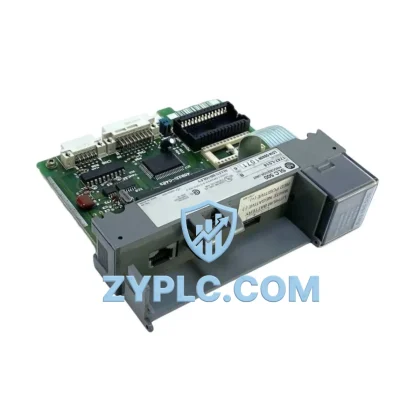
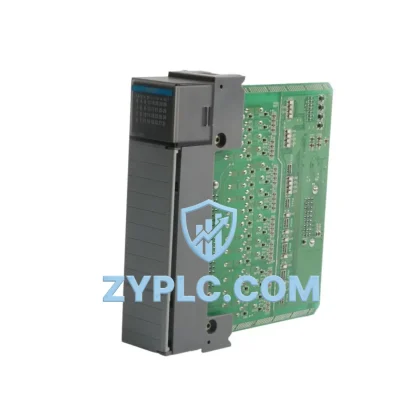
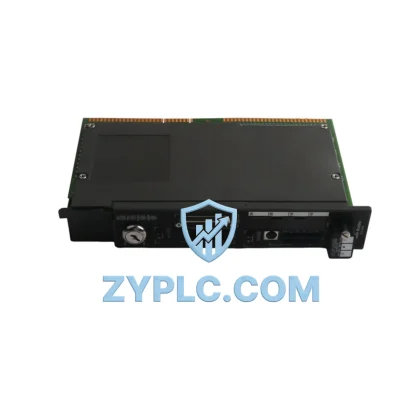
Siemens 6ES7417-4HL01-0AB0 System-Ready CPU for S7-400H Architecture: Control System Architecture and Upstream-Downstream Coordination
The Siemens 6ES7417-4HL01-0AB0 is a high-availability CPU module purpose-built for the SIMATIC S7-400H redundant controller platform. Within a layered industrial automation architecture, this CPU does not operate in isolation — it serves as the central processing node that coordinates signal acquisition from the I/O layer, executes deterministic control logic, manages peer-to-peer synchronization across redundant CPU pairs, and communicates upstream to SCADA and MES systems via industrial Ethernet and PROFIBUS networks. Understanding its role within the full control hierarchy is essential for engineers designing fault-tolerant systems in power generation, petrochemical processing, water treatment, and advanced manufacturing environments.
In a complete S7-400H system architecture, the 6ES7417-4HL01-0AB0 CPU is mounted on a UR2-H dual-rack backplane, which provides the physical and electrical foundation for redundant CPU pairing. The two CPUs communicate via fiber-optic synchronization cables, ensuring bumpless switchover in the event of a primary CPU fault. This architecture eliminates single points of failure at the controller level and is complemented by redundant power supply modules such as the PS 407 10A, which deliver uninterrupted 24 VDC and 5 VDC bus power to both racks simultaneously.
Architecture Specification Table
| Parameter |
Specification |
| System Role |
Redundant CPU — Primary / Standby Controller Node |
| Compatible Platform |
SIMATIC S7-400H Fault-Tolerant Controller System |
| CPU Model |
6ES7417-4HL01-0AB0 |
| Working Memory |
30 MB (code + data) |
| Processing Speed |
0.1 µs per binary instruction |
| Communication Interfaces |
MPI/DP (integrated), Industrial Ethernet (via CP modules) |
| PROFIBUS DP |
Integrated DP master/slave interface, up to 12 Mbit/s |
| Redundancy Synchronization |
Fiber-optic sync cable (6ES7960-1AA04-0XA0 compatible) |
| Rack Compatibility |
UR2-H Dual Rack (6ES7400-2JA00-0AA0) |
| Supply Voltage |
24 VDC (via backplane bus) |
| Operating Temperature |
0 °C to +60 °C |
| Protection Class |
IP20 |
| Mounting |
DIN rail / rack-mounted on S7-400 backplane |
| Country of Origin |
Germany |
| Warranty |
12-Month Warranty — Covered from date of shipment |
Coordinated Control System Design
The 6ES7417-4HL01-0AB0 achieves its full potential only when integrated within a coherent system architecture. At the I/O layer, distributed PROFIBUS DP slaves such as the ET 200M remote I/O station — populated with SM 321 digital input modules and SM 331 analog input modules — feed real-time process signals into the CPU’s execution cycle. These signals traverse the PROFIBUS DP network at up to 12 Mbit/s, ensuring low-latency data acquisition from field instruments including pressure transmitters, flow meters, and temperature sensors.
At the network layer, CP 443-1 Industrial Ethernet communication processors expand the CPU’s connectivity to plant-level SCADA systems and historian servers via PROFINET or standard TCP/IP protocols. For installations requiring PROFIBUS PA integration — common in hazardous area instrumentation — DP/PA Link modules bridge the high-speed DP backbone to the intrinsically safe PA segment, maintaining signal integrity across the full field device hierarchy.
The power layer is equally critical to system reliability. Redundant PS 407 power supply modules installed in both the primary and standby racks ensure that neither CPU experiences a power interruption during a supply module fault. The UR2-H backplane supports this dual-supply architecture natively, with automatic load sharing and fault isolation between the two power domains.
At the human-machine interface layer, SIMATIC TP1500 or MP377 HMI panels connect to the S7-400H system via Industrial Ethernet or MPI, providing operators with real-time process visualization, alarm management, and manual override capability. The HMI communicates with the active CPU transparently — following automatic switchover, the HMI reconnects to the new primary CPU without operator intervention, preserving display continuity during fault events.
At the execution layer, the CPU’s digital and analog outputs drive variable frequency drives, motorized valve actuators, and relay output modules such as the SM 322 DO 16×DC24V. For applications requiring high-speed output switching, the SM 322 DO 32×DC24V/0.5A module provides expanded channel density within the same rack footprint. Terminal modules from the ET 200S family further simplify field wiring by enabling hot-swap I/O replacement without interrupting the control loop — a critical capability in continuous process environments where planned shutdowns are costly.
Application in Layered Automation Systems
Power Generation and Utilities: In thermal power plants and combined-cycle facilities, the 6ES7417-4HL01-0AB0 manages turbine control sequences, boiler feedwater regulation, and grid synchronization interlocks. The redundant CPU architecture ensures that a single controller fault does not interrupt generation output, satisfying the high-availability requirements mandated by grid operators and plant safety standards.
Petrochemical and Refinery Processing: Continuous distillation columns, reactor temperature control loops, and compressor surge protection systems demand deterministic scan times and fault-tolerant execution. The S7-400H platform with the 6ES7417-4HL01-0AB0 CPU delivers sub-10ms cycle times for critical control loops while maintaining full redundancy across the controller, I/O, and network layers — meeting IEC 61511 functional safety requirements when paired with appropriate safety instrumented system components.
Water and Wastewater Treatment: Municipal water treatment facilities rely on uninterrupted pump sequencing, chemical dosing control, and effluent quality monitoring. The 6ES7417-4HL01-0AB0 supports long-duration continuous operation with its robust thermal design and extended MTBF rating, reducing the frequency of planned maintenance interventions in remote or unmanned pump stations.
Mining and Metals Processing: Conveyor belt management, crusher control, and flotation cell automation in mining operations benefit from the CPU’s high I/O channel capacity and PROFIBUS DP master capability, which supports large distributed I/O networks spanning hundreds of meters across open-pit or underground installations.
Packaging and Discrete Manufacturing: High-speed packaging lines and assembly systems require precise motion coordination and rapid fault response. The 6ES7417-4HL01-0AB0’s fast program execution and deterministic interrupt handling support synchronized multi-axis control when integrated with SINAMICS drive systems via PROFIBUS or PROFINET communication.
Architecture Engineering FAQ
Q1: Is the 6ES7417-4HL01-0AB0 compatible with existing S7-400 non-redundant racks, or does it require the UR2-H dual rack?
The 6ES7417-4HL01-0AB0 is specifically designed for the S7-400H redundant system and requires the UR2-H dual-rack backplane for proper redundant operation. While the physical form factor is compatible with standard S7-400 racks, the redundancy synchronization interfaces and H-system firmware are optimized for the UR2-H environment. For non-redundant S7-400 applications, alternative CPU 417 variants without the H-suffix designation are the appropriate selection. Engineers migrating from a standard S7-400 to an S7-400H architecture should plan for rack replacement and fiber-optic synchronization cable routing as part of the upgrade scope.
Q2: What communication modules are recommended for integrating the 6ES7417-4HL01-0AB0 into a PROFINET-based plant network?
For PROFINET IO integration, the CP 443-1 Advanced communication processor is the standard module for S7-400H systems. It supports PROFINET IO controller and device roles simultaneously, enabling the CPU to manage distributed PROFINET IO devices while also communicating with plant-level Ethernet infrastructure. For installations requiring both PROFIBUS DP and PROFINET connectivity, the CP 443-1 can be installed alongside the integrated DP interface, providing dual-network access without consuming additional CPU processing resources. Contextual Integration with existing plant networks is achievable without modifying the core CPU configuration.
Q3: What does the 12-Month Warranty cover, and how does it support long-term maintenance planning for installed S7-400H systems?
The 12-Month Warranty covers manufacturing defects, component failures, and functional non-conformance under normal operating conditions from the date of shipment. For S7-400H systems installed in critical infrastructure, this warranty period provides a defined assurance window during initial commissioning and early operation — the phase when latent defects are most likely to manifest. For long-term maintenance planning, we recommend maintaining a spare CPU module on-site to enable immediate hot-swap replacement in the event of a primary CPU fault, minimizing mean time to repair (MTTR) and preserving system availability commitments. Our team can advise on recommended spare parts lists and stocking strategies aligned with your plant’s maintenance philosophy.
© 2026 ZYPLC. All rights reserved.
Original Source: https://zyplc.com
Contact: +86 19859288691 | plc.sales@zyplc.com