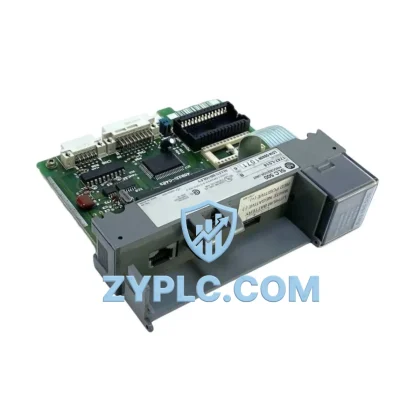
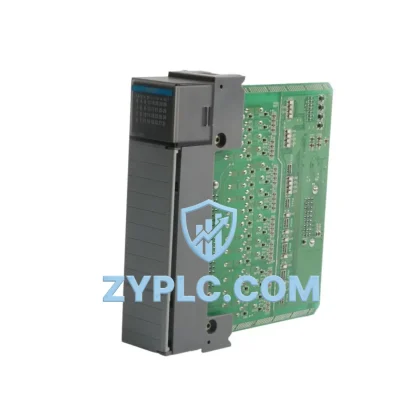
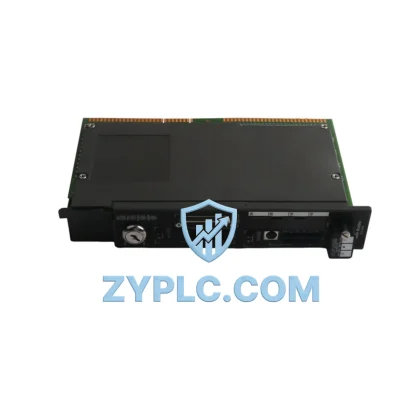
Siemens 6ES7960-1AA04-5AA0 System-Ready Sync Module for S7-400H Architecture: Control System Architecture and Upstream-Downstream Coordination
The Siemens 6ES7960-1AA04-5AA0 is a fiber-optic synchronization module purpose-built for the SIMATIC S7-400H high-availability redundant controller platform. Within a layered industrial automation architecture, this component occupies a critical position at the control layer, serving as the real-time communication bridge between the two redundant CPU subsystems. Its role is not merely passive signal transmission — it actively governs the synchronization state of the entire redundant control system, ensuring that both CPU racks maintain identical process images, output states, and program execution status at all times. This level of architectural coherence is what separates a truly fault-tolerant system from a simple backup arrangement.
In a complete S7-400H control architecture, the 6ES7960-1AA04-5AA0 operates in conjunction with a pair of S7-400H CPUs — typically the 6ES7414-4HM14-0AB0 or 6ES7417-4HT14-0AB0 — mounted in separate IM 460/461 expansion racks or dedicated H-system racks. The fiber-optic medium used by this sync module eliminates electromagnetic interference concerns that would otherwise compromise synchronization integrity in high-noise industrial environments such as power substations, steel mills, or petrochemical processing units. The optical path provides galvanic isolation between the two CPU subsystems, which is an essential safety and reliability requirement in these sectors.
From a system architecture perspective, the 6ES7960-1AA04-5AA0 enables the S7-400H platform to achieve bumpless switchover — a transition from the active CPU to the standby CPU that occurs within one bus cycle, typically under 100 milliseconds, without any detectable process disturbance. This capability is foundational for applications where even a momentary output interruption could trigger safety shutdowns, product loss, or equipment damage. Industries such as continuous chemical processing, offshore oil and gas, water treatment, and high-speed packaging lines depend on this level of control continuity.
The synchronization module integrates seamlessly into the broader I/O and network layers of the S7-400H system. On the I/O side, the redundant CPUs share access to distributed I/O nodes via PROFIBUS DP or PROFINET, using interface modules such as the IM 153-2 or IM 155-6 PN/2 for ET 200M and ET 200SP stations respectively. The sync module ensures that both CPUs maintain consistent I/O images across all connected field devices, including analog input modules for process variables, digital output modules for valve and actuator control, and safety I/O modules for SIL-rated interlocks. This consistency is what allows the standby CPU to assume control instantly without re-initializing field devices or losing process state.
At the network layer, the S7-400H system communicates with SCADA servers, historian systems, and HMI panels via Industrial Ethernet using the CP 443-1 Advanced communication processor. The 6ES7960-1AA04-5AA0 sync module does not directly participate in this network layer, but its reliable operation is a prerequisite for the redundant CPU pair to present a single, coherent control node to the network. Without proper synchronization, network-level redundancy protocols would be unable to determine which CPU holds the authoritative process state, leading to data inconsistency at the SCADA and MES levels.
The power layer of an S7-400H system typically employs redundant PS 407 power supply modules — such as the 6ES7407-0KA02-0AA0 — installed in both CPU racks. The sync module itself draws minimal power from the rack backplane, but its continuous operation depends on stable DC bus voltage from these power supplies. In critical installations, UPS systems are integrated at the cabinet level to ensure that both CPU racks and the sync module remain powered during mains supply interruptions, preserving the synchronization state and avoiding unnecessary switchover events.
For human-machine interface integration, the S7-400H system connects to SIMATIC WinCC or WinCC flexible SCADA platforms, as well as TP and MP series HMI panels. The sync module’s status — including synchronization state, fiber link quality, and switchover history — is accessible via the CPU diagnostic buffer and can be surfaced on HMI screens through standard S7 communication blocks. This visibility is essential for maintenance engineers who need to monitor system health and respond proactively to degraded synchronization conditions before they escalate to unplanned switchovers.
From a maintenance and lifecycle perspective, the 6ES7960-1AA04-5AA0 is designed for long-term deployment in industrial environments. Its fiber-optic connectors are rated for thousands of mating cycles, and the module itself carries Siemens’ standard industrial product quality assurance. ZYPLC supplies this module with a 12-Month Warranty covering manufacturing defects and functional failures, providing procurement and maintenance teams with the confidence needed for long-term spare parts planning. Contextual Integration support is available to assist engineers with system configuration, rack assignment, and fiber routing during commissioning.
In terms of inventory and supply chain considerations, the 6ES7960-1AA04-5AA0 is a strategic spare part for any facility operating S7-400H redundant systems. Given the criticality of the synchronization function, most reliability-focused maintenance programs specify a minimum of one spare sync module per installed system. ZYPLC maintains stock of this module to support both planned maintenance cycles and emergency replacement scenarios, with rapid dispatch capability to minimize system exposure time during maintenance windows.
Architecture Specification Table
| Parameter |
Specification |
| System Role |
Fiber-Optic Synchronization Module for S7-400H Redundant CPU Pair |
| Compatible Platform |
SIMATIC S7-400H High-Availability Controller |
| Communication Medium |
Fiber-Optic (Plastic Optical Fiber) |
| Synchronization Function |
Real-Time CPU-to-CPU Process Image Synchronization |
| Switchover Time |
< 1 PLC Scan Cycle (Bumpless Switchover) |
| Supply Voltage |
DC 5V via S7-400 Rack Backplane |
| Operating Temperature |
0°C to +60°C |
| Installation |
S7-400H CPU Rack, Dedicated Sync Module Slot |
| Protection Rating |
IP20 (Cabinet Installation) |
| Country of Origin |
Germany |
| Warranty |
12-Month Warranty (ZYPLC) |
| Contextual Integration |
Supported — Configuration and Commissioning Assistance Available |
Coordinated Control System Design
The 6ES7960-1AA04-5AA0 achieves its full architectural value only when deployed within a properly configured S7-400H system. The following components represent the typical coordination environment for this sync module:
The redundant CPU pair — commonly the 6ES7414-4HM14-0AB0 (CPU 414-4H) or 6ES7417-4HT14-0AB0 (CPU 417-4H) — forms the processing core of the H-system. Each CPU is installed in its own rack, and the sync module connects the two CPUs via fiber-optic cables, enabling the master-standby relationship. The 6ES7407-0KA02-0AA0 PS 407 10A power supply modules provide stable DC power to each rack independently, ensuring that a power fault in one rack does not propagate to the other.
Distributed I/O is connected via PROFIBUS DP using IM 153-2 interface modules for ET 200M stations, or via PROFINET using IM 155-6 PN/2 interface modules for ET 200SP stations. These interface modules support media redundancy, allowing the distributed I/O network itself to tolerate cable or switch failures without interrupting process control. The CP 443-1 Advanced communication processor handles Industrial Ethernet connectivity to the plant network, SCADA servers, and remote engineering stations.
At the field level, SM 321 digital input modules and SM 322 digital output modules handle discrete signals from sensors, limit switches, solenoid valves, and motor starters. SM 331 analog input modules process 4–20 mA signals from pressure transmitters, flow meters, and temperature sensors. For safety-critical applications, F-SM series fail-safe I/O modules are integrated to handle SIL 2/3 rated safety loops within the same rack architecture.
HMI integration is achieved through SIMATIC WinCC SCADA software or TP1200 Comfort panel connections, providing operators with real-time visibility into synchronization status, CPU switchover events, and system diagnostics. This complete ecosystem — from the sync module at the control layer through to the HMI at the operator layer — represents the full architectural context in which the 6ES7960-1AA04-5AA0 delivers its system-level value.
Application in Layered Automation Systems
The 6ES7960-1AA04-5AA0 sync module finds its most critical applications in industries where process continuity is a non-negotiable operational requirement. In power generation and distribution, S7-400H systems with this sync module control turbine governors, excitation systems, and switchgear automation, where a control system failure could result in grid instability or generation loss. The bumpless switchover capability ensures that protection and control functions remain active even during CPU maintenance or unexpected failures.
In petrochemical and refinery applications, the S7-400H platform controls distillation columns, reactor temperature loops, and compressor surge control systems. The sync module ensures that the redundant CPU pair maintains identical PID controller states, preventing process upsets during switchover events. This is particularly important in exothermic reaction control, where a momentary loss of output could lead to runaway conditions.
For water and wastewater treatment facilities, the S7-400H system with this sync module manages pump sequencing, chemical dosing, and filtration control across large geographic areas. The high-availability architecture ensures that treatment processes continue uninterrupted even during planned maintenance of individual system components. In mining and metallurgy, the sync module supports continuous casting control, ore processing automation, and conveyor system management, where production stoppages carry significant financial penalties.
Packaging and discrete manufacturing lines use the S7-400H platform for high-speed motion coordination and quality inspection integration. The sync module’s sub-cycle switchover time ensures that production lines do not require restart procedures following a CPU switchover, preserving production throughput and product quality consistency.
Architecture Engineering FAQ
Q1: Is the 6ES7960-1AA04-5AA0 compatible with all S7-400H CPU variants, and what fiber cable length is supported?
The 6ES7960-1AA04-5AA0 is designed for use with S7-400H series CPUs that support fiber-optic synchronization, including the CPU 412-3H, CPU 414-4H, and CPU 417-4H variants. The module uses plastic optical fiber (POF) cables, with a maximum supported cable length of 10 meters between the two CPU racks. For installations requiring greater separation between redundant racks — such as geographically separated control rooms — the 6ES7960-1AB04-5AA0 glass fiber variant should be specified instead. Always verify CPU firmware compatibility in the Siemens SIMATIC S7-400H system manual before installation.
Q2: How does the sync module behave during a switchover, and what diagnostic information is available to maintenance engineers?
During a switchover event, the 6ES7960-1AA04-5AA0 facilitates the transfer of master status from the active CPU to the standby CPU within one PLC scan cycle. The module itself does not initiate switchovers — this decision is made by the CPU firmware based on detected faults or manual operator commands. Diagnostic information, including synchronization state (synchronized, synchronizing, or not synchronized), fiber link quality, and switchover event timestamps, is stored in the CPU diagnostic buffer and accessible via STEP 7 or TIA Portal online diagnostics. This data can be integrated into WinCC SCADA displays for continuous monitoring. ZYPLC’s Contextual Integration support includes assistance with diagnostic block configuration during system commissioning.
Q3: What does the 12-Month Warranty cover, and how does ZYPLC support long-term spare parts availability for S7-400H systems?
The 12-Month Warranty provided by ZYPLC covers manufacturing defects and functional failures of the 6ES7960-1AA04-5AA0 module under normal operating conditions. This warranty period begins from the date of shipment and includes replacement or repair of defective units at no additional cost. For long-term spare parts planning, ZYPLC maintains dedicated stock of S7-400H system components, including sync modules, redundant CPUs, power supplies, and interface modules, to support both scheduled maintenance programs and emergency replacement requirements. Customers operating multiple S7-400H systems are encouraged to contact ZYPLC to discuss volume stocking agreements and priority dispatch arrangements.
© 2026 ZYPLC. All rights reserved.
Original Source: https://zyplc.com
Contact: +86 19859288691 | [email protected]