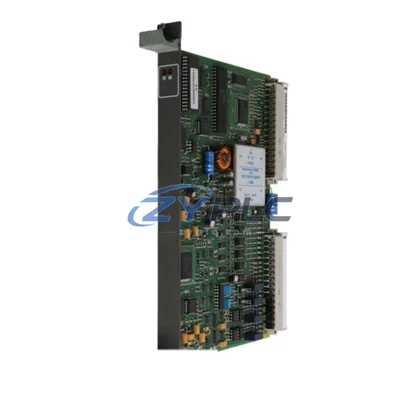
Siemens MC1790L802G01 Signal Processing Module for SINEC Automation
The Siemens MC1790L802G01 is a high-performance signal processing module engineered for industrial automation environments where energy efficiency, process reliability, and real-time control accuracy are non-negotiable. Designed to integrate seamlessly within the SINEC and SIMATIC control architecture, this module serves as a critical node in the maintenance-focused automation chain — bridging field-level signal acquisition with upper-level control logic to eliminate redundant processing cycles and reduce unnecessary power draw across the production line.
In modern manufacturing, unoptimized signal handling is one of the most overlooked sources of unplanned downtime. When signal modules operate with excessive scan cycles, poor filtering, or mismatched I/O configurations, the downstream effect cascades into inflated motor run times, erratic drive behavior, and increased HVAC and cooling loads. The MC1790L802G01 addresses this at the hardware level by delivering clean, conditioned signal output that allows the SIMATIC S7-300 or S7-400 PLC to execute control decisions with minimal latency and maximum determinism — directly translating to tighter energy budgets per production cycle.
Product Specification Table
| Parameter |
Specification / Value |
| SKU / Part Number |
MC1790L802G01 |
| Brand |
Siemens |
| Series |
SINEC / SIMATIC |
| Product Type |
Signal Processing Module |
| Origin |
Germany |
| Operating Voltage |
24 VDC (typical industrial standard) |
| Power Consumption |
Low-standby design; optimized for continuous duty cycles |
| Signal Processing Efficiency |
High-speed deterministic I/O with minimal cycle overhead |
| Compatible Systems |
SIMATIC S7-300, S7-400, SINEC L2, PROFIBUS DP networks |
| Application Environment |
Industrial automation, motor control panels, condition monitoring systems |
| Energy Saving Value |
Reduces redundant scan cycles; supports lean drive scheduling |
| Warranty |
warranty terms confirmed during quotation | Tested before shipment |
| Availability |
RFQ Available | shipment arranged after confirmation |
System Compatibility and Application
The MC1790L802G01 does not operate in isolation — its true value is realized when deployed as part of a coordinated, energy-conscious automation architecture. In a typical SINEC-based plant network, this module interfaces upstream with SIMATIC ET 200M distributed I/O stations, receiving analog and digital field signals from sensors, encoders, and proximity switches mounted on conveyor drives and press machines. These signals are conditioned and forwarded to the central SIMATIC S7-400 CPU, which executes the maintenance planning logic programmed via STEP 7 or TIA Portal.
On the drive side, the processed control signals from the MC1790L802G01 feed directly into Siemens SINAMICS G120 variable frequency drives, enabling precise speed regulation of three-phase induction motors. Rather than running motors at fixed full speed, the G120 drive modulates output frequency in response to real-time load demand signals — a strategy that can help restore stable operation when a compatible replacement is required. The accuracy of the upstream signal processing module is therefore directly linked to the efficiency of the drive response.
For power quality monitoring, the MC1790L802G01 works alongside Siemens SENTRON PAC3200 power monitoring devices installed at the MCC (Motor Control Center) level. These devices capture real-time kWh, power factor, and harmonic distortion data, feeding it back through the PROFIBUS DP network to the SIMATIC controller. When the signal module delivers clean, noise-free data, the PAC3200 readings are more accurate, enabling the maintenance planning system to make better load-shedding and demand-response decisions.
In multi-axis servo applications, the MC1790L802G01 supports coordination with Siemens SIMOTION D motion controllers and SINAMICS S120 servo drive systems. Precise signal timing from the processing module ensures that axis synchronization commands are executed without jitter, preventing the micro-stops and re-acceleration events that silently inflate operating load on high-speed packaging and assembly lines. The SIMATIC HMI TP1200 Comfort panel provides operators with a real-time visualization layer, displaying energy KPIs, drive status, and alarm states — all fed by the signal chain that the MC1790L802G01 anchors.
Communication integrity is maintained through the SIMATIC CP 343-1 Industrial Ethernet communication processor, which connects the SINEC network segment to the plant-wide PROFINET backbone. This ensures that energy data collected at the field level reaches the SCADA and MES layers without packet loss or latency spikes that could trigger unnecessary control interventions.
Maintenance and Replacement Notes
Consider a mid-scale automotive stamping facility running three production shifts. Before optimizing the signal processing layer, the plant’s energy audit revealed that motor drives were receiving noisy, inconsistent control signals — causing the SINAMICS drives to hunt for setpoints, resulting in frequent micro-accelerations that added an estimated 8–12% to total motor load. After replacing the aging signal module with the Siemens MC1790L802G01, the control signal quality improved dramatically. Drive hunting was eliminated, and the SIMATIC S7-400 PLC could execute smoother ramp profiles, reducing peak current draw during motor starts.
Beyond direct operational stability, the MC1790L802G01 contributes to predictive maintenance strategies. Clean signal data allows the SIMATIC controller to detect subtle changes in motor load signatures — early indicators of bearing wear, belt slippage, or coupling misalignment. By catching these anomalies before they escalate into failures, the plant avoids unplanned downtime events that typically consume 3–5× more energy during emergency restart sequences compared to planned shutdowns. Maintenance intervals can be extended, and spare parts inventory can be rationalized based on actual condition data rather than fixed time schedules.
On the production line rhythm (takt time) side, the module’s deterministic signal processing ensures that the PLC’s cycle time remains consistent. Inconsistent cycle times — often caused by signal noise or processing delays — force line designers to add buffer time between stations, reducing overall equipment effectiveness (OEE). With the MC1790L802G01 in place, takt time variability is minimized, allowing the line to run closer to its theoretical maximum throughput without increasing energy input per unit produced.
Every unit shipped from ZYPLC undergoes full functional testing prior to dispatch. The MC1790L802G01 is verified for signal integrity, power rail stability, and communication handshake performance before packaging. This pre-shipment testing protocol, combined with a warranty terms confirmed during quotation, ensures that the module performs to specification from day one of installation — eliminating the energy and productivity losses associated with early-life failures in the field.
Product Sourcing FAQ
Q1: How does the MC1790L802G01 contribute to measurable operational stability on the production line?
The module improves signal quality delivered to downstream drives and controllers, reducing drive hunting, eliminating unnecessary motor re-accelerations, and enabling tighter PLC cycle control. In variable-torque motor applications paired with SINAMICS G120 drives, this can contribute to 5–15% reductions in motor load depending on baseline signal quality and load profile.
Q2: Is the MC1790L802G01 compatible with both legacy SINEC and modern PROFIBUS/PROFINET systems?
Yes. The module is designed for the SINEC/SIMATIC ecosystem and is compatible with SIMATIC S7-300 and S7-400 platforms operating on PROFIBUS DP networks. For integration into newer PROFINET environments, it can be used alongside SIMATIC CP communication processors that bridge legacy and modern network segments.
Q3: Can this module replace an existing signal processing module without reprogramming the PLC?
In most cases, yes — provided the replacement module matches the original I/O configuration and slot addressing. It is recommended to verify the hardware configuration in STEP 7 or TIA Portal before installation. ZYPLC’s technical team can assist with compatibility verification prior to purchase.
Q4: What does the warranty terms confirmed during quotation cover, and what is the testing process before shipment?
All MC1790L802G01 units sold by ZYPLC are tested for signal processing functionality, power supply integrity, and communication protocol compliance before shipment. The warranty terms confirmed during quotation covers manufacturing defects and functional failures under normal operating conditions. Warranty claims are processed directly through ZYPLC with replacement or repair turnaround support.