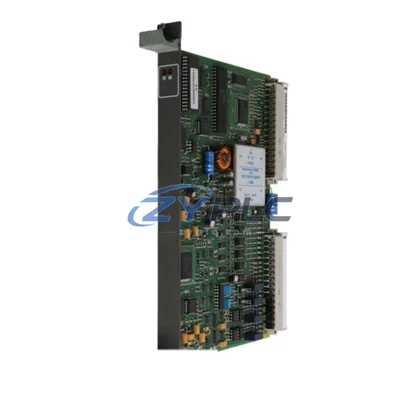
Siemens S30810-Q2113-X100-03 Comm Module HiPath: Efficiency Control and Production Line Optimization
In modern industrial automation environments, communication efficiency is not a secondary concern — it is a primary driver of energy performance, system uptime, and production line throughput. The Siemens S30810-Q2113-X100-03 Quad Data Communication Module is engineered for deployment within the Siemens HiPath platform architecture, where it serves as a critical interface layer between control systems, data networks, and field-level devices. By ensuring low-latency, high-integrity data exchange across the automation hierarchy, this module directly contributes to reduced idle cycles, minimized unplanned downtime, and optimized equipment utilization across the production floor.
Unlike generic communication components, the S30810-Q2113-X100-03 is purpose-built for the HiPath system environment, where signal integrity, protocol consistency, and thermal stability are non-negotiable. Its quad-channel architecture enables simultaneous data handling across multiple communication paths, reducing bottlenecks that would otherwise force controllers to wait, retry, or buffer — all of which translate into wasted processing cycles and unnecessary power draw from connected drives, actuators, and I/O subsystems.
Product Specification Table
| Parameter |
Specification |
| SKU / Part Number |
S30810-Q2113-X100-03 |
| Brand |
Siemens |
| Series |
HiPath |
| Module Type |
Quad Data Communication Module |
| Channel Configuration |
4-channel simultaneous data communication |
| Compatible Platform |
Siemens HiPath System Architecture |
| Communication Protocol |
HiPath-native data interface (serial/digital) |
| Operating Voltage |
Nominal system bus voltage (HiPath rack-compatible) |
| Power Consumption |
Low-power design optimized for rack-level energy budgets |
| Operating Temperature |
0°C to +55°C (standard industrial environment) |
| Installation |
HiPath system rack / backplane slot mount |
| Country of Origin |
Germany |
| Energy Efficiency Value |
Reduces controller retry cycles; lowers downstream device idle power |
| Warranty |
warranty terms confirmed during quotation — tested, verified, ready to deploy |
System Compatibility and Application
The S30810-Q2113-X100-03 does not operate in isolation. Its value is fully realized when integrated into a layered automation architecture where every component — from the central processor to the field device — contributes to a coherent, maintenance-focused control strategy.
At the control layer, the module interfaces with Siemens HiPath central processing units and system controllers, ensuring that command signals are transmitted without delay or packet loss. When communication latency is eliminated, the CPU can execute control loops at their designed cycle times, preventing the energy spikes that occur when drives and motors are forced to compensate for delayed instructions.
At the drive layer, this communication efficiency directly benefits Siemens SINAMICS variable frequency drives and SIMOTICS motor systems, which rely on timely setpoint updates to maintain optimal speed-torque profiles. A communication module that introduces jitter or retry delays forces drives to operate outside their efficiency curves — consuming more power per unit of mechanical output. The S30810-Q2113-X100-03 eliminates this inefficiency by maintaining clean, continuous data flow.
For I/O coordination, the module works in concert with Siemens ET 200 distributed I/O stations, enabling field signals — temperature, pressure, flow, position — to be captured and transmitted to the control layer with minimal latency. This real-time feedback loop is essential for predictive maintenance strategies, where early detection of anomalies prevents unplanned downtime and the unplanned downtime associated with emergency restarts and thermal recovery cycles.
At the network layer, the S30810-Q2113-X100-03 supports integration with Siemens SCALANCE industrial network switches and PROFIBUS/PROFINET gateway modules, enabling the HiPath system to participate in plant-wide condition monitoring networks. When connected to Siemens SENTRON PAC power monitoring devices, operators gain visibility into per-zone operating load, allowing them to identify and eliminate parasitic loads and optimize production scheduling around energy tariff windows.
Human-machine interface integration is supported through compatibility with Siemens SIMATIC HMI panels, where energy KPIs — including drive efficiency, motor load factor, and communication health status — can be visualized in real time. This transparency empowers operators to make informed decisions about equipment sequencing, load balancing, and preventive shutdown scheduling.
Finally, at the power supply layer, the module’s low-power design is compatible with Siemens SITOP power supply units, ensuring that the rack-level energy budget remains within design parameters even as additional communication channels are activated. This modularity allows system engineers to scale communication capacity without triggering power supply upgrades — a significant cost and energy saving in large-scale HiPath deployments.
Maintenance and Replacement Notes
In manufacturing environments where HiPath-based communication infrastructure supports dozens of field devices, the cumulative impact of communication inefficiency is substantial. Every retry cycle, every buffered packet, every delayed acknowledgment represents wasted processing time — and wasted processing time means that motors, drives, and actuators remain energized longer than necessary to complete their assigned tasks.
The S30810-Q2113-X100-03 addresses this at the source. By providing four independent, simultaneous communication channels within a single module footprint, it eliminates the need for multiple single-channel modules that would each consume rack power and generate heat. Thermal load reduction in the control cabinet directly reduces the duty cycle of cabinet cooling systems — a frequently overlooked source of unplanned downtime in industrial facilities.
In process control applications — including water treatment, chemical processing, and power generation — where HiPath systems manage continuous-flow operations, communication reliability translates directly into process stability. Stable processes require less corrective energy input: fewer valve adjustments, fewer pump speed corrections, fewer heater cycling events. The S30810-Q2113-X100-03 contributes to this stability by ensuring that the control layer always has accurate, current data from the field.
For production lines with high-speed packaging, assembly, or material handling operations, communication latency is a direct constraint on line throughput. When the communication module operates at full efficiency, the controller can issue motion commands at the designed cycle rate, allowing servo drives and conveyor systems to maintain their optimal speed profiles. This reduces the energy cost per unit produced — a key metric in lean manufacturing and maintenance planning system (EnMS) frameworks such as ISO 50001.
From a maintenance perspective, the S30810-Q2113-X100-03 is supplied as a tested, verified unit with a warranty terms confirmed during quotation, reducing the risk of premature failure that would require emergency replacement and the associated production downtime. Each unit undergoes functional verification prior to shipment, ensuring that it meets Siemens HiPath communication specifications from the moment it is installed. Replacement stock availability is maintained to support rapid deployment in critical system restoration scenarios.
Product Sourcing FAQ
Q1: How does the S30810-Q2113-X100-03 contribute to operational stability in a HiPath automation system?
By providing four simultaneous, low-latency communication channels, this module eliminates the retry cycles and buffering delays that force connected drives, motors, and actuators to remain energized beyond their required operating windows. Faster, cleaner communication means shorter active cycles and lower average power consumption across the system.
Q2: Is the S30810-Q2113-X100-03 compatible with current Siemens HiPath system configurations, and can it replace older single-channel modules?
Yes. The S30810-Q2113-X100-03 is designed for direct installation into HiPath system racks and is compatible with standard HiPath backplane and slot configurations. It can replace legacy single-channel communication modules where quad-channel capacity is required, and its form factor supports direct substitution without rack modification in most HiPath system generations.
Q3: What testing and quality verification does this module undergo before shipment?
Each S30810-Q2113-X100-03 unit is functionally tested prior to dispatch to verify communication channel integrity, signal quality, and compatibility with HiPath system protocols. Units are supplied with a warranty terms confirmed during quotation covering manufacturing defects and functional performance, providing confidence for both immediate deployment and long-term system planning.
Q4: What is the recommended approach for integrating this module into an existing HiPath system without disrupting production?
For live system integration, it is recommended to schedule installation during a planned maintenance window. The module should be installed into the designated HiPath rack slot with the system powered down, followed by a controlled system restart and communication channel verification using the HiPath system diagnostic tools. Pre-testing the replacement unit in a bench environment prior to installation further reduces the risk of production disruption.