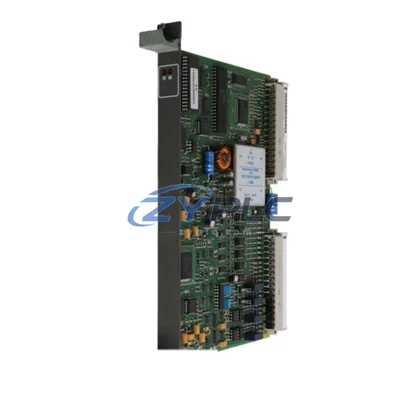
Woodward 5464-544 Remote Transceiver for MicroNet
The Woodward 5464-544 Remote Transceiver is a precision-engineered communication component designed to operate within the MicroNet distributed control platform. Rather than functioning as a standalone device, the 5464-544 is architected to serve as a critical signal relay node within a multi-layer industrial automation system — bridging the gap between the central processing layer and distributed I/O or remote terminal units across geographically separated control cabinets. Its role in maintaining signal fidelity, reducing latency, and supporting redundant communication paths makes it an indispensable element in high-availability turbine control, power generation, and process automation environments.
In a complete MicroNet control system architecture, the 5464-544 operates in close coordination with the MicroNet controller CPU module, which handles real-time processing and closed-loop control logic. The transceiver’s primary function is to extend the communication reach of the control backbone, enabling remote I/O racks and field devices to remain tightly synchronized with the central controller without signal degradation. This is particularly critical in applications where control cabinets are distributed across large industrial facilities such as gas turbine power plants, compressor stations, or combined heat and power installations.
From a system hierarchy perspective, the 5464-544 occupies the network layer, interfacing upward with the CPU and downward with analog and digital I/O modules mounted on MicroNet expansion racks. It supports the MicroNet backplane communication protocol, ensuring deterministic data exchange cycles that are essential for turbine speed governing, fuel control, and protective relay coordination. When paired with MicroNet analog input modules and digital output modules, the transceiver enables precise closed-loop feedback loops that govern actuator positioning, valve control, and generator synchronization sequences.
Redundancy is a core design consideration in any mission-critical control architecture, and the 5464-544 supports dual-redundant communication topologies. In redundant MicroNet configurations, two transceivers can be deployed in parallel — one active, one standby — with automatic failover logic managed by the MicroNet system controller. This eliminates single points of failure in the communication path and ensures uninterrupted control signal delivery even during module replacement or maintenance windows. The 5464-544 is therefore frequently specified alongside MicroNet redundancy modules and dual-channel power supply units to form a fully fault-tolerant control node.
Power layer integration is equally important. The 5464-544 draws regulated DC power from the MicroNet system power supply, which must be correctly sized to account for the cumulative load of all installed modules including CPU cards, I/O modules, communication gateways, and transceivers. Engineers specifying the 5464-544 should verify compatibility with the MicroNet 24VDC power distribution bus and confirm that the system power supply — such as the Woodward MicroNet power supply module — provides sufficient current headroom for full rack population. Proper power sequencing and grounding practices are essential to prevent transient-induced communication errors during system startup or load switching events.
At the human-machine interface layer, the 5464-544 supports integration with Woodward’s operator interface terminals and SCADA systems via the MicroNet communication gateway. Operators can monitor transceiver status, communication link quality, and diagnostic fault codes through the HMI, enabling proactive maintenance scheduling before communication degradation affects control performance. This visibility is especially valuable in remote or unmanned installations where on-site inspection is infrequent.
For execution layer devices — including servo actuators, electro-hydraulic valves, variable frequency drives, and protective relays — the 5464-544 ensures that control commands issued by the MicroNet CPU are transmitted with minimal jitter and maximum reliability. In turbine control applications, even microsecond-level communication delays can affect governor response and frequency regulation performance, making the transceiver’s signal integrity characteristics a critical engineering parameter.
From a long-term maintenance and lifecycle management perspective, the 5464-544 is designed for hot-swap replacement in compatible MicroNet rack configurations, minimizing planned outage duration during module exchange. Maintaining a spare 5464-544 in inventory is a widely recommended practice among MicroNet system operators, particularly for installations in remote locations where procurement lead times may be extended. ZYPLC maintains availability subject to RFQ confirmation of the 5464-544 with full functional testing and a, supporting both emergency replacement and planned maintenance programs.
Product Specification Table
| Parameter |
Specification |
| Part Number |
5464-544 |
| Brand |
Woodward |
| Series |
MicroNet |
| Product Type |
Remote Transceiver / Communication Module |
| System Role |
Network Layer Signal Relay — MicroNet Distributed Control Architecture |
| Communication Protocol |
MicroNet Backplane / Proprietary Serial Communication |
| Operating Voltage |
24VDC (Regulated, from MicroNet Power Supply) |
| Installation Environment |
Industrial Control Cabinet, DIN Rail or Rack-Mount Compatible |
| Operating Temperature |
0°C to +60°C (Typical Industrial Grade) |
| Redundancy Support |
Dual-Redundant Communication Path Compatible |
| system integration |
MicroNet CPU, I/O Modules, HMI Gateway, Power Supply |
| Warranty |
(ZYPLC availability subject to RFQ confirmation) |
| Condition |
New / Refurbished — Fully Tested |
| Origin |
USA |
System Compatibility Notes
The 5464-544 achieves its full performance potential when integrated within a complete MicroNet control system architecture. A typical MicroNet turbine control panel includes the MicroNet CPU module as the central processing unit, responsible for executing control algorithms, managing I/O scan cycles, and coordinating communication with remote nodes. The 5464-544 Remote Transceiver extends this communication reach to remote I/O racks populated with MicroNet analog input modules (for thermocouple, RTD, and 4-20mA signal conditioning), MicroNet digital input/output modules (for discrete valve position feedback and relay command outputs), and MicroNet speed input modules for magnetic pickup and proximity probe signal processing.
At the power layer, the MicroNet system power supply module provides regulated 24VDC to all rack-mounted components including the 5464-544. For high-availability installations, a redundant MicroNet power supply is installed in parallel, with automatic switchover ensuring uninterrupted module operation during power supply maintenance. The MicroNet backplane connects all modules within a rack, while the 5464-544 bridges communication between racks or between the main control cabinet and remote junction boxes.
Communication gateways within the MicroNet architecture — such as Modbus RTU/TCP gateway modules or Ethernet communication cards — allow the MicroNet system to interface with plant-level SCADA, DCS, or historian systems. The 5464-544 supports this integration by maintaining reliable low-level communication links that feed real-time data upward through the network hierarchy. At the HMI layer, Woodward operator interface panels display system status, alarm conditions, and transceiver diagnostic information, enabling operators to identify communication faults before they escalate to control system trips.
For execution layer coordination, the MicroNet system — with the 5464-544 as a key communication node — drives servo actuators, electro-hydraulic fuel control valves, inlet guide vane actuators, and generator excitation systems. The deterministic communication cycle supported by the 5464-544 ensures that actuator commands are delivered within the control system’s required response time, maintaining governor stability and protective relay coordination across the full operating range of the turbine or generator set.
Industrial Application Notes
The Woodward 5464-544 Remote Transceiver is deployed across a wide range of industrial automation sectors where MicroNet-based control systems are the platform of choice. In power generation facilities — including gas turbine power plants, steam turbine installations, and combined cycle plants — the 5464-544 serves as the communication backbone between the turbine control panel and remote terminal units monitoring exhaust temperatures, bearing vibrations, and lube oil pressures. Its ability to maintain signal integrity over extended cable runs makes it particularly valuable in large power station layouts where control rooms are physically separated from turbine halls.
In oil and gas processing facilities, the 5464-544 supports MicroNet-based compressor control systems where reliable communication between the CPU and remote I/O racks is essential for surge protection, anti-surge valve control, and process variable monitoring. Petrochemical plants and LNG terminals rely on the MicroNet platform’s deterministic communication architecture — anchored by components like the 5464-544 — to meet the stringent safety integrity requirements of SIL-rated control applications.
Water treatment and pumping stations utilize MicroNet systems for pump sequencing, flow control, and remote monitoring of distributed pump stations. The 5464-544 enables communication between the central control room and remote pump station panels, supporting SCADA integration and automated fault response. In mining and mineral processing operations, MicroNet-based drive control systems use the 5464-544 to coordinate communication between crusher drive controllers, conveyor drive panels, and the central process control system, ensuring synchronized operation across the production line.
Packaging and discrete manufacturing lines also benefit from the MicroNet platform’s modular architecture, with the 5464-544 supporting communication between machine-level controllers and plant-level MES or ERP systems. The transceiver’s robust industrial design — rated for continuous operation in high-vibration, high-temperature control cabinet environments — ensures reliable performance across the full production cycle without requiring frequent recalibration or replacement.
Product Compatibility FAQ
Q1: Is the Woodward 5464-544 compatible with all MicroNet system configurations, and are there any firmware or hardware revision requirements?
The 5464-544 is designed for use within the Woodward MicroNet distributed control platform. Compatibility with specific MicroNet system configurations — including MicroNet Plus, MicroNet TMR, and MicroNet Simplex variants — should be verified against the system’s hardware revision level and firmware version. ZYPLC’s technical team can assist with compatibility verification based on your existing system’s part number matrix and rack configuration documentation. All units supplied by ZYPLC are tested for functional integrity prior to shipment and covered by a
Q2: Can the 5464-544 be installed in a redundant communication architecture, and what additional components are required?
Yes, the 5464-544 supports deployment in redundant MicroNet communication architectures. A typical redundant configuration requires two 5464-544 units installed in designated primary and secondary transceiver slots, along with a compatible MicroNet redundancy management module that handles automatic failover logic. The system power supply must be sized to support the combined load of both transceivers plus all other rack-mounted modules. ZYPLC can supply matched pairs of 5464-544 units with verified serial number traceability for redundant system builds.
Q3: What is the recommended maintenance interval for the 5464-544, and how does the support long-term system reliability?
Woodward MicroNet communication modules including the 5464-544 are designed for continuous industrial service with minimal scheduled maintenance requirements. Recommended maintenance activities include periodic inspection of connector integrity, verification of communication link status via the HMI diagnostic display, and functional testing during planned outage windows. ZYPLC’s covers manufacturing defects and functional failures identified during normal operating conditions, providing assurance for both emergency replacement scenarios and planned maintenance programs. Extended warranty and exchange program options are available upon request.
—