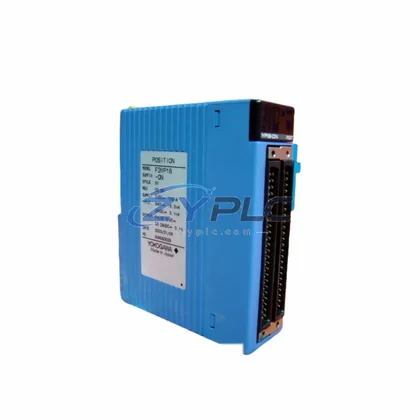
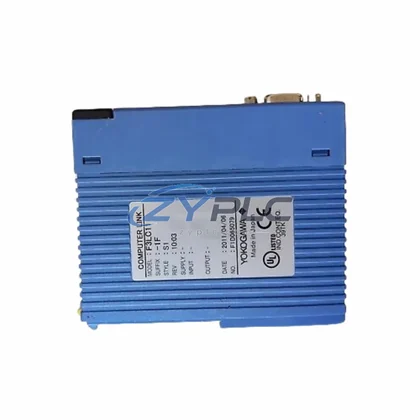
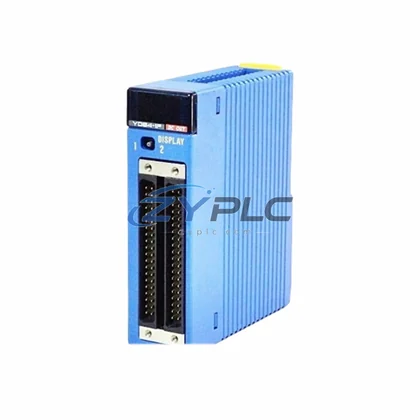
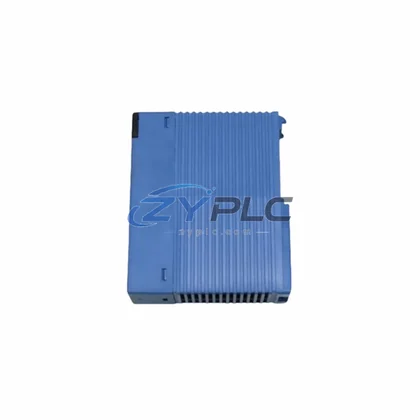
The Yokogawa AIP532 S1 is a high-integrity analog input module purpose-built for deployment within the ProSafe-RS Safety Instrumented System (SIS) platform. In modern industrial automation, no module operates in isolation — every component must be evaluated in the context of the full control system architecture. The AIP532 S1 is designed precisely for this reality: it functions as a critical signal acquisition node within a layered safety and process control hierarchy, enabling seamless data flow from field instrumentation through to the safety logic solver and supervisory control layers.
Within a complete ProSafe-RS architecture, the AIP532 S1 occupies the I/O layer, receiving 4–20 mA analog signals from field transmitters — pressure, temperature, flow, and level instruments — and converting them into digital values for processing by the ProSafe-RS Safety Control Unit (SCU). This signal path is fundamental to SIL-2 certified loop integrity, and the AIP532 S1 is engineered to maintain that integrity under demanding industrial conditions including electrical noise, vibration, and wide ambient temperature ranges.
Product Specification Table
| Parameter |
Specification |
| System Role |
Analog Input Module — I/O Layer, ProSafe-RS SIS |
| Compatible Platform |
Yokogawa ProSafe-RS Safety Instrumented System |
| Input Signal Type |
4–20 mA DC analog (HART-compatible) |
| Number of Channels |
8 channels (isolated) |
| SIL Certification |
SIL 2 (IEC 61508) |
| Electrical Isolation |
Channel-to-channel and channel-to-bus isolation |
| Power Supply |
Supplied via ProSafe-RS backplane bus |
| Communication Interface |
Internal ProSafe-RS I/O bus |
| Operating Temperature |
0°C to +60°C |
| Mounting |
ProSafe-RS I/O chassis / rack-mount backplane |
| Diagnostics |
Online self-diagnostics, fault detection per channel |
| Warranty |
warranty terms confirmed during quotation — Tested, verified, ready for deployment |
System Compatibility Notes
The AIP532 S1 achieves its full value only when understood as part of a coordinated system architecture. In a typical ProSafe-RS installation, the module is mounted on a ProSafe-RS I/O Chassis (e.g., the ANB10S backplane), which provides the physical and electrical bus connection to the ProSafe-RS Safety Control Unit (SCU) — the logic solver responsible for executing the safety application program. The SCU communicates upstream with the Yokogawa CENTUM VP Distributed Control System (DCS) via the Vnet/IP control network, enabling integrated process and safety supervision from a unified engineering environment.
On the field side, the AIP532 S1 receives signals from HART-compatible field transmitters, including Yokogawa’s own EJA110E differential pressure transmitter and YTA710 temperature transmitter, both of which are commonly deployed in SIL-rated measurement loops. The analog signals are conditioned and digitized within the module, then passed to the SCU for safety function evaluation in accordance with the configured cause-and-effect matrix.
For power distribution, the ProSafe-RS architecture relies on redundant Yokogawa PW481 Power Supply Modules, which feed the I/O chassis and ensure uninterrupted operation even during single power supply failure — a critical requirement in safety-critical applications. Redundant power architecture is a standard design practice in SIS installations serving oil and gas, chemical, and power generation facilities.
Network-layer integration is handled through the Yokogawa ALR111 Vnet/IP Communication Module, which bridges the ProSafe-RS safety domain with the plant-wide CENTUM VP control network. This enables the safety system to share process data with the DCS historian, alarm management system, and operator HMI stations — including the Yokogawa HIS (Human Interface Station) running CENTUM VP — without compromising the independence of the safety function.
In redundant SIS architectures, the AIP532 S1 may be deployed in a 1oo2 or 2oo3 voting configuration alongside additional analog input modules, with the SCU performing the voting logic. This redundancy model is particularly common in high-demand safety loops such as emergency shutdown (ESD) systems, burner management systems (BMS), and high-integrity pressure protection systems (HIPPS). Terminal modules such as the Yokogawa TB series field terminal blocks provide the physical wiring interface between field cables and the I/O module, simplifying installation and enabling hot-swap maintenance without loop interruption.
Industrial Application Notes
The AIP532 S1 is deployed across a wide range of process industries where functional safety and system reliability are non-negotiable. In oil and gas upstream and midstream facilities, it serves as the primary analog input interface for wellhead pressure monitoring, pipeline ESD systems, and compressor protection loops. In petrochemical and refinery applications, it supports reactor temperature monitoring, distillation column pressure control, and fired heater safety systems — all requiring SIL-2 certified measurement integrity.
In power generation plants — including thermal, combined-cycle, and nuclear auxiliary systems — the AIP532 S1 integrates into turbine protection and boiler safety systems, where analog signal accuracy and diagnostic transparency are essential for regulatory compliance. Water and wastewater treatment facilities use the module in pump protection, chemical dosing control, and overflow prevention systems, benefiting from its robust self-diagnostic capability that reduces unplanned downtime.
In mining and metallurgical operations, the AIP532 S1 supports conveyor load monitoring, crusher protection, and smelter process control — environments characterized by high electrical noise and mechanical vibration, conditions the module is rated to withstand. Pharmaceutical and food processing facilities deploy it in clean-room compatible control panels where precise analog measurement and full audit traceability are required for GMP compliance.
Across all these applications, the AIP532 S1 contributes to system-level goals: reducing mean time to repair (MTTR) through online diagnostics, extending system lifecycle through backward compatibility with existing ProSafe-RS infrastructure, and supporting long-term maintenance planning through stable spare parts availability backed by a warranty terms confirmed during quotation.
Product Compatibility FAQ
Q1: Is the AIP532 S1 compatible with both new ProSafe-RS installations and existing legacy systems?
The AIP532 S1 is designed for full compatibility with the ProSafe-RS platform across multiple hardware generations. It mounts directly onto standard ProSafe-RS I/O chassis backplanes and is recognized by the ProSafe-RS Engineering Environment (SENG) without requiring firmware modifications. For legacy installations, compatibility should be verified against the specific SCU firmware version and chassis revision in use. Our technical team can assist with compatibility confirmation prior to procurement.
Q2: How does the AIP532 S1 support redundant architecture design and SIL-2 loop integrity?
The AIP532 S1 supports redundant I/O configurations when paired with a redundant SCU and appropriate voting logic configured in the safety application. Each channel includes independent diagnostics that detect open-circuit, short-circuit, and out-of-range conditions, reporting faults to the SCU for safe-state activation. In 1oo2D or 2oo3 architectures, multiple AIP532 S1 modules can be assigned to the same safety function, with the SCU performing the required voting. This design meets IEC 61508 SIL-2 requirements for both hardware fault tolerance and diagnostic coverage.
Q3: What does the warranty terms confirmed during quotation cover, and how is long-term maintenance supported?
Every AIP532 S1 supplied by ZYPLC is covered by a warranty terms confirmed during quotation against manufacturing defects and functional failure under normal operating conditions. Prior to shipment, each unit undergoes functional testing and verification. For long-term maintenance, we recommend maintaining a defined spare parts inventory of AIP532 S1 modules proportional to the number of installed units — typically one spare per ten installed modules for critical SIS applications. Our team provides ongoing technical support for installation, commissioning, and troubleshooting throughout the warranty period and beyond.