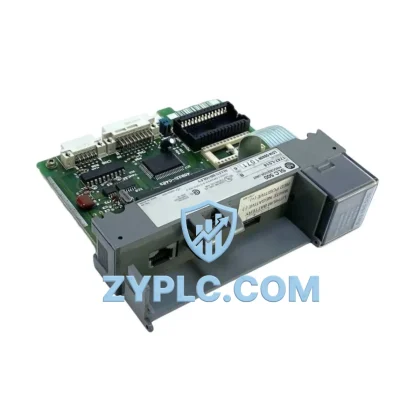
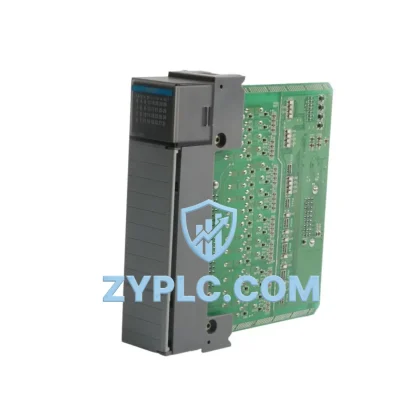
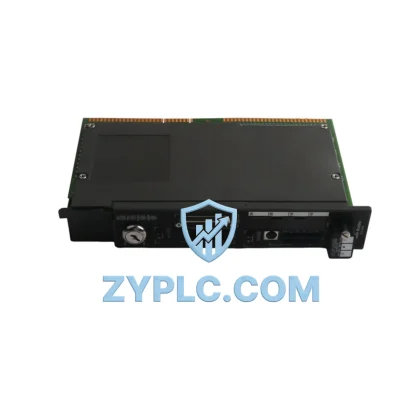
Yokogawa CP461-50 S2 System-Ready Processor for CS 3000 Architecture
The Yokogawa CP461-50 S2 is a high-performance DCS processor module engineered for deployment within the CENTUM CS 3000 distributed control system platform. As the computational core of the field control station (FCS), this processor module governs real-time scan cycles, inter-module communication, and control algorithm execution across the entire station architecture. Its role is not peripheral — it sits at the intersection of every control layer, coordinating signal flow from field instruments through I/O modules, across the control network, and up to the operator interface. Understanding the CP461-50 S2 means understanding how a well-structured automation system holds together under continuous industrial load.
In a layered automation architecture, the processor module defines the ceiling of system performance. The CP461-50 S2 supports high-speed scan execution with deterministic cycle times, making it suitable for process-critical applications where timing consistency directly affects product quality and equipment safety. It interfaces natively with the CENTUM CS 3000 V-net communication bus, enabling seamless data exchange with engineering workstations, historian servers, and operator stations running the HIS (Human Interface Station). This tight integration between the processor and the supervisory layer eliminates latency bottlenecks that commonly degrade system responsiveness in legacy DCS configurations.
Architecture Specification Table
| Parameter |
Specification |
| System Role |
Field Control Station (FCS) Processor Module |
| Compatible Platform |
Yokogawa CENTUM CS 3000 |
| SKU / Part Number |
CP461-50 S2 |
| Module Type |
DCS Processor Module |
| Communication Bus |
V-net (Vnet/IP compatible architecture) |
| Control Execution |
Real-time deterministic scan cycle |
| Redundancy Support |
Dual-redundant processor configuration supported |
| Installation Environment |
Industrial control cabinet, DIN rail or rack-mount FCS chassis |
| Origin |
Japan |
| Contextual Integration |
Native CENTUM CS 3000 architecture compatibility |
| Warranty |
12-Month Warranty (tested before shipment) |
| Availability |
In stock — ready for global dispatch |
Coordinated Control System Design
The CP461-50 S2 does not operate in isolation. Its value is realized through its coordination with every adjacent layer of the CENTUM CS 3000 architecture. At the I/O layer, the processor communicates directly with analog input modules such as the AAI141-S and AAI543-H, as well as digital I/O modules including the ADV151-P50 and ADO141-P50, all mounted within the same FCS node unit. These modules feed real-time process values — temperature, pressure, flow, valve position — into the processor’s control algorithms, which then generate output commands back through the I/O bus within a single scan cycle.
At the power layer, the CP461-50 S2 relies on stable DC supply from the PW481 or PW482 power supply modules installed in the same FCS chassis. Power redundancy is a standard design consideration in high-availability plants, and the CS 3000 architecture supports dual power feeds to the processor node, ensuring that a single power supply failure does not interrupt control execution. This is particularly important in continuous process industries such as petrochemicals, LNG terminals, and power generation, where unplanned shutdowns carry significant financial and safety consequences.
At the network layer, the CP461-50 S2 connects to the plant-wide V-net control bus, which links multiple FCS nodes, the engineering workstation (EWS), and the HIS operator stations. The V-net architecture supports deterministic token-passing communication, which guarantees that each FCS node — including those running CP461-50 S2 processors — receives its communication slot within a fixed time window. This predictability is essential for coordinated multi-loop control strategies, where timing mismatches between stations can cause process upsets.
For redundancy-critical applications, the CP461-50 S2 can be configured in a dual-redundant pair. In this configuration, a standby processor module mirrors the active module’s memory state in real time. If the active processor detects a fault, the standby assumes control within milliseconds — transparent to the field devices and operator displays. This bumpless transfer capability is a defining feature of the CENTUM CS 3000 platform and is fully supported by the CP461-50 S2 hardware design.
At the human interface layer, operator stations running the CENTUM CS 3000 HIS software receive live process data from the CP461-50 S2 via the V-net bus. Alarm management, trend displays, and control faceplate interactions are all driven by data that originates in the processor’s scan cycle. The integrity of this data path — from field sensor through I/O module, through the CP461-50 S2, across V-net, and onto the HIS display — determines the quality of operator decision-making in real production environments.
Application in Layered Automation Systems
The CP461-50 S2 has been deployed across a wide range of process industries where the CENTUM CS 3000 platform was selected as the primary DCS. In refinery and petrochemical applications, the processor manages multi-loop regulatory control for distillation columns, heat exchangers, and reactor systems, where scan cycle consistency directly affects product yield and energy consumption. In power generation facilities — including coal-fired, gas turbine, and combined-cycle plants — the CP461-50 S2 coordinates boiler control, turbine sequencing, and auxiliary system management within a unified FCS architecture.
In water and wastewater treatment plants, the processor supports SCADA-integrated control of pumping stations, chemical dosing systems, and filtration processes. Its ability to handle both analog PID loops and discrete sequence logic within a single FCS node reduces the need for separate PLC subsystems, simplifying the overall control architecture and reducing maintenance overhead. In mining and mineral processing operations, the CP461-50 S2 manages crusher control, conveyor sequencing, and flotation cell regulation — applications that demand high I/O density and reliable communication with remote field stations.
In pharmaceutical and food processing environments, where batch control and recipe management are critical, the CP461-50 S2 supports structured batch execution in compliance with ISA-88 principles when integrated with the appropriate CENTUM CS 3000 batch management software. The processor’s deterministic execution model ensures that batch phase transitions occur at precisely the right moment, reducing variability between production runs and supporting regulatory compliance documentation.
For system integrators and plant engineers managing aging CENTUM CS 3000 installations, the CP461-50 S2 represents a direct replacement path for failed or end-of-life processor modules. Its compatibility with existing FCS chassis, I/O modules, and V-net infrastructure means that a processor swap can be completed without rewiring, reconfiguring the network, or modifying the control database — minimizing downtime and engineering cost during maintenance windows.
Architecture Engineering FAQ
Q1: Is the CP461-50 S2 compatible with existing CENTUM CS 3000 FCS chassis and I/O modules?
Yes. The CP461-50 S2 is designed for direct installation into standard CENTUM CS 3000 FCS node units. It is compatible with the full range of CS 3000 I/O modules — including analog input/output, digital input/output, and pulse input types — without requiring chassis modification or I/O reconfiguration. This makes it a reliable replacement option for plants maintaining existing CS 3000 infrastructure.
Q2: Can the CP461-50 S2 be configured for redundant operation, and what does the switchover process involve?
Yes. The CP461-50 S2 supports dual-redundant processor configuration within the CENTUM CS 3000 architecture. In a redundant pair, the standby module continuously synchronizes with the active module’s control memory. Upon detection of a processor fault, the standby assumes active control with bumpless transfer — no process upset, no operator intervention required. Redundancy configuration is managed through the CS 3000 engineering workstation and does not require hardware modification beyond installing the second processor module in the designated redundant slot.
Q3: What warranty and pre-shipment testing does ZYPLC provide for the CP461-50 S2?
Every CP461-50 S2 unit supplied by ZYPLC is covered by a 12-Month Warranty from the date of shipment. Prior to dispatch, each module undergoes functional testing to verify processor initialization, communication bus response, and I/O interface integrity. Units are shipped in anti-static protective packaging with inspection documentation. For urgent plant maintenance requirements, expedited shipping options are available. Contact ZYPLC at plc.sales@zyplc.com or +86 19859288691 for availability confirmation and lead time.
© 2026 ZYPLC. All rights reserved.
Original Source: https://zyplc.com
Contact: +86 19859288691 | plc.sales@zyplc.com