
ZYPLC Blog
Emerson KJ3204X1-BA1 Spares: DeltaV Digital Output Evidence Before a Process Stop
A DeltaV digital output failure can stop a pump, block a permissive, or leave a valve command uncertain while the controller itself appears healthy. Emerson KJ3204X1-BA1 must be matched to the carrier, terminal block, output type, field load, redundancy, configuration, and process acceptance record. ZYPLC readers need a DCS output-spare method that distinguishes the module […]
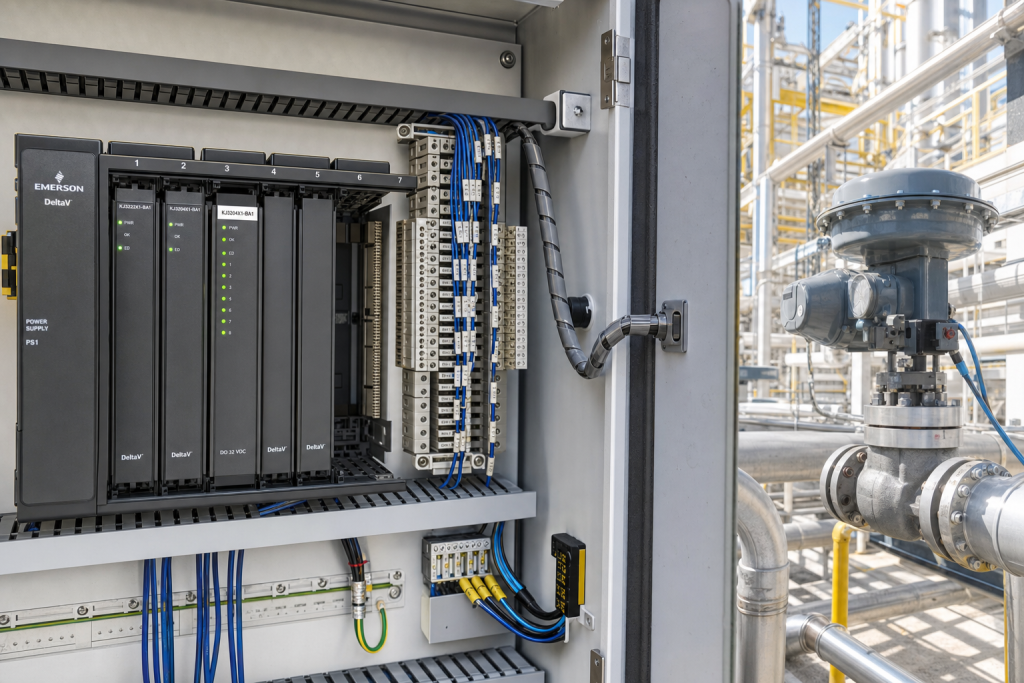
A DeltaV digital output failure can stop a pump, block a permissive, or leave a valve command uncertain while the controller itself appears healthy. Emerson KJ3204X1-BA1 must be matched to the carrier, terminal block, output type, field load, redundancy, configuration, and process acceptance record.
ZYPLC readers need a DCS output-spare method that distinguishes the module from the field device and the I/O carrier around it. The commercial match is only the first part of a safe process recovery decision.
Record the DeltaV output chain
Capture controller and carrier, module label, slot, terminal block, output type, commons, field voltage, load, fuse, solenoid or motor role, redundancy, configuration, and process consequence.
The live Emerson KJ3204X1-BA1 reference is a catalog match for an RFQ. Compare the installed module, carrier, terminal block, output type, load, and slot before approval.
Photograph module and carrier labels, terminal block, fuses, field wiring, status indicators, cabinet, and the controlled device served by the output.
Do not confuse a healthy output card with a healthy field command
The output module may be correct while the terminal block, fuse, solenoid, actuator, field cable, interlock, or configuration remains the cause of the stop. Preserve diagnostics and point-state evidence before replacement.
The related Emerson KJ3208X1-BA1 output reference shows why similar DeltaV output modules must be separated by carrier, terminal, signal, and approved use.
Request exact, tested exchange, repair, substitute, and engineering-review options separately, with actual-item photos, output test scope, carrier compatibility, condition, warranty, and dispatch timing.
Acceptance must prove the commanded state
After replacement, verify carrier recognition, output state, terminal voltage, load response, field device movement, interlocks, alarms, redundancy, bypass removal, and approved process testing.
Mark the item exact, carrier check pending, bench-tested, substitute, or engineering review required.
Keep labels, slot and point map, field wiring, diagnostics, output measurements, process response, and final controls approval together.
Make the DCS spare decision traceable
Store the module with its carrier and terminal-block information. A DeltaV output part without the surrounding identity can create an avoidable outage delay.
Keep a direct replacement, repaired exchange, and substitute option on separate RFQ lines. They have different configuration and validation implications.
Receiving inspection should verify the actual label, terminal condition, connector, test report, included hardware, and output test scope.
Before the shutdown, confirm the DeltaV configuration backup, point list, test equipment, field-device isolation plan, and named process approver.
The strongest spare record starts with the installed function rather than the supplier description. State what the item does, where it is mounted, what it connects to, and what production, safety, motion, measurement, or monitoring decision depends on it. This lets engineering, stores, and procurement work from the same evidence.
Keep an exact replacement, a repair exchange, a refurbished bench item, a possible substitute, and a migration candidate as separate options. They do not carry the same approval burden. A direct spare may fit a short outage window; a substitute may require wiring changes, firmware review, parameter work, software restoration, validation, or a controlled production trial.
The live product references in this article are catalog matches, not permission to skip engineering checks. Compare the candidate with the installed label, revision, connector view, power information, configuration, accessory scope, and environmental requirement. If one detail is unknown, record it as an open question instead of silently assuming compatibility.
Receiving inspection should repeat the evidence used for the RFQ. Photograph the received label, packaging, connectors, terminals, mounting features, condition, and included accessories. Record what was checked and what remains unknown. An item that looks clean is not automatically field-ready, and an item that powers up is not automatically accepted by the installed function.
Review the spare before the maintenance window, not only after a failure. Confirm that the item is physically present, the accessory scope is complete, the backup or configuration path is available, the test equipment is ready, and the decision owner is still named. If the item is stored at another location, confirm transport time and release authority.
A good quotation response mirrors the plant record. It states the exact model, actual condition, test scope, included hardware, warranty, dispatch timing, and unresolved compatibility questions. Avoid a quote that quietly combines an exact part, an exchange repair, and a possible substitute under one generic compatible heading.
Before the maintenance window, confirm the approved isolation and test method. For control and I/O hardware, that may include a controlled dry run; for instrumentation and monitoring, it may include calibration or baseline comparison; for networks and generators, it may include a staged functional test. The acceptance method should be named before the part is ordered.
Finally, assign ownership for each decision. Procurement can verify identity and commercial terms; stores can verify packaging and label; maintenance can verify installation; and the responsible controls, safety, motion, reliability, instrumentation, or network engineer can approve functional recovery.
FAQ
What must match on a KJ3204X1-BA1 spare?
Match DeltaV carrier, slot, terminal block, output type, commons, voltage, load, configuration, redundancy, and process role.
Can KJ3208X1-BA1 be treated as an automatic substitute?
No. Carrier, terminal, output specification, load, configuration, and controls approval must be checked.
What should the RFQ include?
Send module and carrier labels, point map, terminal and load photos, diagnostics, condition, test scope, and deadline.
What proves DeltaV output recovery?
Carrier recognition, correct output state, terminal voltage, load response, field movement, interlocks, alarms, and approved process testing.
Send ZYPLC the DeltaV module, carrier, and terminal labels, point map, load and wiring photos, condition requirement, and shutdown deadline. We can help prepare a traceable Emerson output-spare RFQ.
© 2026 ZYPLC. All rights reserved. Official Website: https://zyplc.com Inquiry: sales@zyplc.com | WhatsApp/Tel: +86 18359293191
Continue reading
Related sourcing guides
 Oct 7, 2026
CENTUM CS 3000 Spares: Verify CPU and Analog Output Evidence
How to validate Yokogawa CENTUM CS 3000 CPU and analog output spares, configuration backups and loop evidence before a DCS outage.
 Sep 28, 2026
DeltaV Analog Input Faults: Trace the Loop Before Replacing the Card
Separate transmitter, wiring, termination, channel and configuration causes in a DeltaV analog input fault before selecting a replacement module.