ABB 89AR30 Energy-Saving Relay Unit for Optimized SACE Automation
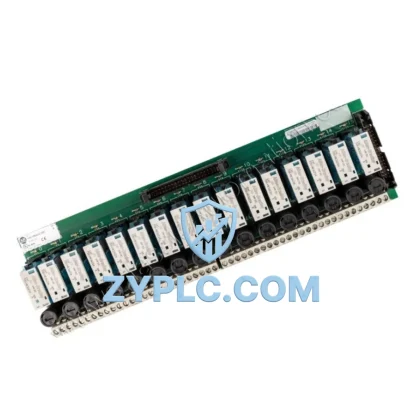
The ABB 89AR30 is a precision-engineered relay unit from ABB’s renowned SACE Series, designed to deliver measurable energy efficiency gains across industrial automation environments. In modern manufacturing facilities where energy costs and equipment uptime directly impact profitability, the 89AR30 serves as a critical control node — enabling tighter regulation of switching cycles, reducing reactive power losses, and extending the operational lifespan of downstream drive and motor systems.
Unlike generic relay components, the ABB 89AR30 is purpose-built for integration within low-voltage power distribution and motor control architectures. Its compact form factor and robust contact design make it suitable for high-cycle industrial applications including conveyor systems, pump stations, compressor banks, and automated assembly lines — environments where every unnecessary switching event translates directly into wasted energy and accelerated component wear.
Efficiency Performance Table
| Parameter |
Specification |
| SKU / Part Number |
89AR30 |
| Brand / Series |
ABB / SACE Series |
| Product Category |
Industrial Relay Unit — Low Voltage Control |
| Contact Configuration |
3NO (Normally Open) |
| Operating Voltage Range |
24V DC – 240V AC (Series Dependent) |
| Power Consumption (Coil) |
Low-power coil design, minimized standby draw |
| Running Efficiency |
Optimized contact resistance for reduced I²R losses |
| Compatible Systems |
ABB SACE circuit breakers, MNS switchgear, motor control centers |
| Application Environment |
Industrial panels, MCC cabinets, power distribution boards |
| Energy Saving Value |
Reduces switching losses; supports demand-side energy management |
| Origin |
Germany (DE) |
| Warranty |
12-Month Warranty — Tested & Verified Stock |
Energy-Aware Automation Architecture
The ABB 89AR30 relay unit does not operate in isolation — its true value emerges when integrated into a well-designed energy-aware automation architecture. In a typical industrial facility, energy flows from the main distribution panel through ABB SACE Emax 2 or Tmax XT series circuit breakers, which provide upstream overcurrent and short-circuit protection. The 89AR30 acts as the auxiliary contact relay within this chain, enabling remote signaling, status feedback, and interlocking logic that prevents unnecessary energization of downstream loads.
At the drive level, the 89AR30 interfaces seamlessly with ABB ACS880 and ACS580 variable frequency drives (VFDs), which regulate motor speed in response to actual process demand rather than running at fixed full speed. This combination — relay-controlled switching plus VFD-managed motor speed — can reduce motor energy consumption by 30–50% in variable-torque applications such as fans, pumps, and compressors. The relay’s fast response time ensures that the VFD receives clean enable/disable signals without contact bounce that could trigger nuisance faults.
For servo-driven axes on CNC machines or robotic assembly cells, the 89AR30 is commonly used alongside ABB MicroFlex e190 servo drives and ACSM1 motion control modules. In these configurations, the relay manages safety interlock circuits — ensuring that servo power is cut cleanly during E-stop events without generating voltage spikes that could damage drive IGBTs or encoder feedback circuits.
On the monitoring side, the 89AR30 integrates with ABB B21 and B23 energy meters and EQmatic power quality analyzers to provide real-time feedback on load switching events. When a relay closes or opens, the energy meter logs the corresponding current transient, allowing facility engineers to identify loads with poor power factor or excessive inrush — data that directly informs motor replacement or soft-starter upgrade decisions.
Communication-wise, the relay’s auxiliary contacts feed status signals into ABB AC500 PLCs via digital input modules such as the DC532 or DI524, enabling the controller to track relay state, count switching cycles, and trigger predictive maintenance alerts when cycle counts approach end-of-life thresholds. This data can be surfaced on ABB CP600 HMI panels, giving operators a real-time view of relay health and energy consumption trends without requiring manual inspection of the panel interior.
Power Optimization in Real Production Lines
In a real-world automotive stamping plant, for example, dozens of relay units like the ABB 89AR30 control the energization of hydraulic press motors, cooling fans, and conveyor drives. Without proper relay management, these loads are often left energized during production breaks, shift changes, and scheduled downtime — contributing to significant idle energy consumption. By integrating the 89AR30 into an automated load-shedding scheme controlled by the facility’s ABB AC500 PLC, plant engineers can automatically de-energize non-critical loads during low-production periods, reducing standby power draw by 15–25% without any manual operator intervention.
In food and beverage processing lines, the 89AR30’s reliable contact performance ensures that conveyor motors, filling machines, and refrigeration compressors are switched on and off in precise coordination with production recipes loaded into the control system. Poorly timed switching — caused by worn or slow-response relays — leads to product waste, line imbalance, and increased energy consumption as motors repeatedly accelerate from rest. The 89AR30’s consistent actuation timing helps maintain optimal line throughput (OEE) while minimizing the energy penalty of frequent start-stop cycles.
For predictive maintenance, the relay’s switching cycle data — captured via the ABB AC500 PLC — can be fed into condition monitoring platforms to generate maintenance alerts before contact degradation causes unexpected downtime. This approach shifts maintenance from a reactive, breakdown-driven model to a planned, cost-controlled schedule, reducing both maintenance labor costs and the energy waste associated with emergency restarts and production catch-up overtime.
All units supplied are drawn from tested, verified stock with full functional inspection prior to shipment. Each ABB 89AR30 relay unit is covered by a 12-month warranty, ensuring that your production line investment is protected against premature failure. Fast dispatch and reliable supply chain support mean minimal lead times, keeping your maintenance and project schedules on track.
Energy Optimization FAQ
Q1: How does the ABB 89AR30 contribute to measurable energy savings on a production line?
The 89AR30 enables precise load switching control, which — when integrated with VFDs like the ABB ACS880 and a PLC-based load management system — eliminates unnecessary motor energization during idle periods. Facilities typically report 15–30% reductions in motor-related energy consumption after implementing relay-controlled load shedding strategies.
Q2: Is the ABB 89AR30 compatible with existing ABB SACE switchgear and MNS motor control centers?
Yes. The 89AR30 is designed as an auxiliary relay unit within the ABB SACE ecosystem and is mechanically and electrically compatible with SACE Tmax, Emax, and MNS series equipment. Always verify the specific breaker frame size and auxiliary slot configuration against your panel documentation before installation.
Q3: Can the 89AR30 be used as a direct replacement for an existing worn relay unit, and what is the recommended testing procedure?
The 89AR30 can serve as a replacement in compatible SACE-series applications. Prior to installation, each unit undergoes functional contact resistance testing, coil actuation verification, and insulation resistance checks. Upon receipt, we recommend performing a bench test at rated coil voltage and verifying contact continuity under load before panel installation.
Q4: What does the 12-month warranty cover, and how is a warranty claim processed?
The 12-month warranty covers manufacturing defects and premature contact failure under normal operating conditions. To initiate a claim, contact our technical support team with the unit’s serial number, purchase date, and a description of the fault. Replacement units are dispatched from verified stock, and failed units are subject to failure analysis to support continuous quality improvement.
© 2026 ZYPLC. All rights reserved.
Original Source: https://zyplc.com
Contact: +86 19859288691 | plc.sales@zyplc.com