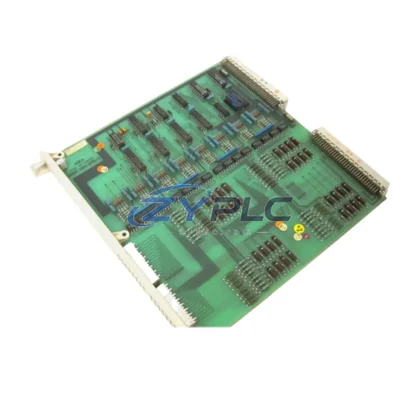
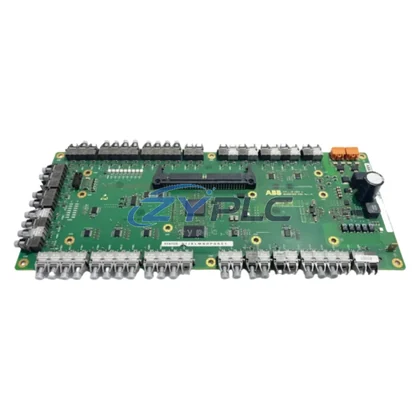
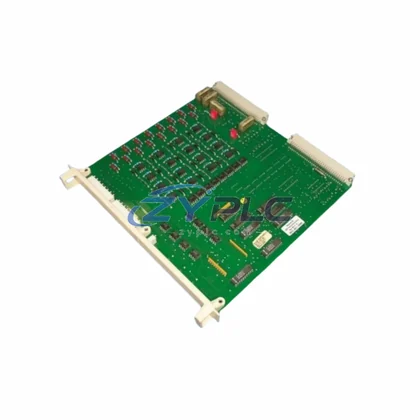
ABB SDCS-DSL-4 Signal Module for SDCS Automation
The ABB SDCS-DSL-4 is a high-performance signal processing module engineered for the SDCS series DC drive platform, including the DCS400, DCS500, and DCS600 drive families. Designed for demanding industrial environments, the SDCS-DSL-4 plays a critical role in industrial automation systems by enabling precise feedback signal acquisition, real-time motor speed regulation, and seamless integration with upstream control systems. For factories seeking to reduce unnecessary energy consumption, improve equipment utilization rates, and lower total cost of ownership, the SDCS-DSL-4 delivers measurable results at the drive level — where energy efficiency is won or lost.
Product Specification Table
| Parameter |
Specification / Value |
| SKU / Part Number |
SDCS-DSL-4 |
| Brand |
ABB |
| Series |
SDCS (DCS400 / DCS500 / DCS600) |
| Module Type |
Signal Processing / Feedback Interface Module |
| Power Consumption |
Low-power signal-level operation (<5W typical) |
| Drive Compatibility |
ABB DCS400, DCS500, DCS600 DC Drive Series |
| Communication Interface |
Internal SDCS backplane bus |
| Application Environment |
Industrial automation, paper mills, metal processing, crane & hoist, extruders |
| Maintenance Value |
Accurate speed/torque feedback reduces motor over-drive and idle unplanned downtime |
| Origin |
Germany |
| warranty terms confirmed during quotation |
Tested and verified before shipment — full functional guarantee |
| Stock Status |
RFQ Available — ready for shipment arranged after confirmation |
System Compatibility and Application
In a modern industrial drive system, energy efficiency is not achieved by a single component — it is the result of tightly coordinated signal chains across the entire control architecture. The SDCS-DSL-4 sits at the heart of this chain, processing encoder and tachometer feedback signals that allow the ABB DCS600 DC drive to maintain precise closed-loop speed and torque control. Without accurate signal processing, drives compensate with excess power draw, leading to thermal losses, mechanical stress, and shortened motor life.
When deployed alongside the SDCS-CON-4 control board and the SDCS-POW-4 power supply module, the SDCS-DSL-4 forms a complete SDCS drive control stack capable of managing multi-axis DC motor systems with minimal energy overhead. The SDCS-IOB-3 I/O expansion board further extends the system’s ability to monitor analog process variables — such as line tension, roll speed, and load current — feeding real-time data back into the control loop to prevent energy-wasting overcorrections.
For facilities running ABB’s DCS500 or DCS400 series drives, the SDCS-DSL-4 ensures backward-compatible signal integrity across legacy and modernized drive cabinets. Integration with PROFIBUS DP or Modbus RTU fieldbus adapters — such as the NDPA-02 or NMBP-01 — allows the drive system to report real-time energy consumption data to SCADA platforms or maintenance planning systems (EMS), enabling plant-level power monitoring and demand-side optimization.
In multi-drive production lines, the SDCS-DSL-4 works in concert with ABB’s ACS880 AC drive series for mixed-drive environments, where DC and AC motors share a common control network. The signal module’s high-resolution feedback processing ensures that torque handoff between drive zones is smooth, eliminating the speed mismatches that cause product defects and force operators to run lines below rated capacity — a hidden source of energy inefficiency. Pairing the SDCS-DSL-4 with an ABB CP600 HMI panel gives operators a real-time window into drive performance metrics, enabling proactive maintenance planning without requiring dedicated energy metering hardware.
Maintenance and Replacement Notes
Consider a paper mill running a multi-section winder driven by ABB DCS600 units. Each section motor must maintain precise tension and speed ratios to prevent web breaks and material waste. Without reliable signal processing from a module like the SDCS-DSL-4, speed deviations accumulate across sections, forcing operators to reduce line speed — directly cutting throughput and increasing energy cost per ton of output. With the SDCS-DSL-4 restoring accurate feedback, the drive can operate at rated speed with tighter torque margins, reducing both energy consumption per production cycle and the frequency of unplanned stops.
In metal rolling applications, the SDCS-DSL-4 enables the DCS600 to execute rapid torque reversals during reversing mill operations with minimal overshoot. This precision reduces the braking energy dissipated as heat in resistor banks, and in regenerative drive configurations, allows more energy to be returned to the DC bus. Facilities report measurable reductions in peak demand charges when drive feedback accuracy is restored through proper signal module replacement.
Predictive maintenance is another area where the SDCS-DSL-4 contributes to operational efficiency. Degraded signal modules produce noisy or intermittent feedback, which manifests as unexplained speed fluctuations, increased drive fault rates, and erratic torque behavior. By replacing a failing SDCS-DSL-4 proactively — identified through drive diagnostic logs — maintenance teams can avoid unplanned downtime events that cost far more in lost production than the module itself. All SDCS-DSL-4 units shipped by ZYPLC undergo functional load testing and signal integrity verification before dispatch, ensuring the replacement module performs to ABB factory specification from the first power-on.
Inventory availability is maintained to support urgent replacement needs. ZYPLC stocks the SDCS-DSL-4 alongside complementary SDCS series components — including the SDCS-CON-4, SDCS-POW-4, and SDCS-IOB-3 — enabling same-series sourcing for complete drive board sets. Every unit is covered by a warranty terms confirmed during quotation, with technical support available to assist with installation verification and drive recommissioning.
Product Sourcing FAQ
Q1: How does the SDCS-DSL-4 contribute to operational stability in a DC drive system?
The SDCS-DSL-4 processes encoder and tachometer feedback signals that enable the DCS400/DCS500/DCS600 drive to maintain precise closed-loop control. Accurate feedback prevents the drive from over-compensating with excess torque or speed, directly reducing unnecessary power draw and heat generation in the motor and drive cabinet.
Q2: Is the SDCS-DSL-4 compatible with both DCS500 and DCS600 drive platforms?
Yes. The SDCS-DSL-4 is designed for the SDCS modular control platform, which is shared across the DCS400, DCS500, and DCS600 series. It is a direct plug-in replacement within the SDCS backplane and does not require firmware reconfiguration when replacing a like-for-like unit in the same drive generation.
Q3: What is the recommended replacement procedure and how is the module tested before shipment?
Replacement involves powering down the drive, removing the faulty SDCS-DSL-4 from the backplane, and inserting the new module. No special tools are required. All ZYPLC-supplied SDCS-DSL-4 modules are tested under simulated load conditions and signal injection to verify feedback accuracy and communication integrity before dispatch. A warranty terms confirmed during quotation covers all units against functional defects.
Q4: Can the SDCS-DSL-4 be integrated into an condition monitoring or SCADA system?
The SDCS-DSL-4 itself is a drive-internal signal module; energy data is surfaced at the drive level via the DCS600’s fieldbus interface (e.g., PROFIBUS DP via NDPA-02 adapter or Modbus via NMBP-01). This data can be fed into SCADA, EMS, or plant historian platforms for real-time condition monitoring, demand forecasting, and predictive maintenance scheduling.