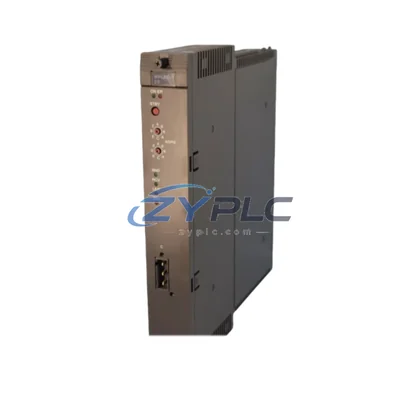
Allen-Bradley 1747-L20C PLC Processor for SLC 500 Automation
In modern manufacturing environments where equipment uptime and replacement lead time directly affect production continuity, the Allen-Bradley 1747-L20C SLC 500 PLC Processor stands as a proven control core for energy-conscious automation architectures. Designed by Rockwell Automation, the 1747-L20C delivers deterministic scan-cycle execution, efficient I/O management, and reliable program control — all critical factors in reducing idle operating load, minimizing unnecessary actuator cycling, and optimizing production line throughput.
The 1747-L20C supports up to 4K of user memory and manages local and expanded I/O through the SLC 500 chassis backplane, enabling precise coordination of field devices without the overhead of oversized control platforms. In energy-sensitive applications — from conveyor systems and packaging lines to HVAC control and pump stations — this processor’s efficient instruction execution reduces unnecessary relay switching, shortens scan times, and ensures that motor drives and output modules respond only when process conditions demand it.
Product Specification Table
| Parameter |
Specification / Value |
| SKU |
1747-L20C |
| Brand / Series |
Allen-Bradley / SLC 500 |
| User Memory |
4K Words |
| I/O Capacity |
Up to 960 I/O points (local + expanded) |
| Communication Port |
DH-485 (built-in) |
| Compatible Systems |
SLC 500 chassis, 1746 I/O modules, RSLogix 500 |
| Application Environment |
Discrete control, motor management, condition monitoring loops |
| Maintenance Value |
Reduced scan overhead, precise output control, minimal idle cycling |
| Warranty |
Warranty and support terms confirmed before quote |
| Availability |
Confirmed via RFQ before quotation |
System Compatibility and Application
The 1747-L20C operates at the center of an maintenance-focused control loop that spans from field-level sensing to drive-level execution. In a typical SLC 500 system, the processor communicates with 1746-IB16 DC input modules to receive real-time signals from proximity sensors, flow meters, and current transducers — allowing the control program to detect low-load conditions and trigger operational-efficiency routines automatically.
On the output side, the 1747-L20C coordinates with 1746-OB16 transistor output modules to switch motor contactors and solenoid valves with millisecond precision, eliminating the unplanned downtime associated with over-cycling or delayed shutdowns. When paired with a PowerFlex 40 or PowerFlex 400 variable frequency drive via the DH-485 network, the processor can issue speed reference commands that match motor output to actual load demand — a direct path to measurable kWh savings on pump, fan, and conveyor applications.
For multi-axis or high-precision applications, the 1747-L20C integrates with 1746-HSCE high-speed counter modules to track encoder feedback from servo-driven axes, enabling the PLC to optimize motion profiles and reduce peak current draw during acceleration phases. The 1747-SDN DeviceNet scanner module extends the processor’s reach to distributed field devices — including smart sensors, valve manifolds, and motor protection relays — over a single cable, reducing wiring losses and simplifying energy audit data collection.
At the supervisory level, the 1747-L20C connects to PanelView 550 or PanelView 600 HMI terminals via DH-485, giving operators real-time visibility into cycle counts, output states, and alarm conditions. This closed-loop visibility is essential for identifying unplanned downtime patterns — such as motors running at full speed during low-demand periods — and implementing corrective logic directly in the PLC program. Integration with RSLinx Classic and RSLogix 500 software further enables remote monitoring and program optimization without requiring on-site intervention, reducing both travel costs and unplanned downtime.
Maintenance and Replacement Notes
On active production lines, the 1747-L20C delivers maintenance planning through three primary mechanisms: load-responsive output control, predictive maintenance triggering, and production rhythm synchronization.
In load-responsive control, the processor continuously evaluates analog inputs from current sensors and pressure transducers connected through 1746-NI4 analog input modules. When measured values fall below defined thresholds — indicating low production demand — the PLC automatically reduces motor speed references sent to connected VFDs, dims lighting circuits, or places auxiliary equipment in standby mode. This dynamic response eliminates the flat-rate operating load that plagues fixed-speed systems.
For predictive maintenance, the 1747-L20C accumulates runtime counters and fault logs that maintenance teams can retrieve via RSLogix 500 or through a connected 1747-UIC USB-to-DH-485 interface. By tracking motor start counts, output module switching cycles, and communication error rates, the system flags components approaching end-of-life before they cause unplanned stops — each of which typically wastes energy through emergency restarts, scrap production, and idle machine time during repair.
Production rhythm synchronization is achieved by linking the 1747-L20C’s scan cycle to upstream and downstream equipment states. When a bottleneck station signals a hold condition, the processor immediately reduces conveyor speeds and pauses non-critical actuators, preventing energy-intensive equipment from running empty. This coordinated response — impossible with relay-based control — directly reduces per-unit operating load and improves overall equipment effectiveness (OEE).
Every 1747-L20C unit supplied by ZYPLC undergoes a full pre-shipment functional test, including program load verification, I/O scan confirmation, and communication port validation. Units are shipped with a warranty and support terms confirmed before quote covering manufacturing defects and operational failures under normal industrial use conditions.
Product Sourcing FAQ
Q1: How does the 1747-L20C contribute to measurable operational stability on a production line?
The 1747-L20C enables operational stability by executing precise, condition-based output control that eliminates unnecessary motor starts, reduces idle-state power draw, and coordinates VFD speed references with actual process demand. When integrated with analog I/O modules and variable frequency drives, the processor can help restore stable operation when a compatible replacement is required.
Q2: Is the 1747-L20C compatible with existing SLC 500 chassis and I/O modules?
Yes. The 1747-L20C is fully compatible with all standard SLC 500 fixed and modular chassis, including 1746-series I/O modules (digital, analog, specialty), and communicates natively over DH-485. It is programmed using RSLogix 500 software, which supports the full SLC 500 instruction set including PID, sequencer, and communication instructions.
Q3: What is the recommended replacement or upgrade path if the 1747-L20C is being retired from a legacy system?
For systems requiring expanded memory or Ethernet connectivity, the 1747-L40C (8K memory) or 1747-L553 (64K memory with DH+ and RS-232) are direct SLC 500 upgrades. For full platform migration, Rockwell Automation’s MicroLogix 1400 or CompactLogix L1 series offer modern Ethernet/IP connectivity while maintaining backward compatibility with many SLC 500 I/O modules through adapter solutions.
Q4: What does the warranty and support terms confirmed before quote from ZYPLC cover, and what is the pre-shipment test process?
The warranty and support terms confirmed before quote covers all manufacturing defects and operational failures under standard industrial operating conditions (0–60°C, non-condensing). Prior to shipment, each 1747-L20C unit is tested for power-on functionality, DH-485 communication integrity, program memory read/write verification, and I/O scan response. A test report is available upon request. Warranty claims are processed within 5 business days of fault confirmation.