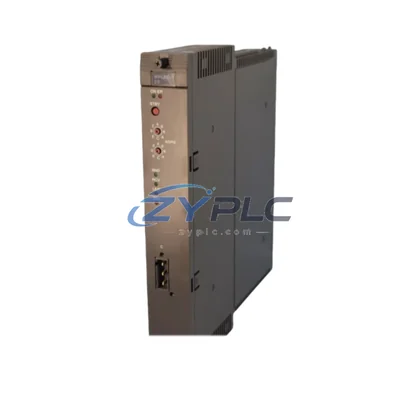
Allen-Bradley 1756-L72 PLC for ControlLogix Automation
The Allen-Bradley 1756-L72 is a high-performance ControlLogix programmable logic controller engineered to deliver precision motor control, real-time condition monitoring, and adaptive drive regulation across demanding industrial production environments. With 4MB of user memory and a robust multi-tasking architecture, the 1756-L72 serves as the central intelligence layer in maintenance-focused automation systems — enabling factories to reduce idle power consumption, tighten production cycle times, and extend equipment service intervals through data-driven control logic.
In modern manufacturing, downtime is rarely the result of a single component failure. It accumulates through inefficient motor ramp profiles, uncoordinated drive sequencing, oversized actuator cycles, and the absence of real-time feedback loops. The 1756-L72 addresses each of these vectors by integrating seamlessly with the broader ControlLogix ecosystem, providing deterministic scan times that keep every downstream device — from variable frequency drives to servo amplifiers — operating within its optimal efficiency band.
Product Specification Table
| Parameter |
Specification |
| User Memory |
4 MB |
| I/O Capacity |
Up to 128,000 I/O points |
| Communication Ports |
USB (programming), EtherNet/IP via 1756-EN2T |
| Typical Scan Time |
< 1 ms (deterministic) |
| Operating Voltage |
24 VDC (via 1756-PA75 or 1756-PB75 power supply) |
| Compatible Drive Systems |
PowerFlex 525, PowerFlex 755, Kinetix 5500 |
| Compatible HMI |
PanelView Plus 7, FactoryTalk View SE |
| Application Environment |
Discrete, process, motion, and safety control |
| Maintenance Value |
Adaptive load scheduling, drive coordination, idle-state power reduction |
| Warranty |
Warranty and support terms confirmed before quote — tested and verified before shipment |
System Compatibility and Application
The 1756-L72 controller operates at the core of a layered automation architecture designed to minimize downtime at every stage of the production cycle. At the drive level, the controller communicates directly with PowerFlex 525 variable frequency drives over EtherNet/IP, enabling dynamic speed adjustment based on real-time load demand rather than fixed motor profiles. This alone can help restore stable operation when a compatible replacement is required.
For precision motion applications, the 1756-L72 pairs with the Kinetix 5500 servo drive and 1756-M02AE motion module to deliver coordinated multi-axis control. By synchronizing servo acceleration and deceleration curves with production line throughput targets, the system eliminates unnecessary energy spikes caused by abrupt starts and stops. The result is a smoother production rhythm with measurably lower peak demand charges.
On the I/O side, the 1756-IB16 digital input module and 1756-OB16E digital output module provide the high-density, fast-response signal handling needed to capture energy-relevant events — motor overcurrent conditions, drive fault states, and thermal threshold breaches — before they escalate into unplanned downtime. Paired with the 1756-IF16 analog input module, the system can ingest 4–20 mA signals from current transformers and power transducers, feeding live operating load data directly into the controller’s logic engine.
Network-level energy visibility is achieved through the 1756-EN2T EtherNet/IP communication module, which connects the 1756-L72 to plant-wide SCADA platforms and FactoryTalk Energy Manager. This integration allows production managers to correlate operating load data with shift schedules, batch records, and equipment utilization metrics — identifying the specific machines, time windows, and process steps responsible for the highest energy draw.
For facilities running mixed automation architectures, the 1756-DNB DeviceNet bridge module extends the controller’s reach to legacy field devices, ensuring that older motor starters, sensors, and actuators can be brought under centralized maintenance planning without requiring full hardware replacement.
Maintenance and Replacement Notes
In a typical discrete manufacturing environment, the 1756-L72 contributes to maintenance planning across three operational phases: startup sequencing, steady-state production, and idle management.
During startup, the controller executes staggered motor enable sequences through coordinated PowerFlex 755 drive commands, preventing simultaneous inrush currents that inflate peak demand billing. A single uncoordinated startup event across a 10-motor production line can generate demand spikes that persist on utility bills for an entire billing cycle. The 1756-L72 eliminates this by enforcing programmable inter-start delays calibrated to the facility’s contracted demand threshold.
During steady-state production, the controller continuously monitors cycle time deviations through encoder feedback from Kinetix servo axes and adjusts conveyor speeds via PowerFlex VFD commands to maintain optimal line balance. When a downstream station signals a buffer-full condition through the 1756-IB16 input module, the controller reduces upstream conveyor speed rather than stopping it entirely — maintaining motor efficiency while preventing product accumulation.
During planned and unplanned idle periods, the 1756-L72 executes operational-efficiency routines that transition non-critical drives to sleep mode, reduce compressed air pressure setpoints via analog output commands to proportional valves, and log idle duration data for OEE (Overall Equipment Effectiveness) reporting. These routines are fully programmable through Studio 5000 Logix Designer and can be triggered by production schedule data received from MES systems over EtherNet/IP.
From a maintenance perspective, the controller’s built-in diagnostics track drive run-hour accumulation, motor thermal model data from PowerFlex drive parameters, and I/O module health status — enabling maintenance teams to schedule interventions based on actual equipment condition rather than fixed calendar intervals. This predictive maintenance capability reduces both downtime and the unplanned downtime associated with running degraded equipment at reduced efficiency.
Every unit of the 1756-L72 supplied by ZYPLC undergoes full functional testing prior to shipment, including communication port verification, memory integrity checks, and I/O scan validation. Warranty terms are confirmed during quotation.
Product Sourcing FAQ
Q: How much energy can the 1756-L72 help save in a typical motor-driven production line?
A: Operational stability depend on the specific application, but facilities integrating the 1756-L72 with PowerFlex variable frequency drives typically report Actual operating results depend on the installed system, load profile, and commissioning parameters. Additional savings of 5–15% are achievable through idle-state management routines and demand peak shaving logic programmed in Studio 5000.
Q: Is the 1756-L72 compatible with existing ControlLogix chassis and I/O modules?
A: Yes. The 1756-L72 is fully compatible with the 1756 ControlLogix chassis family and all current-generation 1756-series I/O modules, including the 1756-IB16, 1756-OB16E, and 1756-IF16. It also supports legacy 1756-series modules, making it suitable for both greenfield installations and brownfield upgrades.
Q: Can the 1756-L72 replace an older ControlLogix controller such as the 1756-L61 or 1756-L63?
A: In most cases, yes. The 1756-L72 is backward-compatible with programs developed for earlier L6x-series controllers. A project conversion through Studio 5000 Logix Designer is recommended to verify tag mapping and task configuration before deployment. ZYPLC can provide pre-shipment configuration support upon request.
Q: What does the warranty and support terms confirmed before quote cover, and what is the testing process?
A: Every 1756-L72 unit shipped by ZYPLC is tested for communication functionality, memory integrity, and I/O scan performance before dispatch. The warranty and support terms confirmed before quote covers hardware defects and functional failures under normal operating conditions. Units that develop faults within the warranty period are eligible for replacement or repair. Contact our team at plc.sales@zyplc.com or +86 19859288691 for warranty claims and technical support.