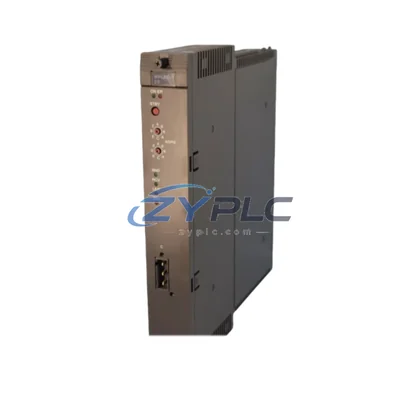
Allen-Bradley 1756-LSP Safety Module for GuardLogix Automation
The Allen-Bradley 1756-LSP is a GuardLogix Safety Partner Module engineered for industrial-grade safety control across industrial production lines. Installed directly within the 1756 ControlLogix chassis, the 1756-LSP works in tandem with the primary GuardLogix controller to enforce SIL 2 and SIL 3 safety functions while minimizing power overhead in the control architecture. For factories targeting reduced idle operating load, lower unplanned downtime, and improved Overall Equipment Effectiveness (OEE), the 1756-LSP is a critical node in a lean, maintenance-focused automation strategy.
Product Specification Table
| Parameter |
Specification |
| SKU |
1756-LSP |
| Brand / Series |
Allen-Bradley / GuardLogix 1756 |
| Product Type |
Safety Controller Module (Safety Partner) |
| Power Consumption |
3.2 W (backplane) — low-draw safety co-processor |
| Operating Efficiency |
Deterministic safety scan with minimal CPU overhead on primary controller |
| Compatible Systems |
ControlLogix 1756 chassis, GuardLogix 5570 / 5580 controllers, Studio 5000 Logix Designer |
| Application Environment |
Discrete manufacturing, process safety, motor drive interlocks, conveyor safety, robotic cells |
| Maintenance Value |
Enables safe speed reduction and zone-based shutdown to cut motor unplanned downtime during low-demand periods |
| Communication Protocol |
EtherNet/IP (CIP Safety), DeviceNet Safety |
| Origin |
USA |
| Warranty |
Warranty and support terms confirmed before quote — tested and verified before shipment |
System Compatibility and Application
In a fully optimized industrial control system, the 1756-LSP functions as the safety enforcement layer within a broader maintenance-focused architecture spanning from field-level sensing to drive-level execution. At the controller tier, the 1756-LSP pairs with the Allen-Bradley 1756-L73S GuardLogix 5570 Safety Controller, which manages both standard and safety logic within a single 1756 ControlLogix chassis. This consolidated architecture eliminates the need for a separate safety PLC, reducing panel footprint and overall system power draw.
On the drive side, the PowerFlex 525 and PowerFlex 755 AC drives receive speed and torque commands from the GuardLogix system via EtherNet/IP. When the 1756-LSP detects a safety condition — such as a guard door opening or an e-stop activation — it triggers a Safe Torque Off (STO) function on these drives, cutting motor power without a full system shutdown. This targeted response prevents the unplanned downtime associated with full-line stops and enables faster, safer restarts. The PowerFlex 755T with built-in regenerative capability can return braking energy to the DC bus, further reducing net operating load during deceleration cycles.
For I/O integration, the 1756-IB16 digital input module and 1756-OB16E digital output module handle field device signals — including safety light curtains, pressure mats, and two-hand control stations — feeding real-time status data to the GuardLogix controller. The 1734 POINT Guard I/O modules extend safety I/O to distributed machine zones over EtherNet/IP, enabling zone-based maintenance planning where only active production cells draw full power.
At the HMI layer, the PanelView Plus 7 operator terminal provides live visibility into safety zone status, drive states, and operating load metrics. Integrated with FactoryTalk View SE, the HMI displays trend data from the 1756-LSP’s safety task execution, helping maintenance teams identify recurring safety faults that indicate mechanical inefficiency or excessive motor load — both of which drive up energy costs.
For power quality monitoring, the PowerMonitor 5000 energy meter can be deployed alongside the 1756 chassis to capture real-time kWh data, demand peaks, and power factor readings. When correlated with GuardLogix safety event logs, this data enables engineers to identify which safety-triggered stops cause the greatest energy disruption and to redesign interlocks or machine sequences accordingly.
Maintenance and Replacement Notes
In automotive body welding lines, the 1756-LSP enables zone-based safe speed reduction on robot cells during part loading, allowing servo drives and welding positioners to operate at reduced power during non-productive dwell periods. Rather than holding full torque on idle axes, the GuardLogix system commands a Safe Limited Speed (SLS) state, cutting motor load by Actual operating results depend on the installed system, load profile, and commissioning parameters.
In food and beverage packaging lines, the 1756-LSP’s integration with conveyor drive systems allows safe stopping of individual conveyor segments when upstream product flow is interrupted. Instead of running empty belts at full speed — a common source of downtime risk — the system safely reduces belt speed or stops individual zones, then restarts them in sequence as product flow resumes. Combined with PowerFlex 525 drives running in operational-efficiency mode, this approach can reduce conveyor system energy use by Actual operating results depend on the installed system, load profile, and commissioning parameters.
In semiconductor and electronics manufacturing, where cleanroom HVAC and precision motion systems represent major energy loads, the 1756-LSP enables safe, rapid response to process anomalies without triggering full-facility shutdowns. By containing safety responses to the affected machine zone, the system preserves energy-intensive environmental controls in adjacent areas, avoiding the costly restart cycles associated with broad safety shutdowns.
From a maintenance perspective, the 1756-LSP’s safety task diagnostics — accessible via Studio 5000 Logix Designer — provide detailed fault logging that supports predictive maintenance programs. Recurring safety faults on specific axes or zones often indicate bearing wear, misalignment, or drive degradation, all of which increase operating load before causing outright failure. Early detection through GuardLogix safety logs allows maintenance teams to schedule corrective action during planned downtime, avoiding both unplanned stops and the energy penalties of running degraded equipment.
Every 1756-LSP unit supplied by ZYPLC undergoes full functional testing prior to shipment, including safety task execution verification and backplane communication checks. Units are held in climate-controlled inventory and shipped with documentation supporting traceability. A warranty and support terms confirmed before quote covers all units against defects in materials and workmanship, with technical support available for integration and commissioning queries.
Product Sourcing FAQ
Q1: How does the 1756-LSP contribute to operational stability compared to a conventional safety relay system?
Unlike traditional safety relay architectures that trigger full machine stops on any safety event, the 1756-LSP enables programmable safety responses — including Safe Limited Speed, Safe Stop 1, and Safe Torque Off — proportional to the actual hazard. Drives and motors can be safely decelerated rather than abruptly cut, reducing energy spikes from repeated full-stop/restart cycles and extending drive and motor service life.
Q2: Is the 1756-LSP compatible with existing ControlLogix systems, and does upgrading require a full chassis replacement?
The 1756-LSP installs directly into any standard 1756 ControlLogix chassis alongside a compatible GuardLogix controller such as the 1756-L71S, 1756-L73S, or 1756-L83ES. No chassis replacement is required. Existing standard I/O modules, communication modules such as the 1756-EN2T EtherNet/IP module, and power supplies remain compatible, making the upgrade path straightforward and cost-effective.
Q3: What is the recommended replacement if the 1756-LSP is being upgraded to a newer GuardLogix platform?
For new installations or platform upgrades, the GuardLogix 5580 series (1756-L8xES controllers) with the corresponding 1756-L8SP Safety Partner offers enhanced processing capacity and supports CIP Safety over EtherNet/IP with higher node counts. Existing 1756-LSP safety programs can be migrated using Studio 5000 Logix Designer’s import/export tools, preserving safety logic investment while gaining access to improved diagnostics and condition monitoring integration.
Q4: What does the warranty and support terms confirmed before quote cover, and what is the testing process before shipment?
All 1756-LSP units supplied by ZYPLC are tested for backplane communication integrity, safety task execution, and firmware version compatibility before dispatch. The warranty and support terms confirmed before quote covers manufacturing defects and component failures under normal operating conditions. Units are traceable to batch records, and ZYPLC’s technical team provides pre-sales compatibility checks and post-sales commissioning support to ensure correct integration within your GuardLogix safety architecture.