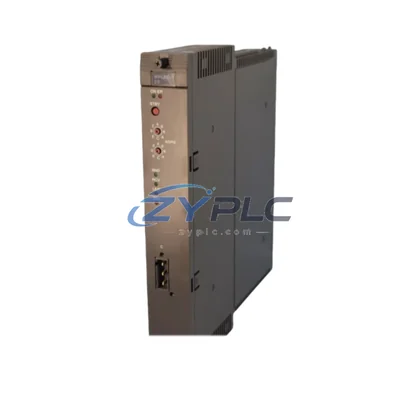
Allen-Bradley 1762-L40BWA PLC MicroLogix 1200: Efficiency Control & Production Line Optimization
The Allen-Bradley 1762-L40BWA is a 40-point relay output PLC from the MicroLogix 1200 series, engineered to deliver precise, maintenance-focused control across demanding industrial environments. With 24 DC inputs and 16 relay outputs, this controller provides the processing backbone for applications where minimizing unplanned downtime, maximizing equipment uptime, and tightening production cycle times are operational priorities. Whether deployed in standalone machine control or integrated into a broader Rockwell Automation architecture, the 1762-L40BWA delivers measurable efficiency gains at every stage of the production loop.
At ZYPLC, every 1762-L40BWA unit is sourced from verified supply channels, subjected to pre-shipment functional testing, and backed by a warranty terms confirmed during quotation. Stock is maintained for prompt dispatch, supporting both urgent replacement needs and planned system upgrades.
Product Specification Table
| Parameter |
Specification |
| SKU / Part Number |
1762-L40BWA |
| Series |
MicroLogix 1200 |
| Brand |
Allen-Bradley (Rockwell Automation) |
| I/O Configuration |
24 DC Inputs / 16 Relay Outputs (40-point) |
| Power Supply |
120/240V AC |
| Operating Voltage |
24V DC Input |
| Program Memory |
8K words user memory |
| Communication Port |
RS-232 (DH-485 / DF1 protocol) |
| Compatible Expansion |
1762 I/O expansion modules (up to 6 modules) |
| Operating Temperature |
0°C to 60°C |
| Application Environment |
Industrial automation, motor control, conveyor, HVAC, packaging |
| Maintenance Value |
Precise relay switching reduces inrush current; scan-time efficiency minimizes idle power draw |
| Warranty |
warranty terms confirmed during quotation (ZYPLC) |
| Availability |
RFQ Available — Ships within 1–3 business days |
System Compatibility and Application
The 1762-L40BWA is most effective when positioned as the central control node within a layered automation architecture designed for energy accountability. In motor-driven applications, it pairs naturally with PowerFlex 40 variable frequency drives (VFDs) — the drive handles speed regulation and soft-start sequencing while the MicroLogix 1200 manages the control logic, interlocks, and fault response. This combination eliminates the energy penalty of across-the-line motor starts and allows the system to match motor output precisely to load demand.
For distributed I/O expansion, the 1762-IQ16 digital input module and 1762-OW16 relay output module extend the controller’s reach across larger panel layouts without adding a second CPU, keeping the control footprint lean and power consumption predictable. Where analog process variables — such as pressure, temperature, or flow — need to be monitored, the 1762-IF4 analog input module feeds real-time process data directly into the MicroLogix scan cycle, enabling closed-loop control that responds to actual conditions rather than fixed timers.
Communication is handled via the onboard RS-232 port, which supports DF1 full-duplex and DH-485 protocols. This allows the 1762-L40BWA to exchange data with PanelView 600 or PanelView Plus HMI terminals for operator visibility, or to report status upstream to a ControlLogix L6x gateway acting as a supervisory node. In condition monitoring applications, integrating a PowerMonitor 500 energy meter into the same network allows the MicroLogix to correlate its output states with actual power consumption data — identifying which machine cycles carry the highest energy cost and where scheduling adjustments can reduce peak demand charges.
For safety-critical zones, the 1762-L40BWA can be coordinated with a SmartGuard 600 safety controller to enforce safe-state conditions during e-stop events, preventing the unplanned downtime and mechanical stress associated with uncontrolled shutdowns. The relay output architecture of the L40BWA is particularly well-suited to this role, as relay contacts provide inherent galvanic isolation between the control circuit and the load.
Maintenance and Replacement Notes
In a typical packaging or conveyor application, the 1762-L40BWA contributes to energy reduction through several concrete mechanisms. First, by implementing demand-based motor control — starting conveyors only when upstream sensors confirm product presence — the controller eliminates the common practice of running motors continuously during low-throughput periods. A single 5.5 kW conveyor motor running unnecessarily for two hours per shift represents a measurable and avoidable energy cost; the MicroLogix 1200’s fast scan time (typically under 1 ms per K of logic) ensures that sensor-triggered start/stop commands execute without perceptible delay, maintaining production rhythm while cutting idle run time.
Second, the relay output design supports load shedding strategies during scheduled maintenance windows or shift changeovers. Outputs can be grouped logically in the ladder program so that non-critical loads — lighting circuits, auxiliary pumps, cooling fans — are de-energized in a controlled sequence when the line is not producing. This structured shutdown approach, rather than a blanket power cut, protects equipment from thermal shock and reduces restart energy spikes.
Third, the 1762-L40BWA’s high-speed counter inputs can be used to track production counts and calculate real-time OEE (Overall Equipment Effectiveness) metrics within the PLC program itself. When actual output falls below the target rate, the controller can trigger an alarm output or adjust a downstream VFD reference speed — tightening the production cycle without operator intervention. Over a full production shift, this closed-loop rate management reduces both energy per unit produced and the accumulation of work-in-process inventory that ties up floor space and handling resources.
Predictive maintenance integration is achievable by monitoring motor run-hour accumulators within the MicroLogix program. When a motor’s accumulated run time crosses a configurable threshold, the controller flags a maintenance advisory output — allowing lubrication or bearing inspection to be scheduled during planned downtime rather than responding to an unplanned failure. Unplanned stops are among the highest-cost events in any production environment, combining lost throughput, restart energy spikes, and potential product scrap.
All units supplied by ZYPLC undergo pre-shipment functional verification, confirming I/O response, communication port integrity, and power supply performance before dispatch. The warranty terms confirmed during quotation covers manufacturing defects and ensures that replacement or repair support is available throughout the initial deployment period — reducing the total cost of ownership for maintenance-conscious operations teams.
Product Sourcing FAQ
Q1: How does the 1762-L40BWA contribute to measurable operational stability on a production line?
The controller enables demand-based start/stop logic for motors and actuators, eliminating idle run time. When paired with PowerFlex VFDs, it supports speed-matched motor control that reduces operating load proportionally to load — a 20% speed reduction on a centrifugal pump or fan typically yields a 49% reduction in power draw (affinity law). The MicroLogix 1200’s fast scan cycle ensures control responses are timely enough to maintain production rhythm without requiring motors to run ahead of demand.
Q2: Is the 1762-L40BWA compatible with existing MicroLogix 1200 expansion modules and HMI systems?
Yes. The 1762-L40BWA accepts up to six 1762-series expansion modules, including digital input/output, analog I/O, and specialty modules. It communicates with PanelView HMI terminals via DH-485 or DF1 protocol over the onboard RS-232 port. It is also compatible with RSLogix 500 / Studio 5000 Logix Designer programming environments for program development and online monitoring.
Q3: Can this unit replace a failed 1762-L40BWA directly, and what is the changeover process?
Direct replacement is straightforward. The program stored in the original unit can be uploaded via RSLogix 500 before removal (if the unit is still partially functional) or restored from a backup file. The replacement unit is installed, the program is downloaded, and I/O wiring reconnects to the same terminal layout. ZYPLC recommends verifying the firmware revision of the replacement unit against the original to ensure program compatibility, particularly for installations using advanced instruction sets.
Q4: What does the warranty terms confirmed during quotation from ZYPLC cover, and what is the claims process?
The warranty terms confirmed during quotation covers verified manufacturing defects and functional failures under normal operating conditions. It does not cover damage resulting from incorrect wiring, overvoltage events, or physical mishandling. To initiate a warranty claim, contact ZYPLC at plc.sales@zyplc.com or +86 19859288691 with the order reference and a description of the fault. ZYPLC will arrange inspection and, where the fault is confirmed as warranty-eligible, provide a replacement unit or repair at no additional cost.