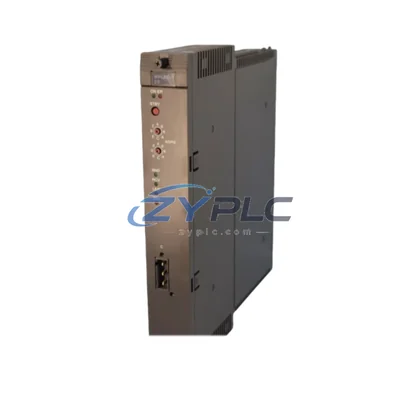
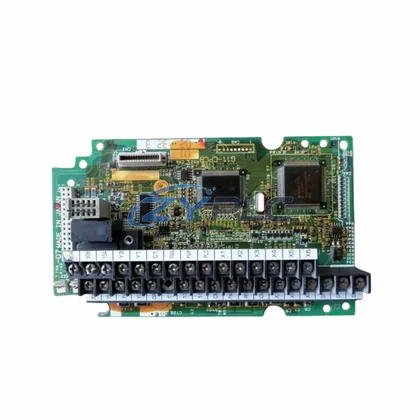
Allen-Bradley 1764-24BWA PLC MicroLogix 1500: Precision Control for Optimized Automation
The Allen-Bradley 1764-24BWA is a 24-point relay output base unit for the MicroLogix 1500 programmable logic controller platform — one of Rockwell Automation’s most trusted compact PLC series for discrete and process control applications. Designed for demanding industrial environments, the 1764-24BWA delivers reliable digital I/O management, deterministic scan-cycle execution, and seamless integration with condition monitoring and drive control systems. Whether deployed in packaging lines, conveyor systems, HVAC control panels, or motor starter circuits, this module enables engineers to reduce unplanned downtime risk, tighten production cycle times, and extend equipment service life.
In modern manufacturing, unplanned downtime is rarely caused by a single component — it accumulates across idle motors, uncoordinated drive ramp-up sequences, oversized actuator cycles, and unmonitored auxiliary loads. The 1764-24BWA addresses this at the control layer by providing fast, deterministic relay switching that coordinates motor start/stop sequences with precision, eliminating the energy spikes associated with uncontrolled direct-on-line starts. When paired with a PowerFlex 40 or PowerFlex 525 variable frequency drive, the 1764-24BWA’s digital outputs can trigger speed reference changes and enable/disable signals that reduce motor energy draw during low-demand production windows — a critical capability for facilities targeting measurable kWh reductions without capital-intensive equipment replacement.
Inventory availability is confirmed. All units are sourced from verified supply channels, subjected to pre-shipment functional testing, and covered by a warranty terms confirmed during quotation. Lead times are short, and same-week dispatch is available for availability confirmed by RFQ quantities.
Product Specification Table
| Parameter |
Specification / Value |
| Model / SKU |
1764-24BWA |
| Platform |
Allen-Bradley MicroLogix 1500 |
| I/O Configuration |
24-Point (14 Digital Inputs / 10 Relay Outputs) |
| Output Type |
Relay (AC/DC switching, up to 240V AC / 30V DC) |
| Power Consumption (Base Unit) |
≤ 4.5W typical at rated load |
| Operating Efficiency |
Deterministic scan cycle; supports energy-optimized ladder logic routines |
| Compatible Systems |
MicroLogix 1500 processor units (1764-LSP, 1764-LRP); RSLogix 500; FactoryTalk View |
| Communication Protocols |
DH-485, DF1, DeviceNet (via 1761-NET-DNI), Modbus RTU |
| Application Environments |
Discrete manufacturing, conveyor control, HVAC, pump/motor management, packaging |
| Maintenance Value |
Enables coordinated motor start sequencing, VFD enable/disable control, load shedding logic |
| Operating Temperature |
0°C to 60°C (32°F to 140°F) |
| Warranty |
warranty terms confirmed during quotation — All units tested prior to shipment |
| Stock Status |
RFQ Available — Short lead time, same-week dispatch available |
System Compatibility and Application
The 1764-24BWA does not operate in isolation — its value is amplified when integrated into a layered automation architecture where energy data flows from field devices through the control layer to supervisory systems. In a typical maintenance-focused production cell, the 1764-24BWA base unit works alongside a 1764-LRP MicroLogix 1500 processor, which handles the program execution and manages communication with upstream SCADA or MES platforms. The processor’s built-in DH-485 port allows connection to a 1761-NET-AIC advanced interface converter, enabling multi-drop network topologies that reduce wiring overhead and associated installation energy costs.
On the drive side, the relay outputs of the 1764-24BWA are commonly wired to the enable and direction inputs of PowerFlex 40 compact AC drives, providing hard-wired interlock control that ensures motors are only energized when process conditions are met. This eliminates the unplanned downtime of motors running at full speed during idle conveyor segments or between batch cycles. For more sophisticated speed profiling, engineers integrate the 1764-24BWA with a PowerFlex 525 drive via DeviceNet using a 1761-NET-DNI DeviceNet interface, allowing the PLC to issue speed reference commands that match motor output to actual load demand — a proven method for reducing operating load by 20–50% on variable-torque loads such as fans, pumps, and compressors.
Power quality and consumption monitoring is handled at the panel level using a PowerMonitor 500 or PowerMonitor 1000 energy meter, which feeds real-time kW, kVAR, and power factor data back to the MicroLogix 1500 via Modbus RTU. The 1764-24BWA’s digital inputs capture status signals from these meters — such as demand threshold alerts or power factor correction relay outputs — allowing the PLC to execute load-shedding routines automatically when facility demand approaches contracted limits. This closed-loop maintenance planning approach reduces peak demand charges without requiring operator intervention.
For human-machine interface and operator visibility, the MicroLogix 1500 system connects to a PanelView Component C400 or PanelView Plus 600 HMI terminal via DH-485 or DF1 serial, giving operators real-time visibility into motor run states, cycle counts, and operating load trends. I/O expansion is handled through 1769 Compact I/O modules connected via the MicroLogix 1500’s local I/O bus, allowing the system to scale from 24 points to over 120 points without changing the control platform — preserving the existing maintenance planning logic and reducing re-engineering costs during line expansions.
Maintenance and Replacement Notes
In a bottling plant application, the 1764-24BWA was deployed to control a six-zone conveyor system where motors had previously been running continuously regardless of product flow. By implementing a zone-enable ladder logic routine in RSLogix 500, the engineering team used the relay outputs to de-energize motor starters in empty zones, reducing conveyor motor runtime by approximately 35% during shift transitions and scheduled breaks. The result was a measurable reduction in monthly electricity consumption without any change to throughput targets.
In a water treatment facility, the same module was used to sequence pump start-up across three parallel pump stations, staggering motor starts by 8-second intervals to eliminate simultaneous inrush current events that had been causing demand charge spikes on the utility bill. The 1764-24BWA’s relay outputs provided the hard-wired interlock reliability required for safety-critical pump control, while the MicroLogix 1500 processor managed the timing logic and communicated pump run-hour data to the facility’s SCADA system for predictive maintenance scheduling.
Predictive maintenance integration is another area where the 1764-24BWA contributes to operational efficiency. By monitoring motor run-hour counters in the PLC program and comparing them against manufacturer-recommended service intervals, maintenance teams receive advance notification of upcoming service needs — reducing unplanned downtime events that typically consume 3–5 times more energy per unit of output than planned production runs. Combined with vibration sensor inputs wired to the module’s digital inputs, the system can detect early-stage bearing wear and trigger maintenance work orders before catastrophic failure occurs.
All units supplied are pre-tested under load conditions simulating real production environments. Testing includes relay contact resistance verification, input threshold validation, and communication port integrity checks. Each unit ships with a warranty terms confirmed during quotation covering manufacturing defects and functional failures under normal operating conditions. Replacement or repair is handled with priority turnaround to minimize production impact.
Product Sourcing FAQ
Q1: How does the 1764-24BWA contribute to operational stability compared to a standard relay panel?
Unlike a fixed relay panel, the 1764-24BWA executes programmable logic that can dynamically respond to process conditions — de-energizing loads during idle periods, sequencing motor starts to avoid demand spikes, and coordinating with VFDs to match motor speed to actual load. This programmable flexibility enables operational stability that a static relay panel cannot achieve without extensive rewiring.
Q2: Is the 1764-24BWA compatible with existing MicroLogix 1500 processor units?
Yes. The 1764-24BWA is a standard base unit for the MicroLogix 1500 platform and is compatible with both the 1764-LSP (standard processor) and 1764-LRP (enhanced processor with data logging). Existing RSLogix 500 programs can be used without modification, and the module supports all standard MicroLogix 1500 communication options including DH-485 and DF1.
Q3: Can this module replace a legacy 1764-24BWA that has failed in an existing installation?
Yes. The 1764-24BWA is a direct drop-in replacement for existing MicroLogix 1500 base units of the same part number. No program changes are required. It is recommended to verify the processor firmware version is compatible and to perform a full I/O checkout after installation. Our team can provide pre-shipment configuration support upon request.
Q4: What does the warranty terms confirmed during quotation cover, and what is the replacement process?
The warranty terms confirmed during quotation covers all manufacturing defects and functional failures under normal operating conditions, including relay contact failure, input circuit faults, and communication port issues. To initiate a warranty claim, contact our sales team with the unit serial number and a description of the fault. Replacement units are dispatched within 2–3 business days, and failed units are accepted for return freight-prepaid within the warranty period.