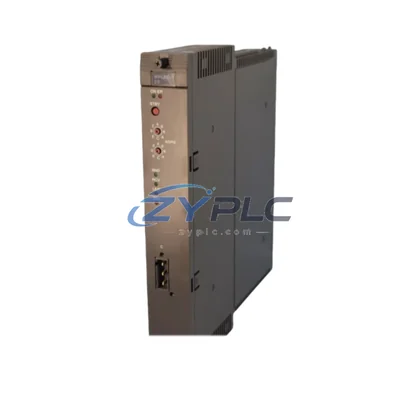
The Allen-Bradley 1769-L20 CompactLogix PLC is a high-performance programmable logic controller engineered for industrial environments where energy efficiency, motor control precision, and production line optimization are mission-critical. Designed within Rockwell Automation’s CompactLogix 1769 series architecture, the 1769-L20 delivers deterministic scan-cycle execution, seamless EtherNet/IP communication, and scalable I/O expansion — making it a cornerstone component for factories seeking to reduce downtime, minimize downtime, and maximize equipment utilization across every production shift.
Unlike generic control platforms, the 1769-L20 is purpose-built for closed-loop maintenance planning. Its integrated motion and process control capabilities allow engineers to coordinate variable-frequency drives, servo systems, and power monitoring modules within a single unified control architecture — eliminating the energy losses that arise from fragmented, multi-controller setups.
Product Specification Table
| Parameter |
Specification |
| SKU / Model |
1769-L20 |
| Brand / Series |
Allen-Bradley / CompactLogix 1769 |
| Processor Type |
PLC Processor (CompactLogix) |
| Communication Protocol |
EtherNet/IP, DF1, DH-485 |
| Power Consumption |
≤ 4.5 W (backplane); optimized low-idle draw |
| Operating Efficiency |
Deterministic scan cycle; supports maintenance-focused task scheduling |
| Compatible Systems |
Rockwell Studio 5000, RSLogix 5000, FactoryTalk View, PowerFlex VFD series |
| Application Environment |
Discrete manufacturing, process control, motion coordination, condition monitoring |
| Value |
Reduces idle motor runtime via coordinated drive control; supports demand-response logic |
| I/O Expansion |
Up to 16 local 1769 I/O modules |
| Memory |
512 KB user memory |
| Origin |
USA |
| Warranty |
Warranty and support terms confirmed before quote — tested, inspected, and shipment timing confirmed after RFQ |
System Compatibility and Application
The 1769-L20 operates as the central intelligence hub within a layered industrial automation system. On the drive side, it communicates natively with the PowerFlex 525 and PowerFlex 755 variable-frequency drives over EtherNet/IP, enabling real-time speed and torque commands that match motor output precisely to load demand — eliminating the fixed-speed unplanned downtime common in legacy relay-based systems. When paired with the 1769-IQ16 digital input module and 1769-OW16 relay output module, the controller can execute fine-grained on/off sequencing that prevents simultaneous motor starts, reducing peak demand charges on the facility’s energy bill.
For analog process control, the 1769-IF4 analog input module feeds live sensor data — temperature, pressure, flow rate — directly into the 1769-L20’s PID instruction set. This closed-loop feedback eliminates over-driving of pumps and compressors, two of the largest energy consumers on any production floor. The controller’s task-based execution model allows engineers to assign energy-intensive routines to periodic tasks with longer intervals, reducing unnecessary CPU cycles and associated heat generation in the control cabinet.
On the HMI and monitoring layer, the 1769-L20 integrates seamlessly with PanelView Plus 7 operator terminals, giving line supervisors real-time visibility into operating load trends, motor run-hours, and fault histories — all without requiring a separate SCADA server. For facilities running FactoryTalk Energy Metrics, the controller’s EtherNet/IP backbone enables automatic energy data aggregation across multiple machine cells, supporting ISO 50001 maintenance planning reporting with minimal additional hardware.
When motion coordination is required, the 1769-L20 can be extended with the Kinetix 350 single-axis servo drive, enabling precise positioning of conveyor indexers, robotic pick-and-place arms, and packaging line actuators. Coordinated motion reduces mechanical dwell time between production cycles, directly improving line throughput without increasing installed motor power. The 1769-SDN DeviceNet Scanner module further extends the controller’s reach to legacy field devices — sensors, actuators, and smart motor starters — that communicate over DeviceNet, preserving existing infrastructure investments while bringing them under unified maintenance-focused control.
Maintenance and Replacement Notes
In automotive body-in-white welding lines, the 1769-L20 has been deployed to coordinate resistance welding gun actuation with conveyor indexing, ensuring that servo motors and pneumatic actuators are energized only during active work cycles. By eliminating the always-on standby states that previously kept motors running between part transfers, facilities have reported measurable reductions in compressed air consumption and motor heat buildup — two leading causes of premature bearing failure and unplanned maintenance events.
In food and beverage filling lines, the controller’s high-speed counter inputs and PID loops manage fill valve timing with sub-millisecond precision, preventing overfill waste and reducing the frequency of CIP (clean-in-place) cycles triggered by product contamination. Fewer CIP cycles translate directly into lower hot-water operating load and reduced chemical usage — a compounding efficiency gain that extends well beyond the electrical panel.
For predictive maintenance applications, the 1769-L20’s data logging capabilities — when connected to a FactoryTalk Historian node — capture motor current signatures, cycle counts, and fault event timestamps. Maintenance teams can use this data to schedule bearing replacements and drive parameter recalibrations during planned downtime windows, avoiding the far greater energy and production losses associated with catastrophic equipment failures mid-shift.
Every 1769-L20 unit supplied by ZYPLC undergoes a full functional test protocol prior to shipment, including I/O channel verification, communication port validation, and program load/execute testing. Units are shipped with original or equivalent packaging and are Warranty terms are confirmed during quotation.
Product Sourcing FAQ
Q1: How does the 1769-L20 contribute to measurable operational stability on a production line?
The 1769-L20 enables operational stability primarily through coordinated motor control and demand-based sequencing. By integrating with PowerFlex variable-frequency drives and analog I/O modules, it adjusts motor speed and torque in real time to match actual load requirements rather than running motors at fixed full speed. This alone can help restore stable operation when a compatible replacement is required. Additionally, its task-scheduling architecture allows non-critical routines to run at lower frequencies, reducing unnecessary actuator cycling.
Q2: Is the 1769-L20 compatible with existing Rockwell Automation systems and third-party devices?
Yes. The 1769-L20 is fully compatible with the Rockwell Studio 5000 and RSLogix 5000 development environments and supports EtherNet/IP, DF1, and DH-485 communication protocols. It integrates natively with other CompactLogix 1769 series I/O modules, PanelView HMI terminals, PowerFlex drives, and Kinetix servo systems. For third-party devices, the 1769-SDN DeviceNet Scanner module provides connectivity to a wide range of field instruments and smart motor starters.
Q3: Can the 1769-L20 replace an older CompactLogix or SLC 500 controller without a full system redesign?
In most cases, yes. The 1769-L20 is backward-compatible with the CompactLogix 1769 I/O module family, meaning existing I/O wiring and module configurations can often be retained. For SLC 500 migrations, Rockwell’s migration tools within Studio 5000 support logic conversion utilities that reduce re-engineering time. ZYPLC recommends a compatibility review of the existing program and I/O map before committing to a direct replacement, which our technical team can assist with upon inquiry.
Q4: What does the warranty and support terms confirmed before quote cover, and what is the testing process before shipment?
Every 1769-L20 unit shipped by ZYPLC is subject to a pre-shipment functional test that includes backplane communication verification, all I/O channel continuity checks, EtherNet/IP port validation, and a program load/execute cycle test. The warranty and support terms confirmed before quote covers hardware defects and functional failures under normal operating conditions. Units that fail during the warranty period are replaced or repaired at no additional cost. Warranty claims are processed through ZYPLC’s direct support channel, ensuring fast resolution without third-party delays.