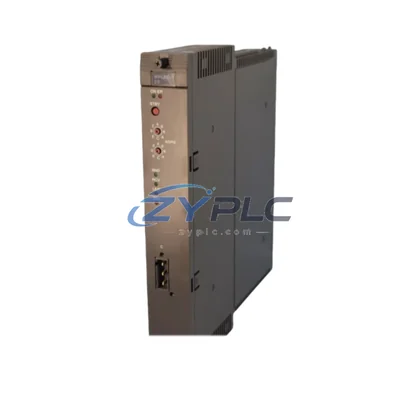
Allen-Bradley 1771-NC15 Analog I/O for 1771
The Allen-Bradley 1771-NC15 is a precision analog I/O module engineered for seamless integration within the 1771 PLC control system architecture. Designed to bridge the gap between field-level instrumentation and the central control layer, this module plays a critical role in maintaining signal fidelity, system consistency, and real-time process visibility across complex industrial environments. Whether deployed in a standalone control cabinet or as part of a multi-rack distributed architecture, the 1771-NC15 delivers the analog signal conditioning and I/O expansion capability that modern automation systems demand.
In layered automation architectures, the 1771-NC15 occupies the I/O layer — the essential interface between physical process variables and the logic execution environment of the PLC CPU. It receives analog signals from field instruments such as pressure transmitters, temperature sensors, flow meters, and level transducers, converting them into digital values that the controller can process in real time. This signal flow is fundamental to closed-loop control, alarm management, and process optimization across industries ranging from petrochemical refining to water treatment and power generation.
The module is fully compatible with the 1771 I/O chassis and backplane system, allowing engineers to configure mixed analog and digital I/O racks without compromising system integrity. When paired with the 1771-A2B or 1771-A4B I/O chassis, the 1771-NC15 integrates directly into the rack’s backplane communication bus, ensuring low-latency data exchange with the processor module. This tight coupling between the I/O layer and the control layer is what enables the 1771 platform to maintain deterministic scan times even under high-channel-count configurations.
Product Specification Table
| Attribute |
Specification |
| System Role |
Analog I/O Module — Field Signal Interface Layer |
| Compatible Platform |
Allen-Bradley 1771 PLC I/O System |
| Signal Type |
Analog Input / Output (Thermocouple / RTD / mA / mV) |
| Communication |
1771 Backplane Bus (parallel I/O rack communication) |
| Electrical Parameters |
Backplane powered; field-side isolation per channel group |
| Installation Environment |
Industrial control cabinet; DIN rail or rack-mount chassis |
| Network Compatibility |
Compatible with DH+, DH-485 via upstream processor modules |
| System Application |
Process control, SCADA integration, PID loop management |
| Warranty |
warranty terms confirmed during quotation — tested, inspected, and shipment arranged after confirmation |
System Compatibility Notes
The 1771-NC15 does not operate in isolation — its value is fully realized when understood within the broader control system architecture it supports. At the control layer, the Allen-Bradley PLC-5 processor (such as the 1785-L40B or 1785-L80B) serves as the system brain, executing ladder logic and managing I/O scan cycles. The 1771-NC15 feeds analog process data directly into this processor via the 1771 backplane, enabling real-time PID control, setpoint comparison, and alarm threshold evaluation without additional signal conditioning hardware.
At the power layer, the 1771-P4S or 1771-P7 power supply modules provide regulated DC power to the I/O chassis, ensuring that analog modules like the 1771-NC15 receive stable, noise-free power — a critical requirement for maintaining measurement accuracy in millivolt-level thermocouple and RTD applications. Power supply redundancy can be achieved by pairing dual 1771-P4S units in high-availability configurations, protecting analog signal integrity even during partial power failures.
For human-machine interface integration, the 1771-NC15 analog data is typically surfaced through PanelView terminals or FactoryTalk View SE SCADA systems, where operators monitor real-time process values, trend historical data, and respond to alarm conditions. The data path from field sensor → 1771-NC15 → PLC-5 processor → DH+ network → PanelView HMI represents a complete, validated signal chain that has been proven across decades of industrial deployment.
In distributed architectures, the 1771-SDN DeviceNet Scanner or 1771-ASB Remote I/O Adapter modules extend the reach of the 1771 system beyond the local control cabinet, allowing analog I/O racks equipped with the 1771-NC15 to be located closer to field instruments — reducing wiring costs and improving signal quality. This architecture is particularly effective in large-footprint facilities such as chemical plants, water treatment stations, and mining operations where field devices may be hundreds of meters from the central control room.
At the execution layer, analog output signals from the 1771-NC15 drive final control elements such as control valves, variable frequency drives (VFDs), and electro-pneumatic positioners. The module’s output channels provide the 4–20 mA or voltage signals required to command these devices with precision, completing the closed-loop control architecture from sensor to actuator.
Industrial Application Notes
The Allen-Bradley 1771-NC15 has established a strong track record across a wide range of process-intensive industries. In petrochemical and refining applications, the module manages analog signals from pressure, temperature, and flow transmitters distributed across distillation columns, heat exchangers, and reactor vessels. Its ability to handle thermocouple and RTD inputs directly — without external signal conditioners — simplifies panel design and reduces potential failure points in safety-critical environments.
In power generation and electrical substation automation, the 1771-NC15 interfaces with current transformers, voltage transducers, and power quality meters, feeding real-time electrical parameters into the PLC-5 control system for load balancing, fault detection, and protective relay coordination. The module’s isolation characteristics and noise immunity make it well-suited for the electrically harsh environments typical of switchgear rooms and generator control panels.
Water and wastewater treatment facilities rely on the 1771-NC15 for continuous monitoring of pH, dissolved oxygen, turbidity, and flow rate — all critical parameters for regulatory compliance and process efficiency. The module’s multi-channel analog input capability allows a single rack slot to handle multiple sensor inputs, maximizing chassis density and minimizing the number of I/O racks required in space-constrained pump stations and treatment plant control rooms.
In metals, mining, and mineral processing applications, the 1771-NC15 supports analog control of conveyor speed references, crusher load monitoring, flotation cell level control, and kiln temperature management. Its compatibility with the broader 1771 ecosystem — including 1771-OFE analog output modules and 1771-IFE analog input modules — allows engineers to build comprehensive analog I/O strategies tailored to the specific signal mix of each application.
Packaging and material handling lines use the 1771-NC15 for tension control, web guiding, and fill-level verification, where precise analog feedback is essential for maintaining product quality and minimizing waste. Integration with servo drives and VFDs via analog command signals allows the PLC-5 system to maintain tight speed and position control across multi-axis packaging machinery.
Product Compatibility FAQ
Q1: Is the 1771-NC15 compatible with all 1771 I/O chassis and PLC-5 processor families?
The 1771-NC15 is designed for use within the Allen-Bradley 1771 I/O system and is compatible with standard 1771 I/O chassis including the 1771-A1B, 1771-A2B, 1771-A3B, and 1771-A4B. It communicates via the 1771 backplane bus and is supported by PLC-5 processors including the 1785-L20B, 1785-L40B, and 1785-L80B families. Configuration is performed through RSLogix 5 software, and the module’s I/O map integrates directly into the processor’s data file structure without requiring special drivers or adapters.
Q2: How does the 1771-NC15 support long-term system maintainability and architecture consistency?
Because the 1771 platform has been in production for decades, spare parts availability and engineering familiarity are key advantages for facilities committed to long-term operation of existing infrastructure. The 1771-NC15 can be replaced on a like-for-like basis without requiring software reconfiguration, provided the replacement module is configured identically. Our warranty terms confirmed during quotation covers the module against defects in materials and workmanship, and each unit is tested prior to shipment to verify analog accuracy, channel isolation, and backplane communication integrity.
Q3: What installation and commissioning support is available for the 1771-NC15 in new or expanded control architectures?
The 1771-NC15 is shipped pre-tested and ready for installation. Module addressing is set via the backplane address switches on the module face, and I/O configuration is completed within the RSLogix 5 project file. For system expansions, the module can be added to an existing rack without taking the entire system offline, provided the chassis has available slots and the processor’s I/O scan list is updated accordingly. Our team provides pre-sales technical support to assist with rack layout planning, address assignment, and compatibility verification for both new installations and legacy system expansions.