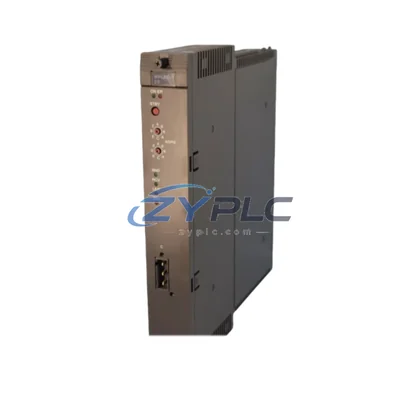
Allen-Bradley 1775-MEA Industrial Network Interface for 1775 Series Systems
In modern industrial environments, seamless data flow between field devices, controllers, remote I/O modules, HMI panels, SCADA platforms, and drive systems is no longer optional — it is the foundation of operational efficiency. The Allen-Bradley 1775-MEA 64K Error Correcting RAM Memory Module is engineered to serve as a critical node in this data chain, providing the PLC-5 processor family and the broader 1775 Series control architecture with the reliable, high-integrity memory backbone required for real-time industrial communication and deterministic control execution.
At its core, the 1775-MEA delivers 64K of error-correcting RAM, ensuring that data stored and retrieved during ladder logic execution, I/O scanning, and inter-processor messaging remains bit-accurate under demanding electrical environments. In facilities where electromagnetic interference from variable frequency drives, servo amplifiers, and high-current switching equipment is a constant challenge, the error-correction capability of the 1775-MEA directly reduces the risk of data corruption that could otherwise trigger unplanned shutdowns or false fault conditions.
Compatibility & Integration Notes
| Attribute |
Specification |
| SKU / Part Number |
1775-MEA |
| Memory Capacity |
64K Error Correcting RAM |
| Compatible Platform |
Allen-Bradley PLC-5 / 1775 Series |
| Protocol Support |
Data Highway Plus (DH+), Remote I/O (RIO), DF1 |
| Interface Type |
Backplane / Processor Memory Slot |
| Network Compatibility |
PLC-5 Family, 1771 I/O, 1775 Series Chassis |
| System Application |
PLC Memory Expansion, Real-Time Control, SCADA Integration |
| Origin |
United States |
| Warranty |
warranty terms confirmed during quotation |
| Availability |
RFQ Available — Ships via DHL / FedEx Globally |
Connected Automation Data Flow
The 1775-MEA operates within a tightly integrated control architecture where every component in the data chain plays a defined role. In a typical PLC-5-based system, the processor reads field signals from 1771-IFE analog input modules and 1771-OFE analog output modules, processes them through ladder logic held in the 1775-MEA’s error-correcting RAM, and transmits control commands back to actuators and drives within a single scan cycle. This deterministic execution is what makes the 1775 Series architecture suitable for high-speed process control applications.
Upstream, the PLC-5 processor communicates with supervisory systems via Data Highway Plus (DH+) — a peer-to-peer industrial network that connects multiple PLC-5 and SLC 500 controllers across a facility. The 1785-KA5 DH+ communication adapter bridges the PLC backplane to the DH+ network, enabling the SCADA host — often running on a Rockwell FactoryTalk View SE platform — to poll real-time process data, push setpoint changes, and log historical trends without interrupting the controller’s scan cycle.
For remote I/O connectivity, the PLC-5 processor uses the 1771-ASB remote I/O adapter to extend its I/O reach across the plant floor. Remote I/O racks housing 1771-IB16 digital input modules and 1771-OB16 digital output modules connect back to the main chassis over the Remote I/O (RIO) link, allowing field devices — including proximity sensors, limit switches, solenoid valves, and motor starters — to be distributed across large production areas without running individual signal cables back to the central control panel.
Drive integration is handled through the 1336 PLUS II variable frequency drive, which accepts speed and torque references from the PLC-5 via hardwired analog signals or through the DH+ network using the 1336-GM1 communication module. This closed-loop drive control, supported by the memory integrity of the 1775-MEA, ensures that motor speed profiles are executed precisely — reducing energy waste during partial-load operation and extending motor service life through smooth acceleration and deceleration ramps.
HMI panels such as the PanelView 1000 connect to the DH+ network to provide operators with real-time process visualization, alarm acknowledgment, and manual override capability. The data displayed on the HMI is sourced directly from the PLC-5 data table — the same memory space managed by the 1775-MEA — ensuring that what operators see on screen accurately reflects the current state of the process without latency or data translation errors.
Solving Data Isolation in Industrial Sites
One of the most persistent challenges in legacy industrial installations is data isolation — the condition where field devices, controllers, and supervisory systems operate in silos, unable to share process data in real time. The Allen-Bradley 1775-MEA, as the memory core of the PLC-5 processor, plays a direct role in eliminating this isolation by providing the data table that serves as the single source of truth for all connected systems.
In facilities that have grown organically over decades, it is common to find multiple PLC platforms, communication protocols, and I/O architectures coexisting on the same plant floor. The 1775 Series architecture addresses this through its support for multiple communication ports — DH+, Remote I/O, and DF1 serial — allowing the PLC-5 to act as a protocol bridge between older field devices and modern SCADA or MES systems. When a 1785-L80E PLC-5/80E processor is equipped with the 1775-MEA memory module, it gains the capacity to manage large data tables that aggregate signals from hundreds of I/O points, enabling plant-wide transparency without requiring a full system replacement.
Remote diagnostics is another area where the 1775-MEA’s role becomes critical. Because the error-correcting RAM ensures data integrity at the processor level, remote maintenance engineers accessing the PLC-5 via a 1784-PCMK DH+ interface card or an Ethernet-to-DH+ gateway can trust that the data they read remotely matches the actual process state. This eliminates the need for on-site verification of every diagnostic reading, reducing maintenance travel costs and accelerating fault resolution times.
For facilities planning to migrate toward Ethernet-based architectures, the 1775-MEA supports a phased transition strategy. The PLC-5 can continue to manage legacy field devices over RIO and DH+ while an EtherNet/IP-to-DH+ gateway provides connectivity to modern Logix-based systems and cloud-connected MES platforms. This coexistence capability protects the capital investment in existing 1775 Series hardware while enabling incremental modernization — a practical approach for continuous-process industries where full system shutdowns for migration are not feasible.
Every 1775-MEA unit supplied by ZYPLC undergoes pre-shipment functional testing to verify memory integrity, error-correction performance, and backplane compatibility. Units are shipped with full documentation and are backed by a warranty terms confirmed during quotation, with availability confirmed by RFQ availability ensuring short lead times for urgent maintenance and production continuity requirements.
Industrial Connectivity FAQ
Q1: Does the 1775-MEA introduce any communication latency in the PLC-5 scan cycle?
No. The 1775-MEA is a backplane-resident memory module that operates at processor bus speed. It does not add network latency to DH+ or Remote I/O communications. Scan cycle time is determined by the processor model and the size of the ladder logic program, not by the memory module.
Q2: Is the 1775-MEA compatible with all PLC-5 processor variants?
The 1775-MEA is designed for use with the Allen-Bradley 1775 Series chassis and PLC-5 processor family. Compatibility should be verified against the specific processor model and chassis configuration. ZYPLC’s technical team can assist with compatibility confirmation prior to order.
Q3: Can the 1775-MEA be used in systems that are being migrated to ControlLogix?
Yes. During a phased migration, the 1775-MEA continues to support the existing PLC-5 system while ControlLogix handles new or migrated sections of the process. Protocol gateways bridge the two platforms during the transition period, allowing both systems to share data without interrupting production.
Q4: What does the warranty terms confirmed during quotation cover, and what is the lead time?
The warranty terms confirmed during quotation covers manufacturing defects and functional failures under normal operating conditions. ZYPLC maintains RFQ-confirmed sourcing of the 1775-MEA, with same-day or next-day dispatch available for urgent orders. Global shipping is handled via DHL and FedEx with full tracking.