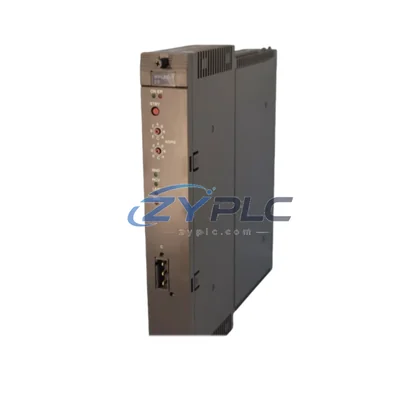
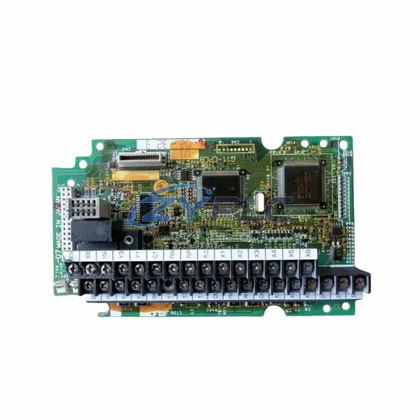
Fuji Electric NP1BS-06 Base Board for NP1B Series
The Fuji Electric NP1BS-06 is a six-slot base board (backplane) engineered for deployment within the MICREX-F / NP1B Series programmable logic controller platform. In modern industrial automation, a base board is far more than a passive mounting structure — it is the physical and electrical backbone that determines how effectively a control system can scale, communicate, and sustain long-term operational reliability. The NP1BS-06 fulfills this role by providing a structured, electrically stable foundation across which CPU modules, I/O modules, power supply units, and communication interfaces interact as a unified control architecture.
Understanding the NP1BS-06 requires placing it within the broader context of layered automation design. In a typical MICREX-F system deployment, the control hierarchy begins at the CPU layer, where a processor such as the NP1PS-08 or NP1PS-16 executes the control logic and manages scan cycles. The NP1BS-06 base board physically hosts this CPU alongside the modules it must coordinate — including digital input modules like the NP1X16-MW, digital output modules such as the NP1Y16T-PW, and analog signal modules for process variable acquisition. Each of these modules slots into the NP1BS-06 and communicates via the internal backplane bus, which the base board maintains with consistent electrical integrity across all six positions.
Product Specification Table
| Parameter |
Specification |
| Model |
NP1BS-06 |
| Brand |
Fuji Electric |
| Series |
MICREX-F / NP1B Series |
| System Role |
6-Slot PLC Base Board (Backplane) |
| Compatible CPU Modules |
NP1PS-08, NP1PS-16, NP1PS-32 Series |
| Slot Capacity |
6 Module Slots |
| Backplane Bus |
Parallel internal bus for CPU-I/O-COM coordination |
| Power Input |
Via dedicated NP1B Series power supply module |
| Communication Support |
Compatible with NP1L-RS1, NP1L-ET1 communication modules |
| Installation Method |
DIN rail or panel mount |
| Operating Temperature |
0°C to 55°C |
| Storage Temperature |
-20°C to 70°C |
| Relative Humidity |
10% to 90% RH (non-condensing) |
| Origin |
Japan |
| Warranty |
warranty terms confirmed during quotation |
System Compatibility Notes
The NP1BS-06 achieves its full value when evaluated as a coordination platform rather than an isolated component. In a complete NP1B Series control cabinet, the base board serves as the integration point for every functional layer of the automation system.
At the power layer, a dedicated NP1B Series power supply module — such as the NP1PW24 — mounts directly onto the base board and distributes regulated DC power to all installed modules. This centralized power architecture eliminates the need for external power distribution rails for individual modules, reducing wiring complexity and improving cabinet-level reliability.
At the control layer, the CPU module (e.g., NP1PS-16) occupies the designated CPU slot on the NP1BS-06 and manages all scan-cycle operations, program execution, and inter-module communication. The base board’s internal bus ensures that the CPU can address each I/O slot with deterministic timing, which is critical for high-speed process control applications in manufacturing and utilities.
At the I/O layer, digital and analog modules populate the remaining slots. A typical configuration might include the NP1X16-MW for 16-channel 24VDC digital inputs, the NP1Y16T-PW for transistor-type digital outputs, and an analog input module for 4–20mA process signals. The NP1BS-06 ensures that all these modules share a common backplane reference, enabling the CPU to execute coordinated read-write cycles without signal latency between channels.
At the communication layer, modules such as the NP1L-RS1 (RS-232C/RS-485 serial) or NP1L-ET1 (Ethernet) can be installed in available slots to extend the system’s connectivity to SCADA platforms, HMI terminals, or upstream MES systems. This system integration capability allows the NP1BS-06-based rack to participate in plant-wide data exchange without requiring external communication gateways.
At the HMI layer, operator interface terminals connect via the communication modules hosted on the NP1BS-06, enabling real-time visualization of process variables, alarm management, and parameter adjustment from the control room or field panel.
For applications requiring redundancy, the NP1BS-06 can be deployed in a primary-standby architecture alongside a secondary rack, with switchover logic managed at the CPU level. This design pattern is common in power distribution substations, water treatment facilities, and continuous process industries where unplanned downtime carries significant operational cost.
Industrial Application Notes
The NP1BS-06 has been deployed across a wide range of industrial sectors, each of which places distinct demands on the base board’s structural and electrical performance.
In manufacturing and assembly lines, the NP1BS-06 supports high-cycle-rate machine control where the CPU must process dozens of I/O updates per scan cycle. The stable backplane bus ensures that digital output modules respond to CPU commands within the required timing window, supporting precise sequencing of actuators, conveyors, and robotic end-effectors.
In electric power and substation automation, the NP1BS-06 provides the physical platform for protection relay logic, breaker control, and status monitoring. Its compatibility with serial communication modules enables integration with IEC 60870-5-101/104 SCADA protocols via external converters, supporting grid-level supervisory control.
In petrochemical and refinery process control, the base board’s operating temperature range and vibration tolerance make it suitable for installation in field control panels located near process equipment. Analog I/O modules hosted on the NP1BS-06 acquire temperature, pressure, and flow signals from field transmitters, feeding real-time data to the CPU for PID loop execution.
In water and wastewater treatment, the NP1BS-06 supports pump station automation, dosing control, and level monitoring. Its modular architecture allows operators to expand I/O capacity by adding extension racks connected via the NP1L-RS1 communication module, accommodating growing process complexity without replacing the base control hardware.
In mining and metallurgical processing, the NP1BS-06 is used in conveyor drive control, crusher sequencing, and ore processing automation. The base board’s robust construction supports reliable operation in environments with elevated dust levels and mechanical vibration, provided appropriate enclosure ratings are applied at the cabinet level.
Product Compatibility FAQ
Q1: Is the NP1BS-06 compatible with all NP1B Series CPU and I/O modules?
The NP1BS-06 is designed for use within the Fuji Electric MICREX-F / NP1B Series platform and is compatible with NP1B Series CPU modules (NP1PS-08, NP1PS-16, NP1PS-32), standard digital and analog I/O modules, and NP1L Series communication modules. Compatibility should be verified against the specific firmware revision of the CPU module and the NP1B Series hardware configuration manual prior to system commissioning. Our technical team can assist with configuration validation as part of the warranty terms confirmed during quotation support service.
Q2: Can the NP1BS-06 be used in a redundant control architecture?
Yes. The NP1BS-06 can serve as the base board in both the primary and standby racks of a redundant NP1B Series system. Redundancy switchover is managed at the CPU module level, and the base board’s role is to provide a stable, electrically consistent mounting platform for all modules in each rack. For critical applications in power generation, water treatment, or continuous process industries, deploying paired NP1BS-06 racks with synchronized CPU modules is a recommended architecture for achieving high system availability. system integration between the primary and standby racks is maintained via the communication modules installed on each base board.
Q3: What does the warranty terms confirmed during quotation cover, and what support is available for long-term maintenance?
The warranty terms confirmed during quotation covers manufacturing defects and functional failures under normal operating conditions from the date of shipment. During the warranty period, defective units are repaired or replaced at no additional cost. For long-term maintenance planning, we recommend maintaining a spare NP1BS-06 in inventory, as base board replacement is a straightforward procedure that does not require CPU reprogramming — module configurations are retained in the CPU’s non-volatile memory. Our engineering support team is available to assist with installation verification, slot configuration guidance, and system architecture consultation throughout the product lifecycle.