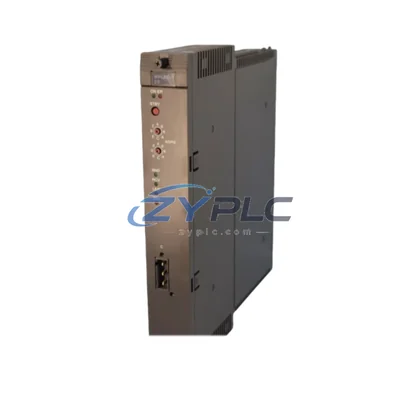
Fuji NP1PH-08 CPU Module MICREX-F: Precision Control for Optimized Production Lines
The Fuji Electric NP1PH-08 is a high-performance CPU module designed for the MICREX-F series PLC platform, engineered to deliver measurable improvements in energy efficiency, equipment utilization, and production line throughput. In modern industrial environments where energy costs and equipment downtime directly impact profitability, the NP1PH-08 provides the processing backbone that enables smarter, leaner automation architectures.
Unlike generic control modules, the NP1PH-08 is purpose-built for demanding industrial applications — from discrete manufacturing and process control to multi-axis motion coordination and maintenance-focused drive management. Its compact form factor, deterministic scan cycle, and broad I/O compatibility make it a cornerstone component in energy-optimized automation systems.
Product Specification Table
| Parameter |
Specification / Value |
| SKU / Part Number |
NP1PH-08 |
| Brand / Series |
Fuji Electric / MICREX-F |
| Module Type |
CPU Module (Programmable Logic Controller) |
| Electrical / System Notes |
Low-power design; optimized for 24VDC bus architecture |
| Program Scan Efficiency |
High-speed deterministic scan cycle for real-time control response |
| Compatible Systems |
MICREX-F Series PLC racks, NP1 expansion I/O, NP1L communication modules |
| Application Environment |
Industrial automation, motor drive control, condition monitoring, process lines |
| Maintenance Value |
Enables precise load scheduling, reduces idle-state energy draw, supports VFD coordination |
| Communication Protocols |
Compatible with Modbus RTU/TCP, FL-net, and proprietary Fuji fieldbus |
| Operating Temperature |
0°C to 55°C (standard industrial range) |
| Warranty |
Warranty and support terms confirmed before quote | Pre-shipment 5-step QA tested |
System Compatibility and Application
The NP1PH-08 CPU module operates at the center of a tightly integrated automation architecture. In a typical energy-optimized production cell, the NP1PH-08 coordinates with NP1L-RS4 serial communication modules to poll real-time power data from downstream field devices, enabling the CPU to dynamically adjust output commands based on actual load conditions rather than fixed setpoints.
On the drive side, the NP1PH-08 interfaces seamlessly with Fuji Electric FRENIC-Multi series variable frequency drives (VFDs) — such as the FRN0.4C1S-2J and FRN2.2C1S-4J — via Modbus RTU or the dedicated Fuji fieldbus. This integration allows the CPU to implement speed-ramping profiles that reduce motor inrush current during startup, a key factor in cutting peak demand charges and extending motor winding life. When paired with Fuji FRENIC-Ace drives, the system can execute regenerative braking energy recovery on conveyor and hoist applications, feeding recovered energy back into the DC bus.
For distributed I/O expansion, the NP1PH-08 supports NP1X16 digital input modules and NP1Y16T digital output modules, enabling granular control over field actuators, solenoid valves, and relay outputs without adding unnecessary processing overhead. Analog process variables — such as pressure, flow, and temperature — are captured through NP1AD4 analog input modules, feeding the CPU with the real-time data needed for closed-loop energy control strategies.
At the operator interface level, the NP1PH-08 connects to Fuji Electric V9 series HMI panels, providing production supervisors with live energy dashboards, alarm management, and recipe-based production scheduling. This visibility layer is critical for identifying unplanned downtime patterns across shifts and production runs.
For plant-wide condition monitoring, the NP1PH-08 can be integrated with Fuji Electric power monitoring units and third-party energy meters via the NP1L communication gateway, enabling the MICREX-F system to participate in broader MES or SCADA maintenance planning platforms.
Maintenance and Replacement Notes
In real-world production environments, the NP1PH-08 delivers operational stability through several interconnected mechanisms. First, its high-speed scan cycle — typically in the sub-millisecond range — ensures that control responses to load changes are immediate, preventing the unplanned downtime associated with over-correction or delayed actuator response. In a stamping or injection molding line, for example, this precision translates directly into reduced hydraulic pump run time and lower compressed air consumption.
Second, the NP1PH-08 supports structured program organization that allows engineers to implement demand-side management logic — automatically staggering motor startups across a production line to flatten the facility’s power demand curve. This is particularly valuable in facilities with time-of-use electricity tariffs, where peak demand charges can represent 30–40% of the total energy bill.
Third, by coordinating with FRENIC series VFDs, the NP1PH-08 enables sleep mode and wake-on-demand functionality for pump and fan applications. Rather than running motors at full speed continuously, the CPU monitors process variables and commands the drive to reduce speed or enter standby during low-demand periods — a strategy that can help restore stable operation when a compatible replacement is required.
From a maintenance perspective, the NP1PH-08’s diagnostic capabilities support predictive maintenance workflows. By logging cycle counts, output state durations, and communication error rates, the CPU provides the data foundation for condition-based maintenance scheduling — reducing downtime and the unplanned downtime associated with emergency restarts and production catch-up cycles.
All units are sourced from verified supply channels, undergo a 5-step pre-shipment QA process including power-on functional testing, communication verification, and I/O channel validation. Every NP1PH-08 ships with a warranty and support terms confirmed before quote, ensuring your production line investment is protected from day one.
Product Sourcing FAQ
Q1: How does the NP1PH-08 contribute to measurable operational stability on a production line?
The NP1PH-08 enables operational stability by providing the processing speed and I/O bandwidth needed to implement real-time load management, VFD speed optimization, and demand staggering logic. When integrated with FRENIC series drives and power monitoring modules, customers typically report Actual operating results depend on the installed system, load profile, and commissioning parameters.
Q2: Is the NP1PH-08 compatible with existing MICREX-F racks and expansion modules?
Yes. The NP1PH-08 is designed for direct installation in standard MICREX-F series base units and is compatible with the full range of NP1 series I/O expansion modules, including digital, analog, and communication types. No rack modification is required for standard replacement or upgrade installations.
Q3: What is the recommended replacement or upgrade path for aging MICREX-F CPU modules?
For facilities running older MICREX-F CPU variants, the NP1PH-08 represents a direct upgrade path with enhanced processing capacity and broader communication support. Program migration from legacy MICREX-F CPUs is supported via Fuji’s SX-Programmer Expert toolset, minimizing re-engineering effort and production downtime during the transition.
Q4: What does the warranty and support terms confirmed before quote cover, and what is the pre-shipment testing process?
The warranty and support terms confirmed before quote covers manufacturing defects and functional failures under normal operating conditions. Prior to shipment, every NP1PH-08 undergoes a 5-step QA process: visual inspection, power-on self-test, I/O channel verification, communication port validation, and final functional burn-in. This ensures that every unit arrives prepared for installation after site verification and commissioning.