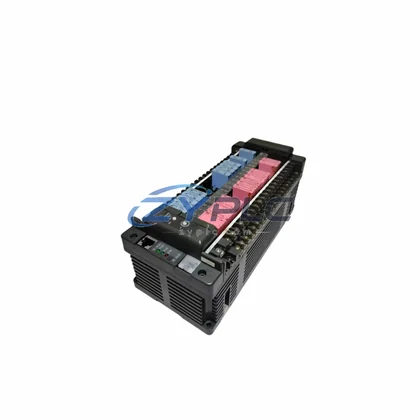
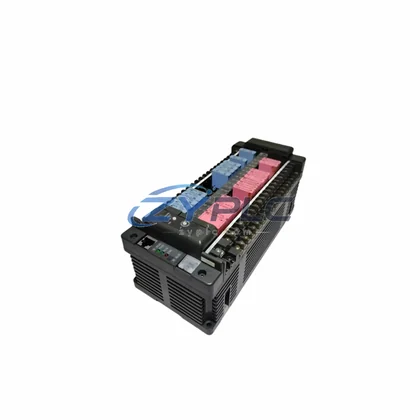
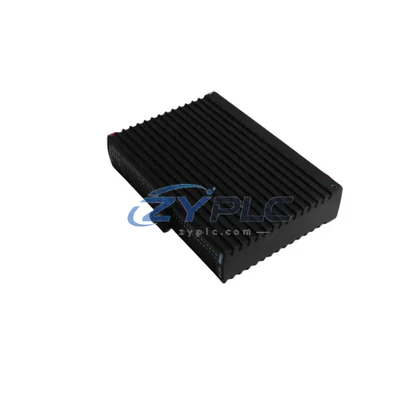
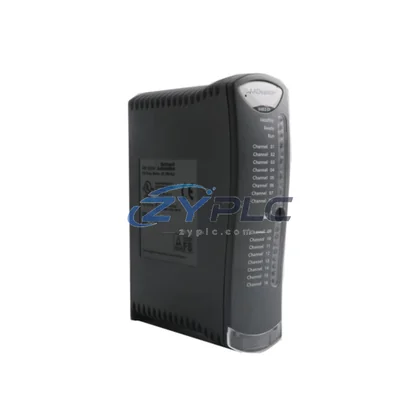
Fuji NP1Y16R-08 Industrial Network Interface for NP1 Systems: Bridging Field Devices and Smart Factory Data Links
In modern industrial environments, the ability to reliably transmit discrete output signals across a distributed control network is fundamental to operational continuity. The Fuji NP1Y16R-08 is a 16-point relay digital output module engineered for the Fuji Electric NP1 Series programmable logic controller platform — a compact, high-density automation backbone widely deployed in manufacturing, process control, and smart factory applications across Asia and globally.
As factories evolve toward Industry 4.0 architectures, the NP1Y16R-08 serves as a critical node in the output data chain: receiving commands from the NP1 CPU, converting logic states into relay contact closures, and driving field actuators, solenoid valves, motor starters, indicator lamps, and safety interlocks. Its relay output design ensures electrical isolation between the control circuit and the load circuit, making it suitable for mixed-voltage field environments where signal integrity and equipment protection are paramount.
Whether integrated into a standalone NP1 rack or deployed as part of a distributed I/O expansion across a multi-drop RS-485 network, the NP1Y16R-08 delivers consistent, low-latency output response that supports real-time control loops, alarm actuation, and interlock logic — all essential functions in SCADA-supervised production lines.
Compatibility & Integration Notes
| Parameter |
Specification |
| SKU / Part Number |
NP1Y16R-08 |
| Brand / Manufacturer |
Fuji Electric |
| Series |
NP1 PLC Series |
| Module Type |
16-Point Relay Digital Output Module |
| Output Type |
Relay Contact (NO) |
| Points per Module |
16 Output Points |
| Communication Protocol |
NP1 Backplane Bus / RS-485 (via NP1L-RS1 or NP1W-RS1 link module) |
| Network Compatibility |
Fuji NP1 Local Bus, Modbus RTU (via gateway), PROFIBUS-DP (via NP1L-PB1) |
| System Application |
PLC Output Expansion, SCADA Integration, HMI-Driven Control, Remote I/O |
| Interface Type |
NP1 Backplane Slot / Terminal Block Field Wiring |
| Transmission Capability |
Real-Time Discrete Output, Relay Isolation, Mixed-Voltage Load Support |
| Country of Origin |
Japan |
| Warranty |
warranty terms confirmed during quotation |
| Availability |
RFQ Available — shipment arranged after confirmation |
Connected Automation Data Flow
The NP1Y16R-08 operates within a tightly integrated data flow that begins at the CPU and extends to the physical field layer. In a typical NP1 system architecture, the NP1PM-48E CPU module executes the ladder logic program and writes output coil states to the backplane bus. The NP1Y16R-08 reads these states in real time and energizes or de-energizes its 16 relay contacts accordingly — driving actuators, contactors, and alarm devices on the plant floor.
For applications requiring remote I/O expansion beyond the local rack, the NP1L-RS1 serial communication link module enables RS-485 multi-drop connectivity, allowing the NP1Y16R-08 to be mounted in a remote expansion rack while maintaining synchronous data exchange with the master CPU. In larger installations, the NP1L-EC1 EtherNet/IP communication module bridges the NP1 backplane to the plant Ethernet network, enabling SCADA systems and MES platforms to monitor output states and issue control commands over TCP/IP.
On the input side, field sensor data — from proximity switches, photoelectric sensors, and pressure transmitters — enters the system through companion modules such as the NP1X1606 16-point DC input module or the NP1X08-08 8-point input module. These input states are processed by the CPU and translated into output commands delivered through the NP1Y16R-08, completing the closed-loop control cycle.
For HMI integration, Fuji Electric’s V9 Series HMI panels communicate with the NP1 CPU via the NP1W-RS1 RS-232C/RS-485 link module, providing operators with real-time visualization of output states, alarm conditions, and production counters. When connected to a SCADA gateway such as the NP1L-TT1 T-Link communication module, the entire NP1 network — including the relay outputs driven by the NP1Y16R-08 — becomes accessible for remote monitoring, data logging, and predictive maintenance analytics.
Power distribution within the NP1 rack is managed by the NP1PS-32 power supply module, which provides stable 24VDC backplane power to all I/O modules including the NP1Y16R-08. For applications involving variable-speed drives, the NP1 output module can interface with Fuji Electric FRENIC-Multi or FRENIC-Ace series inverters via relay contact signals for run/stop commands, fault reset, and speed preset selection — enabling coordinated motor control within a unified automation architecture.
Solving Data Isolation in Industrial Sites
One of the most persistent challenges in industrial automation is the fragmentation of control data across incompatible protocols and isolated subsystems. Legacy equipment often communicates over proprietary serial protocols, while modern SCADA and MES platforms expect Ethernet-based, standardized data streams. The NP1Y16R-08, as part of the Fuji NP1 ecosystem, addresses this challenge through a layered connectivity strategy.
By pairing the NP1Y16R-08 with the NP1L-PB1 PROFIBUS-DP communication module, engineers can integrate the NP1 output layer into a PROFIBUS master network — enabling seamless data exchange with Siemens SIMATIC, ABB, or Schneider Electric control systems in mixed-vendor environments. Similarly, the NP1L-EC1 EtherNet/IP module allows the NP1 relay outputs to be mapped as EtherNet/IP I/O tags, accessible to Rockwell Automation ControlLogix or CompactLogix PLCs acting as scanner devices.
For production line transparency, the NP1Y16R-08’s output states can be logged by SCADA historians, enabling trend analysis, OEE calculation, and downtime root-cause investigation. Remote diagnostics are supported through the NP1 communication infrastructure: maintenance engineers can query output module status, relay cycle counts, and fault flags from a central control room or via a VPN-connected edge gateway — eliminating the need for on-site inspection during routine monitoring cycles.
System expansion is straightforward within the NP1 architecture. Additional NP1Y16R-08 modules can be added to the local rack or remote expansion racks without reprogramming the CPU — the backplane auto-assigns I/O addresses based on slot position. This plug-and-expand design reduces commissioning time and supports phased capacity growth as production demands increase.
All units supplied by ZYPLC undergo pre-shipment functional testing, verifying relay contact continuity, coil actuation response, and backplane communication integrity. Each NP1Y16R-08 is covered by a warranty terms confirmed during quotation and ships with full export documentation, ensuring compliance with international trade requirements.
Industrial Connectivity FAQ
Q1: What communication protocols does the NP1Y16R-08 support for SCADA integration?
The NP1Y16R-08 itself communicates over the NP1 backplane bus. SCADA integration is achieved through companion communication modules: the NP1L-RS1 supports Modbus RTU over RS-485, the NP1L-EC1 supports EtherNet/IP and Modbus TCP, and the NP1L-PB1 supports PROFIBUS-DP. This multi-protocol gateway capability allows the NP1 relay output layer to interface with virtually any SCADA or DCS platform.
Q2: How does the relay output design affect network latency and control response time?
Relay output modules introduce a mechanical switching delay (typically 5–15ms for relay energization) compared to transistor output modules. For most discrete control applications — motor start/stop, valve actuation, alarm annunciation — this latency is well within acceptable limits. For high-speed pulse output or encoder feedback applications, Fuji Electric’s NP1Y08T transistor output modules are recommended instead.
Q3: Can the NP1Y16R-08 be used in a remote I/O configuration away from the main CPU rack?
Yes. Using the NP1L-RS1 or NP1W-RS1 serial link modules, the NP1Y16R-08 can be installed in a remote expansion rack connected via RS-485 cable at distances up to 500 meters from the master CPU. This supports distributed I/O architectures in large facilities such as warehouses, water treatment plants, and multi-zone manufacturing lines.
Q4: What warranty and pre-shipment testing does ZYPLC provide for the NP1Y16R-08?
Every NP1Y16R-08 supplied by ZYPLC is covered by a warranty terms confirmed during quotation against manufacturing defects. Prior to shipment, each unit undergoes functional testing including relay contact verification, backplane communication check, and visual inspection for physical integrity. Expedited shipping options are available for urgent MRO and production-critical requirements.