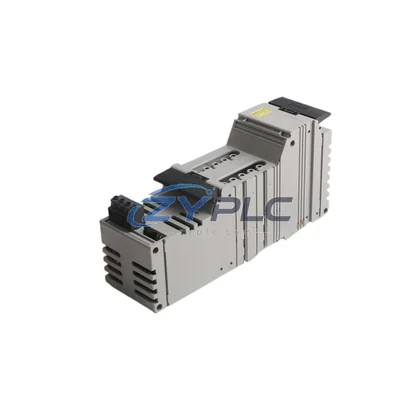
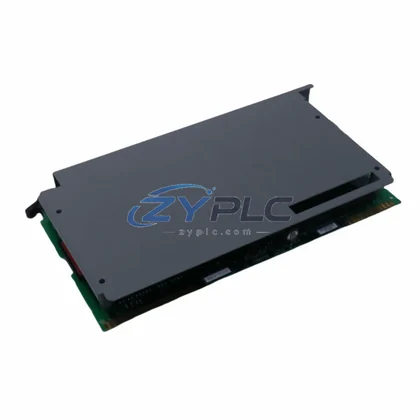
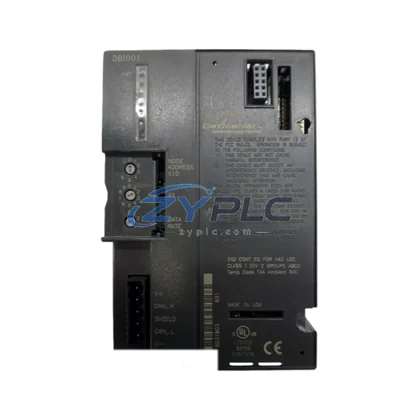
The GE Fanuc HE693THM884 is a high-precision thermocouple input module engineered for seamless integration within the Series 90-30 programmable logic controller platform. Rather than functioning as a standalone component, the HE693THM884 is designed to operate as a coordinated element within a layered automation architecture — connecting the physical process environment to the control layer through accurate, reliable temperature signal acquisition. In modern industrial control systems, the integrity of analog input data directly determines the quality of closed-loop control, process safety, and system diagnostics. The HE693THM884 fulfills this role with a multi-channel thermocouple interface that supports a range of thermocouple types, delivering calibrated temperature readings directly to the CPU over the Series 90-30 backplane bus.
Within a complete Series 90-30 control system, the HE693THM884 occupies the I/O layer, receiving raw thermocouple signals from field sensors and converting them into engineering-unit data accessible by the system CPU — typically a IC693CPU374, IC693CPU364, or IC693CPU352 — via the rack backplane. The module slots into standard 5-slot or 10-slot Series 90-30 racks such as the IC693CHS391 or IC693CHS392, sharing the same power infrastructure supplied by modules like the IC693PWR321 or IC693PWR330 power supply units. This tight physical and electrical integration ensures that the HE693THM884 contributes to overall system consistency without requiring external signal conditioning hardware.
From a signal flow perspective, thermocouple sensors installed at process measurement points — furnaces, heat exchangers, reactors, or drying chambers — transmit millivolt-level EMF signals to the HE693THM884 input terminals. The module performs cold junction compensation internally, linearizes the thermocouple characteristic curve, and presents the result as a scaled integer value in the CPU’s input image table. The CPU ladder logic or function block program then uses this data for PID temperature control, alarm management, or data logging. This architecture eliminates the need for external transmitters in many applications, reducing wiring complexity and potential failure points across the control cabinet.
System architects integrating the HE693THM884 into redundant or high-availability configurations can pair it with complementary I/O modules such as the IC693ALG222 analog voltage input module or the IC693ALG390 analog output module to build a complete analog subsystem within the same rack. For applications requiring discrete I/O alongside temperature monitoring, modules such as the IC693MDL645 DC input module or IC693MDL740 DC output module can occupy adjacent slots in the same chassis, all sharing the same backplane communication and power distribution. This modular co-location reduces panel footprint and simplifies system commissioning.
Communication between the Series 90-30 system and supervisory layers — SCADA, DCS, or MES — is typically handled through the IC693CMM321 communications coprocessor or Ethernet interface modules such as the IC693ETM001, which support Modbus TCP and SRTP protocols. The HE693THM884’s temperature data, once processed by the CPU, becomes available to these network layers for historian logging, remote monitoring, and process optimization. In facilities where multiple PLCs are networked via GE’s Genius Bus or Profibus, the Series 90-30 system acts as a field controller node, with the HE693THM884 providing the thermal process visibility that higher-level systems depend on for accurate production reporting.
For maintenance engineers, the HE693THM884 offers a straightforward replacement and commissioning process. The module is hot-swappable within the Series 90-30 rack architecture when the system is configured for I/O fault tolerance, and its configuration parameters — thermocouple type selection, range limits, filter settings — are stored in the CPU’s configuration memory, allowing a replacement module to resume operation without manual reconfiguration at the module level. This design philosophy reduces mean time to repair (MTTR) and supports the long-term maintainability goals of facilities operating continuous processes where unplanned downtime carries significant cost.
ZYPLC maintains availability subject to RFQ confirmation of the HE693THM884 with full functional testing prior to shipment. Each unit is covered by a warranty terms confirmed during quotation, ensuring that system integrators and maintenance teams can source this module with confidence for both new installations and emergency replacement scenarios. Our inventory management approach prioritizes availability of critical Series 90-30 components, recognizing that the obsolescence of legacy GE Fanuc hardware creates supply chain risk for facilities that depend on these platforms for long-term operation.
Product Specification Table
| Parameter |
Specification |
| System Role |
Thermocouple Analog Input Module — Series 90-30 I/O Layer |
| Compatible Platform |
GE Fanuc Series 90-30 PLC (IC693 family) |
| Input Channels |
8 Channels (Thermocouple) |
| Supported Thermocouple Types |
J, K, T, E, R, S, B (model-dependent) |
| Cold Junction Compensation |
Internal, automatic |
| Resolution |
15-bit + sign |
| Backplane Communication |
Series 90-30 parallel backplane bus |
| Compatible Racks |
IC693CHS391, IC693CHS392, IC693CHS397 |
| Power Requirement |
Supplied via backplane (IC693PWR321 / IC693PWR330) |
| Operating Temperature |
0°C to 60°C |
| Mounting |
Rack-mount, Series 90-30 slot |
| Isolation |
Channel-to-backplane isolation provided |
| Warranty |
warranty terms confirmed during quotation (ZYPLC) |
| Origin |
United States |
System Compatibility Notes
The HE693THM884 achieves its full value when deployed within a coordinated Series 90-30 system architecture. A typical thermal process control system built around this module includes the IC693CPU374 as the central processing unit, executing PID control loops that consume the HE693THM884’s temperature data at each scan cycle. The CPU resides in an IC693CHS392 10-slot rack alongside the HE693THM884, with power supplied by the IC693PWR330 high-capacity power supply module.
On the output side, the IC693ALG390 analog output module translates the CPU’s control signals into 4–20 mA commands for control valves, variable frequency drives, or electric heaters — closing the temperature control loop. Where discrete interlocks are required — high-temperature shutdowns, burner enable signals, or cooling fan control — the IC693MDL740 DC output module provides the necessary relay-equivalent switching capability within the same rack.
For systems requiring expanded I/O beyond a single rack, the IC693CHS397 expansion rack connected via the IC693CBL305 expansion cable allows additional modules to be added without architectural changes to the CPU configuration. In networked plant environments, the IC693ETM001 Ethernet module enables the Series 90-30 system to publish real-time temperature data to SCADA platforms over Modbus TCP, while the IC693CMM321 communications coprocessor supports legacy serial protocols for integration with older DCS systems. This layered communication architecture ensures that the HE693THM884’s thermal measurements reach every level of the plant automation hierarchy.
Industrial Application Notes
Manufacturing & Heat Treatment: In automotive component manufacturing and metal heat treatment facilities, the HE693THM884 monitors furnace zone temperatures across multiple thermocouples simultaneously, providing the Series 90-30 CPU with the data needed to maintain tight temperature uniformity across the heating chamber. The module’s multi-channel architecture allows a single rack slot to replace multiple single-channel temperature transmitters, reducing panel wiring and improving system diagnostics.
Power Generation & Utilities: In power plant auxiliary systems — boiler feedwater preheaters, turbine bearing temperature monitoring, and transformer cooling systems — the HE693THM884 provides continuous thermal surveillance. Its integration with the Series 90-30 backplane allows temperature alarms to be processed within the same PLC scan that controls protective relay outputs, minimizing response latency in safety-critical scenarios.
Petrochemical & Refining: Distillation column temperature profiling, reactor jacket monitoring, and heat exchanger performance tracking in petrochemical plants rely on accurate thermocouple data acquisition. The HE693THM884’s internal cold junction compensation eliminates the need for isothermal terminal blocks in many installations, simplifying field wiring in hazardous area junction boxes.
Water & Wastewater Treatment: Sludge digester temperature control, UV disinfection system monitoring, and chemical dosing system thermal management in water treatment facilities benefit from the HE693THM884’s reliable long-term operation. The module’s compatibility with the Series 90-30 platform — which remains widely deployed in municipal water infrastructure — ensures that facilities can maintain and expand their control systems without platform migration.
Mining & Metallurgy: Conveyor drive motor temperature monitoring, smelter process control, and ore drying system management in mining operations require robust analog input hardware capable of operating in high-vibration, high-dust environments. The HE693THM884, housed within the Series 90-30 rack enclosure, benefits from the platform’s industrial-grade design standards suited to these demanding conditions.
Product Compatibility FAQ
Q1: Is the HE693THM884 compatible with all Series 90-30 CPU models, and does it require special configuration software?
The HE693THM884 is compatible with the full range of Series 90-30 CPUs, including the IC693CPU331, IC693CPU352, IC693CPU364, and IC693CPU374. Configuration is performed using GE Fanuc’s Logicmaster 90-30 or Proficy Machine Edition software, where the module is assigned to its rack slot and thermocouple type, range, and filter parameters are set. No special licensing beyond the standard Series 90-30 hardware configuration package is required.
Q2: Can the HE693THM884 be used in a redundant CPU architecture, and how does failover affect analog data continuity?
In Series 90-30 systems configured with CPU redundancy using the IC693CPU374 and redundancy modules, the HE693THM884’s I/O data is synchronized to the standby CPU via the redundancy link. Upon failover, the standby CPU assumes control with the last-known analog values from the HE693THM884, and normal scanning resumes within the redundancy switchover time. This ensures that temperature-based control loops experience minimal disruption during a CPU failover event.
Q3: What does the warranty terms confirmed during quotation cover, and what is the process for warranty claims on the HE693THM884?
ZYPLC’s warranty terms confirmed during quotation covers functional defects in the HE693THM884 arising from manufacturing or component failure under normal operating conditions. Each module is tested prior to shipment to verify channel accuracy, backplane communication, and cold junction compensation performance. In the event of a warranty claim, customers contact ZYPLC at plc.sales@zyplc.com or +86 19859288691 to initiate the return authorization process. Replacement or repair is completed and the module returned to the customer within the agreed service timeline, minimizing system downtime.