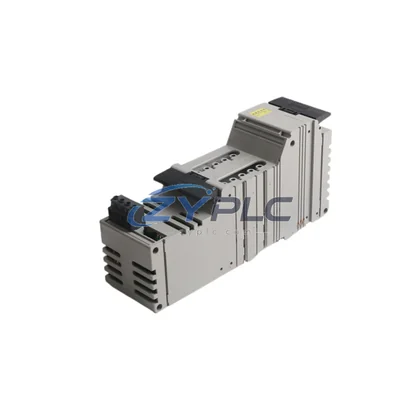
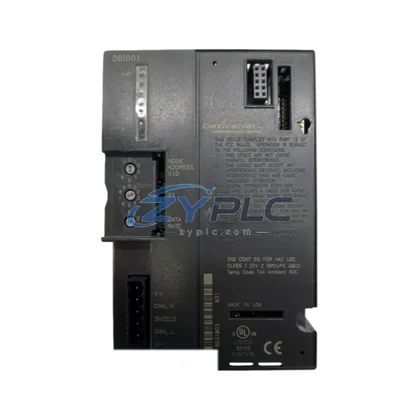
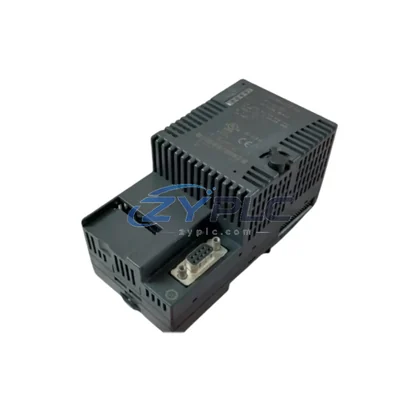
GE Fanuc IC670ALG320 Analog Output for IC670
The GE Fanuc IC670ALG320 is a precision analog output module engineered for seamless integration within the IC670 Series distributed I/O architecture. In modern industrial control environments, analog output capability is not a standalone function — it is a critical node in a layered automation hierarchy that spans the control layer, I/O layer, network layer, power layer, human-machine interface layer, and execution layer. The IC670ALG320 is purpose-built to serve as the signal conversion bridge between the digital control domain and the physical process world, delivering stable, repeatable analog signals to field devices such as control valves, variable frequency drives, and proportional actuators.
Within the IC670 distributed I/O platform, the IC670ALG320 occupies a well-defined role in the I/O layer. It receives setpoint data from the CPU module — typically a Series 90-70 or Series 90-30 programmable logic controller — via the IC670 bus interface unit, translates those digital values into calibrated analog output signals, and transmits them downstream to the execution layer. This signal flow is deterministic, low-latency, and fully synchronized with the scan cycle of the host controller, ensuring that process variables such as flow rate, pressure, temperature, and valve position are controlled with the precision that demanding industrial applications require.
System architects designing with the IC670ALG320 benefit from its native compatibility with the IC670 bus coupler and backplane infrastructure. When paired with complementary modules such as the IC670ALG620 analog input module, the IC670MDL640 discrete output module, and the IC670MDL340 discrete input module, the IC670ALG320 enables a fully balanced I/O subsystem capable of handling both analog and digital process signals within a single distributed node. This modular co-location reduces wiring complexity, shortens commissioning time, and simplifies long-term maintenance by consolidating field terminations at a single physical location.
At the network layer, the IC670 bus interface unit — such as the IC670GBI002 — connects the distributed I/O node to the host PLC backplane or to a fieldbus network, enabling the IC670ALG320 to participate in larger, multi-drop control architectures. In applications where the host controller is a Series 90-70 rack system, the IC670ALG320 node can be located remotely from the main CPU rack, reducing the cost and complexity of long analog signal cable runs while maintaining signal integrity. For installations requiring redundant communication paths, the IC670 architecture supports dual-bus configurations that protect against single-point communication failures, ensuring that analog output commands continue to reach field devices even during partial network faults.
The power layer supporting the IC670ALG320 is provided by the IC670PWR002 or equivalent IC670 series power supply module, which delivers regulated DC power to the bus coupler and all attached I/O modules. Proper power architecture design — including load calculation, power budget verification, and the use of isolated power supplies for analog circuits — is essential to achieving the signal accuracy and noise immunity that the IC670ALG320 is capable of delivering. Engineers integrating this module into new or retrofit control panels should verify that the total current draw of all modules on the IC670 node does not exceed the rated output of the selected power supply.
From the human-machine interface layer, operators interact with the processes controlled by the IC670ALG320 through SCADA systems or HMI terminals connected to the host PLC. The Series 90-70 CPU, acting as the control layer hub, processes operator setpoint inputs from the HMI, executes the control algorithm, and writes the resulting output values to the IC670ALG320 via the I/O bus. This closed-loop architecture — from operator input through the control layer, down through the I/O layer, and out to the execution layer — is the foundation of reliable, auditable process control in industries ranging from power generation to chemical processing.
Product Specification Table
| Parameter |
Specification |
| System Role |
Distributed Analog Output Module — IC670 I/O Layer |
| Compatible Platform |
GE Fanuc IC670 Series Distributed I/O |
| Host Controller Compatibility |
Series 90-70, Series 90-30 PLC via IC670 Bus Interface Unit |
| Output Signal Type |
Analog Voltage / Current Output |
| Number of Output Channels |
4 Channels (industry-standard for IC670ALG320 class) |
| Output Range |
0–10 VDC / 4–20 mA (configurable per channel) |
| Resolution |
12-bit D/A Conversion |
| Power Supply |
Supplied via IC670 Bus (IC670PWR002 or equivalent) |
| Communication Interface |
IC670 Proprietary Bus via IC670GBI002 Bus Interface Unit |
| Installation Environment |
DIN Rail / Panel Mount, IP20, Industrial Control Cabinet |
| Operating Temperature |
0°C to 60°C |
| Warranty |
warranty terms confirmed during quotation — Tested, Verified, shipment arranged after confirmation |
System Compatibility Notes
The IC670ALG320 achieves its full potential when deployed as part of a coordinated IC670 control node rather than as an isolated module. A complete distributed I/O node built around this analog output module typically includes the IC670GBI002 bus interface unit as the communication backbone, the IC670PWR002 power supply module for regulated bus power, and the IC670ALG620 analog input module to close the analog signal loop by reading process feedback signals. Discrete I/O capability is added through the IC670MDL640 discrete output module and the IC670MDL340 discrete input module, enabling the same node to handle both analog process control and digital interlock logic.
At the control layer, the Series 90-70 CPU module — housed in a 9-slot or 12-slot VME backplane — serves as the master controller, executing ladder logic or function block programs that generate the setpoint values written to the IC670ALG320. In redundant CPU architectures, a hot-standby CPU pair ensures that analog output commands continue without interruption during a primary CPU failure. The IC670ALG320’s deterministic response to bus commands makes it well-suited for these high-availability configurations. For applications requiring local operator control, a QuickPanel or Cimplicity HMI terminal connected to the Series 90-70 CPU provides real-time visualization of analog output values and process trends, completing the human-machine interface layer of the control hierarchy.
Industrial Application Notes
The IC670ALG320 is deployed across a wide range of industrial sectors where precise analog output control is essential to process integrity. In power generation facilities, this module controls the analog setpoints of turbine governor valves, boiler feedwater control valves, and excitation system regulators, where output signal accuracy directly affects grid stability and equipment protection. In petrochemical and refinery applications, the IC670ALG320 drives control valves in distillation column reflux loops, reactor feed systems, and compressor anti-surge circuits, where tight analog control is required to maintain product quality and prevent hazardous process upsets.
Water and wastewater treatment plants use the IC670ALG320 to modulate chemical dosing pumps, aeration blower variable frequency drives, and effluent flow control valves, enabling precise treatment process control across varying influent conditions. In mining and mineral processing operations, this module controls the analog inputs of conveyor belt speed drives, flotation cell reagent dosing systems, and thickener rake drive controllers, where reliable analog output is critical to throughput optimization and equipment protection. Metals and metallurgical plants deploy the IC670ALG320 in electric arc furnace electrode regulation systems, rolling mill tension control loops, and continuous casting mold level control circuits, where millisecond-level analog output stability is required to maintain product dimensional tolerances.
Packaging and material handling production lines use the IC670ALG320 to control servo drive analog reference inputs, tension control dancer arm actuators, and web guide correction actuators, enabling high-speed, high-precision motion coordination across multi-axis production systems. In all of these applications, the IC670ALG320’s role within the IC670 distributed I/O architecture — combined with its warranty terms confirmed during quotation and verified pre-shipment testing — provides the reliability and supply chain confidence that maintenance engineers and procurement teams require when sourcing replacement or expansion modules for operational control systems.
Product Compatibility FAQ
Q1: Is the IC670ALG320 compatible with both Series 90-70 and Series 90-30 host controllers?
Yes. The IC670ALG320 connects to the host PLC through the IC670 bus interface unit, which handles the protocol translation between the IC670 distributed I/O bus and the host controller backplane. This architecture makes the IC670ALG320 compatible with any host controller that supports the IC670 remote I/O bus, including Series 90-70 and Series 90-30 systems. System integrators should verify the bus interface unit model and firmware revision to confirm compatibility with the specific CPU and I/O configuration in use.
Q2: Can the IC670ALG320 be used in a redundant control architecture?
The IC670ALG320 is fully compatible with redundant CPU architectures at the control layer. In a hot-standby Series 90-70 redundancy configuration, the primary and secondary CPUs share the same I/O bus, and the IC670ALG320 receives output commands from whichever CPU is currently in the active role. Switchover from primary to secondary CPU is transparent to the I/O modules, ensuring that analog output signals to field devices are maintained without interruption during a CPU failover event. For applications requiring I/O-level redundancy, consult the IC670 system architecture guide for dual-bus coupler configurations.
Q3: What does the warranty terms confirmed during quotation cover, and how does system integration support long-term maintenance?
The warranty terms confirmed during quotation covers the IC670ALG320 against manufacturing defects and functional failures under normal operating conditions, providing procurement teams and maintenance engineers with the supply chain confidence needed for long-term operational planning. system integration means that each module is sourced, tested, and documented with awareness of its intended system architecture — including compatible bus interface units, power supplies, and host controllers — so that replacement modules arrive ready to install without additional configuration uncertainty. This approach reduces mean time to repair and supports the long-term maintainability of IC670-based control systems across their full operational lifecycle.