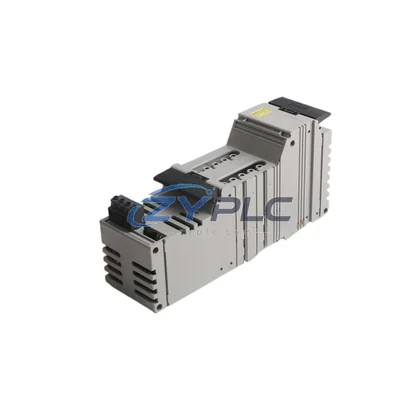
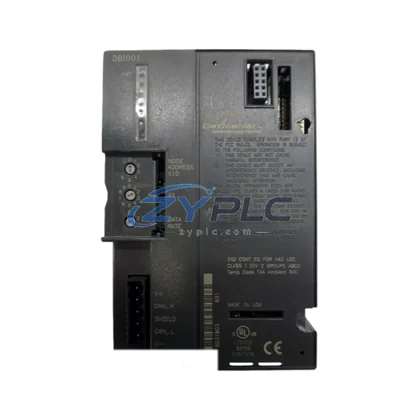
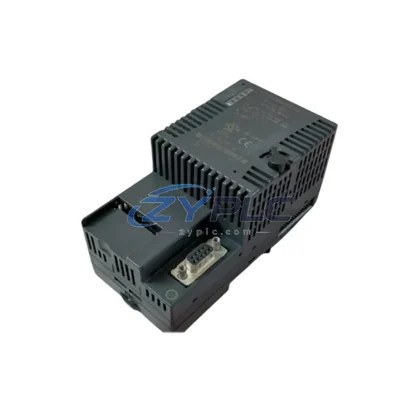
GE IC660BBR101 Relay Output for Genius I/O: Control System and system integration
The GE Fanuc IC660BBR101 is a relay output block engineered for deployment within the Genius I/O distributed I/O architecture — a field-proven platform widely adopted across manufacturing, power generation, petrochemical processing, water treatment, and heavy industrial automation environments. Rather than functioning as a standalone output device, the IC660BBR101 is designed to operate as an integral node within a layered control system, where its relay switching capability supports discrete load control at the field level while maintaining full coherence with the supervisory control and data acquisition (SCADA) layer above it.
In a complete Genius I/O system architecture, the IC660BBR101 connects to the Genius Bus — a serial communications highway that links field I/O blocks directly to a host controller such as the GE Series 90-70 PLC or the GE Series 90-30 PLC. This bus topology eliminates the need for traditional point-to-point wiring between the controller and each output device, significantly reducing installation complexity, cabinet footprint, and long-term maintenance overhead. The relay output block receives command signals from the CPU module over the Genius Bus and actuates its relay contacts to control motors, solenoids, contactors, indicator lamps, and other discrete field devices rated for the block’s output specifications.
System architects integrating the IC660BBR101 into a new or retrofit control panel will typically pair it with complementary Genius I/O components to form a complete I/O subsystem. The IC660BBS101 Bus Interface Unit (BIU) or equivalent Genius Bus Controller serves as the communication gateway between the Genius Bus and the host PLC backplane, ensuring deterministic data exchange across all connected I/O blocks. On the power side, the IC660CBB900 or equivalent Genius Bus power supply provides the regulated 24 VDC bus power required to sustain reliable block operation across extended cable runs in electrically noisy industrial environments.
Product Specification Table
| Parameter |
Specification |
| Model / SKU |
IC660BBR101 |
| Brand / Manufacturer |
GE Fanuc Automation |
| Series / Platform |
Genius I/O Distributed I/O System |
| System Role |
Relay Output Block — Field I/O Layer |
| Output Type |
Relay (dry contact) discrete outputs |
| Number of Output Points |
8 relay output channels |
| Output Voltage Range |
Up to 120/240 VAC or 24 VDC (load-dependent) |
| Communication Interface |
Genius Bus (serial, daisy-chain topology) |
| Bus Data Rate |
153.6 Kbaud (standard Genius Bus) |
| Power Supply Input |
24 VDC bus power via Genius Bus cable |
| Electrical Isolation |
Relay contact isolation between field and logic circuits |
| Installation Environment |
Industrial panel mount; DIN rail or direct mount compatible |
| Operating Temperature |
0°C to 60°C (32°F to 140°F) |
| Relative Humidity |
5% to 95% non-condensing |
| Certifications |
UL Listed; CE compliant (verify current listing) |
| Country of Origin |
United States |
| Warranty |
warranty terms confirmed during quotation — all units tested prior to shipment |
| system integration |
Fully compatible with Genius I/O bus architecture; system integration supported for system-level commissioning |
System Compatibility Notes
A well-engineered Genius I/O control system built around the IC660BBR101 relay output block draws on a coordinated set of modules and components, each fulfilling a defined role within the system hierarchy. At the control layer, the GE Series 90-70 CPU (IC697CPU772 or IC697CPU781) executes the ladder logic or function block programs that determine when relay outputs should be energized or de-energized. The CPU communicates with field I/O blocks through a Genius Bus Controller (IC697BEM731) installed in the 90-70 backplane, which manages bus arbitration and ensures that all connected Genius I/O blocks — including the IC660BBR101 — receive and transmit data within the required scan cycle.
For applications requiring analog process variable monitoring alongside discrete relay control, the IC660BBA020 Analog Input Block and IC660BBA104 Analog Output Block can be deployed on the same Genius Bus segment as the IC660BBR101, allowing a single bus cable to carry both analog and discrete I/O data back to the host controller. This mixed I/O capability is one of the defining strengths of the Genius I/O architecture and is particularly valuable in process industries where temperature, pressure, and flow signals must be monitored in the same control loop that drives relay-switched actuators.
At the discrete input layer, the IC660BBD101 or IC660BBD020 Discrete Input Blocks complement the IC660BBR101 by capturing field status signals — limit switches, proximity sensors, pushbutton states — and returning them to the CPU for logic evaluation. The tight integration between input and output blocks on the Genius Bus ensures that the control loop from field sensor to relay actuator operates with minimal latency, which is critical in safety-related interlocking applications.
For redundancy-critical installations, the Genius Bus supports a dual-bus redundancy configuration using a Genius Dual Bus Controller, which allows the IC660BBR101 and other field blocks to remain operational even if one bus segment experiences a fault. This architecture is commonly specified in power generation, oil and gas, and water treatment facilities where unplanned downtime carries significant operational and safety consequences. The warranty terms confirmed during quotation provided with every IC660BBR101 unit further supports long-term system reliability planning, giving engineering teams confidence in the component’s performance over the initial operational period.
Human-machine interface integration is achieved through GE QuickPanel or Cimplicity HMI platforms, which communicate with the Series 90-70 or 90-30 host controller via Ethernet or serial links. Operators can monitor relay output states, acknowledge alarms, and issue manual override commands through the HMI without interrupting the automated control sequence. This layered approach — from field relay block through bus controller, CPU, and HMI — exemplifies the system integration philosophy that underpins modern industrial automation design.
Industrial Application Notes
Manufacturing and Assembly Lines: In automotive and general manufacturing environments, the IC660BBR101 controls conveyor drive contactors, pneumatic valve solenoids, and machine guard interlocks. Its relay contacts provide the electrical isolation necessary to switch inductive loads without introducing noise into the control bus, and its integration with the Genius Bus allows plant-wide I/O to be monitored from a central SCADA workstation.
Power Generation and Utilities: Power plant auxiliary systems — cooling water pumps, fuel oil transfer pumps, ventilation fans — are frequently controlled through relay output blocks integrated into a Genius I/O architecture. The IC660BBR101’s ability to switch AC loads up to 240 VAC makes it suitable for controlling motor starter coils and circuit breaker trip circuits in medium-voltage switchgear panels. Dual-bus redundancy configurations ensure that a single bus cable fault does not result in loss of control over critical auxiliary equipment.
Petrochemical and Refinery Process Control: In hazardous area applications, the IC660BBR101 is installed in purged and pressurized enclosures or paired with intrinsically safe barriers to control field devices in classified zones. The relay output block’s role in emergency shutdown (ESD) logic — where it must reliably de-energize solenoid valves on demand — requires the kind of deterministic bus communication and proven relay reliability that the Genius I/O platform delivers.
Water and Wastewater Treatment: Municipal water treatment facilities use the IC660BBR101 to control chemical dosing pump contactors, UV disinfection system relays, and lift station pump starters. The distributed I/O architecture allows I/O blocks to be located close to field devices, reducing cable runs and improving signal integrity in large treatment plant layouts.
Mining and Metals Processing: In mining conveyor systems and ore processing plants, the IC660BBR101 controls high-current relay outputs for belt conveyor drives, crusher motor starters, and dust suppression system solenoids. The module’s robust construction and wide operating temperature range support reliable operation in the harsh environmental conditions typical of underground and surface mining operations.
Product Compatibility FAQ
Q1: Is the IC660BBR101 compatible with both the GE Series 90-70 and Series 90-30 host controllers?
Yes. The IC660BBR101 communicates over the Genius Bus protocol, which is supported by both the Series 90-70 (via the IC697BEM731 Bus Controller) and the Series 90-30 (via the IC693BEM331 Genius Bus Controller). The relay output block operates identically on both platforms, and the same I/O configuration data is used regardless of which host CPU is installed. This cross-platform compatibility simplifies spare parts management in facilities that operate both controller families.
Q2: Can the IC660BBR101 be used in a redundant Genius Bus architecture, and what additional components are required?
Yes. The Genius I/O system supports dual-bus redundancy, where two parallel bus cables connect all I/O blocks to redundant bus controllers in the host PLC rack. The IC660BBR101 is compatible with this configuration. To implement dual-bus redundancy, you will need a Genius Dual Bus Controller module in the host rack and dual-bus-capable I/O blocks. In a redundant architecture, if the primary bus experiences a fault, the secondary bus automatically assumes control without interrupting relay output states, which is essential for continuous process applications. All IC660BBR101 units supplied by ZYPLC are covered by a warranty terms confirmed during quotation and are tested for bus communication integrity prior to shipment.
Q3: What is the recommended commissioning procedure for integrating the IC660BBR101 into an existing Genius I/O system, and how does the warranty terms confirmed during quotation apply to replacement units?
Commissioning the IC660BBR101 in an existing Genius I/O system involves assigning a unique Genius Bus device number (1–31) to the block using the onboard DIP switches, then configuring the corresponding I/O reference addresses in the host PLC programming software (Logicmaster 90 or Proficy Machine Edition). After physical installation on the bus cable, the host controller will automatically recognize the new block during the next bus scan and begin exchanging I/O data. For retrofit installations, it is advisable to perform a bus load calculation to confirm that adding the IC660BBR101 does not exceed the maximum number of devices or total bus current capacity. The warranty terms confirmed during quotation covers manufacturing defects and premature component failure under normal operating conditions. Warranty claims are processed through ZYPLC’s technical support team, and replacement units are dispatched with priority to minimize system downtime.