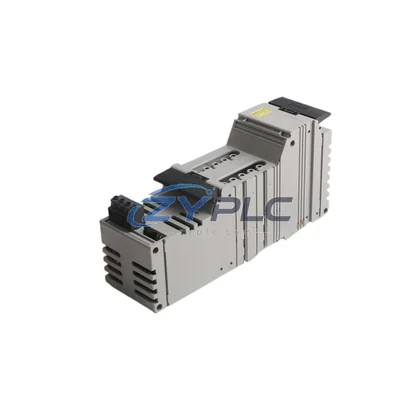
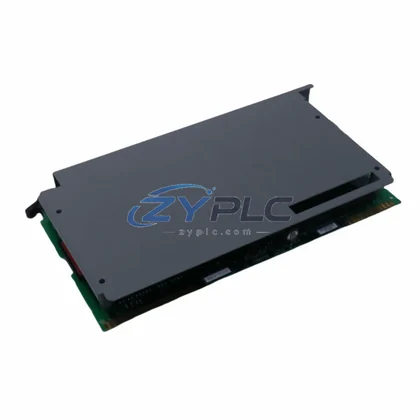
The GE IC697MDL671 is a high-performance interrupt-driven discrete input module engineered for the GE Fanuc Series 90-70 programmable automation controller (PAC) platform. Unlike standard discrete input modules that rely on periodic scan-cycle polling, the IC697MDL671 provides hardware-level interrupt capability, enabling the CPU to respond to critical field events with minimal latency. This makes it an essential component in time-sensitive automation architectures where deterministic response to process changes is non-negotiable.
Within a fully configured Series 90-70 rack system, the IC697MDL671 occupies a standard I/O slot on the IC697CHS750 or IC697CHS790 baseplate, communicating with the main processor — typically the IC697CPX935 or IC697CPX782 CPU — over the high-speed VME backplane. The module receives 24 VDC discrete signals from field devices such as proximity sensors, limit switches, emergency stop circuits, and encoder index pulses. When a configured input transitions state, the module generates a hardware interrupt that preempts the normal program scan, allowing the CPU to execute a dedicated interrupt service routine (ISR) immediately. This architecture is critical in applications such as high-speed packaging lines, turbine trip systems, and batch sequencing where event-driven logic must override cyclic execution.
Product Specification Table
| Parameter |
Specification |
| Part Number |
IC697MDL671 |
| Manufacturer |
GE Fanuc / GE Intelligent Platforms |
| Module Type |
Interrupt Discrete Input Module |
| Platform |
Series 90-70 |
| Input Voltage |
24 VDC Nominal |
| Number of Channels |
16 Channels |
| Interrupt Capability |
Hardware-level interrupt to CPU |
| Backplane Interface |
VME Bus |
| Compatible Baseplates |
IC697CHS750, IC697CHS790 |
| Compatible CPUs |
IC697CPX935, IC697CPX782 |
| Isolation |
Optical Isolation, Channel-to-Backplane |
| Operating Temperature |
0°C to 60°C |
| Certifications |
CE, UL Listed |
| Warranty |
warranty terms confirmed during quotation |
System Compatibility Notes
Deploying the IC697MDL671 within a Series 90-70 control cabinet requires careful coordination across multiple system layers. At the control layer, the module works in direct partnership with the rack CPU. In configurations using the IC697CPX935, the interrupt input module leverages the processor’s multi-rate scheduling engine to assign priority levels to interrupt-driven tasks, ensuring that time-critical field events are serviced before lower-priority background logic. For legacy installations still operating with the IC697CPX782, the interrupt mechanism integrates with the standard fault-handling tables, providing a reliable fallback path when deterministic response is required.
Power integrity is fundamental to interrupt reliability. The IC697PWR711 power supply module delivers regulated DC power across the backplane, and its output stability directly affects the noise immunity of the IC697MDL671’s input circuits. In systems where power redundancy is mandated — such as continuous process plants or utility substations — dual power supply configurations using the IC697PWR731 ensure uninterrupted operation even during single-supply failure events.
On the I/O layer, the IC697MDL671 typically operates alongside standard discrete input modules such as the IC697MDL653 (32-point 24 VDC input) and discrete output modules like the IC697MDL752. While the MDL653 handles routine status monitoring — valve position feedback, motor running confirmation, and level switch states — the IC697MDL671 is reserved for signals that demand immediate CPU attention. This architectural separation between polled and interrupt-driven I/O is a best practice in layered automation design, reducing scan-time overhead while guaranteeing responsiveness for critical events.
Communication between the Series 90-70 rack and supervisory systems is managed through dedicated network interface modules. The IC697CMM742 Ethernet communications module provides TCP/IP connectivity to SCADA, DCS, and MES platforms, enabling real-time visibility into interrupt event logs, diagnostic counters, and module health status. For installations requiring serial communication to legacy operator panels or third-party devices, the IC697CMM711 serial communications module offers RS-232 and RS-485 connectivity. Together, these communication modules ensure that interrupt events captured by the IC697MDL671 are propagated to all relevant layers of the automation hierarchy.
Terminal connectivity and field wiring are completed through the Series 90-70 terminal block assemblies. Proper termination practices — including shielded cable routing, dedicated interrupt signal conduit, and separation from high-current output wiring — are essential to preserving signal integrity and preventing false interrupt triggers caused by electromagnetic interference.
Industrial Application Notes
The interrupt input capability of the IC697MDL671 addresses specific operational requirements across multiple industrial sectors. In high-speed packaging and bottling lines, encoder index pulses and product-detect sensors feed into the interrupt module, enabling the CPU to execute registration corrections and reject sequences within a single scan cycle. Without hardware interrupt capability, these corrections would be delayed by the full scan time of the PLC program, resulting in misaligned labels, missed rejects, or product jams.
In power generation and turbine control, the IC697MDL671 monitors critical trip signals — overspeed, high vibration, flame failure, and bearing temperature alarms — that require sub-millisecond acknowledgment. The interrupt-driven architecture ensures that the CPU initiates shutdown sequences immediately upon signal assertion, independent of the current position in the main program scan. This deterministic behavior is a regulatory requirement in many utility and co-generation facilities.
Within petrochemical and refinery process control, emergency shutdown (ESD) systems benefit from the IC697MDL671’s ability to bypass normal scan-cycle latency. When integrated into a Series 90-70-based safety instrumented system (SIS), the module provides an additional layer of responsiveness for process variables that exceed safe operating limits. Combined with redundant CPU configurations and fault-tolerant power supplies, the interrupt input module contributes to achieving the required Safety Integrity Level (SIL) for the installation.
In water and wastewater treatment, the module is deployed to capture surge events, pump cavitation alarms, and chemical dosing interlock signals. The ability to interrupt the CPU ensures that corrective actions — such as pump shutdown, valve closure, or chemical feed isolation — are initiated without waiting for the next available scan window.
For metals and mining operations, conveyor belt rip-detection sensors, crusher overload signals, and emergency pull-cord switches are connected to the IC697MDL671, providing immediate CPU notification and enabling rapid de-energization of heavy rotating equipment.
Product Compatibility FAQ
Q1: Can the IC697MDL671 be installed in any slot of a Series 90-70 baseplate?
A: The IC697MDL671 is compatible with standard I/O slots on the IC697CHS750 and IC697CHS790 baseplates. However, for optimal interrupt response, it is recommended to install the module in a slot closest to the CPU to minimize backplane signal propagation delay. Consult the Series 90-70 hardware configuration guide for slot assignment rules specific to interrupt-capable modules. All modules supplied by ZYPLC include a warranty terms confirmed during quotation covering manufacturing defects and functional failures.
Q2: How does the IC697MDL671 interact with the CPU’s scan cycle and task scheduling?
A: When an interrupt condition is detected, the module asserts an interrupt request on the VME backplane. The CPU suspends the currently executing task and vectors to the configured interrupt service routine. After the ISR completes, normal scan execution resumes. In multi-rate CPU configurations such as the IC697CPX935, interrupt tasks can be assigned dedicated priority levels to prevent contention with other time-critical periodic tasks. Proper ISR design — keeping interrupt routines short and deterministic — is essential to maintaining overall system stability.
Q3: What field wiring and signal conditioning practices are recommended for interrupt inputs?
A: Interrupt input signals should be routed through shielded, twisted-pair cables with dedicated conduit, separated from power wiring and high-frequency communication cables. Input signals should be debounced at the field device level where possible to prevent false interrupt triggers. Terminal connections should use the Series 90-70 approved terminal assemblies with proper torque specifications. ZYPLC provides system integration support to assist with system architecture planning, wiring best practices, and module configuration for Series 90-70 interrupt applications.