GE IS230SNRLH2A System-Ready Relay Output for Mark VIe Control Architecture
The GE IS230SNRLH2A is a signal relay output module engineered for deployment within the GE Mark VIe distributed control system architecture. Rather than functioning as a standalone component, this module occupies a critical position in the I/O layer of a multi-tier turbine and process control platform, bridging the logic execution layer with field-level actuators, contactors, and protective relay circuits. Its design philosophy reflects GE’s commitment to system-level consistency, enabling engineers to maintain uniform signal conditioning, relay isolation, and diagnostic transparency across the entire control cabinet.
In a fully integrated Mark VIe architecture, the IS230SNRLH2A works in close coordination with the UCSC or UCVG controller modules, which handle real-time logic execution and sequence-of-events recording. The relay outputs driven by this module are mapped directly to the controller’s output tables, ensuring deterministic switching behavior with millisecond-level response times. This tight coupling between the control layer and the I/O layer is what distinguishes a properly architected GE Mark VIe system from ad hoc relay panel designs.
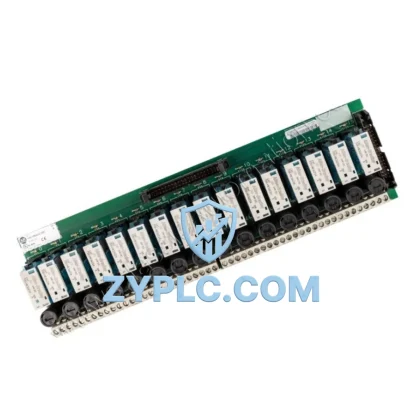
From a system integration perspective, the IS230SNRLH2A is typically installed on a Mark VIe I/O rack alongside complementary modules such as the IS230SNAIH2A analog input module, the IS230SNDIHA digital input module, and the IS230SPDOH1A pulse output module. Together, these modules populate the I/O backplane — often the IS200BICLH1A or IS200BICIA1A — which provides the physical and electrical backbone for signal routing between the terminal boards and the VME-based controller chassis. The IS200SRLYH2AAA terminal board, which pairs directly with the IS230SNRLH2A, provides the field-side screw terminations for relay coil circuits and contact outputs, maintaining galvanic isolation between the control electronics and the field wiring.
Network and communication integrity within the Mark VIe platform is managed through the IONet Ethernet backbone, which connects I/O packs to the controller using a deterministic, time-stamped protocol. The IS230SNRLH2A’s host I/O pack communicates over this network, and its relay output states are continuously monitored by the Mark VIe diagnostic framework. Any relay coil failure, contact weld, or communication timeout is immediately flagged in the system alarm log, enabling maintenance teams to respond before a fault escalates to a trip event. This level of diagnostic granularity is only achievable when the relay output module is operating within its intended system context — not as a replacement part in an incompatible rack.
For applications requiring redundancy, the IS230SNRLH2A supports TMR (Triple Modular Redundancy) configurations when paired with the appropriate voting logic modules and redundant I/O packs. In a TMR architecture, three independent IS230SNRLH2A modules may drive parallel relay circuits, with the Mark VIe controller performing 2-of-3 voting to determine the final output state. This architecture is commonly specified for turbine trip circuits, emergency shutdown systems, and fire and gas detection outputs where a single point of failure cannot be tolerated. The module’s relay contacts are rated for the inductive loads typical of solenoid valves, motor starters, and protective relay coils encountered in these safety-critical applications.
Power supply integrity is another dimension of system architecture that directly affects IS230SNRLH2A performance. The module draws its logic power from the I/O pack’s internal DC bus, which is typically fed by a redundant pair of IS200EPSMG1A or IS200EPSMG2A power supply modules. These supplies are monitored by the Mark VIe power management subsystem, and any voltage deviation outside the specified tolerance band triggers an alarm before the I/O pack loses power. Engineers specifying a new Mark VIe panel should account for the relay output module’s coil energization current when calculating the total I/O pack power budget, particularly in high-density configurations where multiple relay output modules are installed in the same rack.
From a long-term maintenance and lifecycle management perspective, the IS230SNRLH2A offers significant advantages over generic relay panels. Because the module’s relay states, cycle counts, and diagnostic history are stored within the Mark VIe historian, maintenance planners can implement condition-based replacement strategies rather than relying on fixed-interval overhauls. This data-driven approach reduces unnecessary downtime and extends the effective service life of the control system. ZYPLC maintains a ready inventory of IS230SNRLH2A modules, each covered by a 12-Month Warranty, ensuring that replacement units are available for rapid deployment without compromising system architecture integrity.
Architecture Specification Table
| Parameter |
Specification |
| System Role |
Signal Relay Output Module — Mark VIe I/O Layer |
| Compatible Series |
GE Mark VIe Distributed Control System |
| Primary SKU |
IS230SNRLH2A |
| Paired Terminal Board |
IS200SRLYH2AAA |
| Output Type |
Relay Contact Output (Form C) |
| Relay Contact Rating |
2A @ 30VDC / 0.5A @ 125VAC (resistive) |
| Number of Output Channels |
12 relay output channels |
| Logic Power Supply |
Derived from I/O pack internal DC bus |
| Communication Interface |
IONet Ethernet (via host I/O pack) |
| Redundancy Support |
TMR (Triple Modular Redundancy) capable |
| Backplane Compatibility |
IS200BICLH1A / IS200BICIA1A Mark VIe I/O Rack |
| Operating Temperature |
0°C to +60°C |
| Relative Humidity |
5% to 95% non-condensing |
| Mounting |
DIN rail / panel-mount via Mark VIe I/O rack |
| Diagnostics |
Continuous self-test via Mark VIe diagnostic framework |
| Warranty |
12-Month Warranty — ZYPLC |
Coordinated Control System Design
A complete Mark VIe turbine control system integrating the IS230SNRLH2A typically includes the following coordinated components across multiple system layers. At the control layer, the UCSC or UCVG controller module executes the application logic and drives the relay output commands via the IONet backbone. The IS230SNAIH2A analog input module and IS230SNDIHA digital input module provide the feedback signals — process temperatures, pressures, and discrete status inputs — that the controller uses to determine relay output states. The IS230SPDOH1A pulse output module handles speed reference signals for turbine governor control, operating in parallel with the relay outputs on the same I/O rack.
At the power layer, redundant IS200EPSMG1A power supply modules ensure that the I/O pack hosting the IS230SNRLH2A maintains continuous operation even during a single power supply failure. The IS200BICLH1A backplane distributes both power and IONet communications to all modules in the rack, providing a single, managed infrastructure for the entire I/O assembly. At the human-machine interface layer, the Mark VIe operator workstation running ToolboxST software provides real-time visibility into relay output states, alarm histories, and module diagnostics, enabling operators to monitor IS230SNRLH2A performance without interrupting production.
For safety-critical applications, the IS230SNRLH2A relay outputs are often wired in series with IS200TRPGH1A trip relay modules, creating a hardware-enforced safety layer that operates independently of the software logic. This architecture ensures that even a controller software fault cannot inadvertently energize a relay output that should remain de-energized during a protective trip event.
Application in Layered Automation Systems
The IS230SNRLH2A finds application across a broad range of industrial sectors where the GE Mark VIe platform is the control system of choice. In gas turbine power generation, the module drives fuel valve solenoids, inlet guide vane actuators, and generator breaker trip coils, all of which require the high-reliability relay switching that the IS230SNRLH2A provides. In combined-cycle power plants, the same module architecture is extended to steam turbine bypass valve control and heat recovery steam generator (HRSG) damper positioning.
In the oil and gas sector, IS230SNRLH2A modules are deployed in compressor station control panels, where they manage suction and discharge valve actuators, anti-surge control outputs, and emergency shutdown (ESD) relay circuits. The module’s TMR capability is particularly valued in offshore platform applications, where the consequences of a spurious trip or a failure-to-trip are both economically and operationally severe. In petrochemical process plants, the module integrates with the Mark VIe’s process control functions to manage reactor feed valve sequencing, heat exchanger bypass control, and flare system isolation.
Water treatment and municipal utility applications leverage the IS230SNRLH2A for pump motor starter control, chemical dosing pump sequencing, and UV disinfection system relay outputs. Mining and mineral processing operations use the module in conveyor drive control panels, crusher motor protection circuits, and tailings pump station automation. In each of these applications, the IS230SNRLH2A’s value is amplified by its integration within the Mark VIe architecture — providing not just relay switching, but a fully documented, diagnostically transparent output channel that supports the long-term maintenance and audit requirements of regulated industrial facilities.
Architecture Engineering FAQ
Q1: Is the IS230SNRLH2A compatible with both Mark VIe and Mark VI control systems, and can it be used interchangeably between the two platforms?
The IS230SNRLH2A is specifically designed for the Mark VIe I/O architecture and communicates via the IONet Ethernet protocol used in Mark VIe systems. While GE Mark VI and Mark VIe share some physical form factors, the I/O pack firmware, backplane pinouts, and communication protocols differ between the two generations. Substituting IS230SNRLH2A modules into a Mark VI rack without proper engineering validation is not recommended. Always verify the target system’s I/O pack firmware version and backplane compatibility before installing replacement modules.
Q2: What installation and commissioning steps are required when replacing an IS230SNRLH2A in a live Mark VIe system?
Replacing an IS230SNRLH2A in a running Mark VIe system requires coordination between the control system engineer and the operations team. The affected I/O pack should be placed in a safe state, with all relay outputs confirmed de-energized before the module is removed. After installing the replacement module, the ToolboxST configuration tool should be used to verify that the new module’s firmware version matches the system baseline and that all relay output assignments are correctly mapped. A functional test of each relay output channel should be performed before returning the I/O pack to service. ZYPLC’s 12-Month Warranty covers the replacement module for the full commissioning and initial operating period.
Q3: How does ZYPLC’s 12-Month Warranty apply to IS230SNRLH2A modules, and what support is available for long-term inventory planning?
Every IS230SNRLH2A supplied by ZYPLC is covered by a 12-Month Warranty from the date of shipment, covering manufacturing defects and functional failures under normal operating conditions. ZYPLC maintains a standing inventory of IS230SNRLH2A and IS200SRLYH2AAA terminal boards to support both emergency replacement and planned maintenance programs. For customers managing large Mark VIe fleets, ZYPLC offers Contextual Integration support — a service that maps your installed base of I/O modules to recommended spare parts lists, ensuring that critical relay output modules are available when needed without overstocking. Contact ZYPLC at +86 19859288691 or [email protected] to discuss your inventory requirements.
—
© 2026 ZYPLC. All rights reserved.
Original Source: https://zyplc.com
Contact: +86 19859288691 | [email protected]