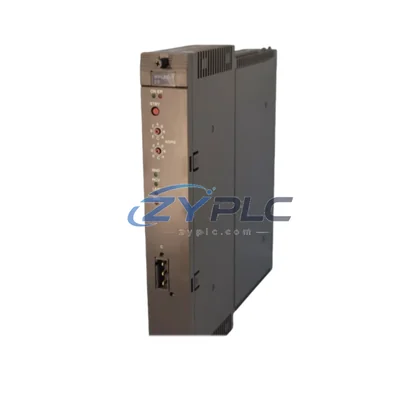
GE UR9WH CPU Module for UR Series: Compatibility and Replacement Notes
The GE UR9WH is a high-performance CPU processing module purpose-built for the GE UR Series protection relay platform, one of the most widely deployed digital protection and control architectures in transmission substations, generation facilities, and industrial power distribution systems. Rather than functioning as a standalone component, the UR9WH occupies the central processing tier of a layered automation hierarchy — coordinating signal acquisition, protection logic execution, inter-relay communication, and SCADA reporting within a unified, deterministic control framework.
In modern power system automation, the CPU module is the architectural keystone. The UR9WH interfaces directly with the UR Series chassis backplane, enabling seamless integration with analog and digital I/O modules, communications cards, and power supply modules housed within the same rack. This tight hardware coupling eliminates inter-device latency and ensures that protection functions — including differential, distance, overcurrent, and busbar protection — execute within the relay’s defined operating time windows, regardless of system load or communication traffic.
From a system architecture perspective, the UR9WH sits at the intersection of the control layer and the communications layer. It processes real-time inputs from current transformers (CTs) and voltage transformers (VTs) routed through the relay’s analog input modules, applies configurable protection algorithms, and simultaneously maintains peer-to-peer communication with adjacent UR Series relays via the GSSE (Generic Substation State Event) protocol or IEC 61850 GOOSE messaging. This dual-layer operation — local protection plus network-level coordination — is what makes the UR9WH indispensable in bus protection schemes, transformer differential applications, and line protection architectures where inter-relay logic must be synchronized across multiple IEDs.
Product Specification Table
| Parameter |
Specification |
| System Role |
Central Processing Unit (CPU) Module — UR Series Protection Relay Platform |
| Compatible Platform |
GE UR Series (C60, C70, C90Plus, D60, F60, L90, T60, B90, N60, M60) |
| Processing Architecture |
Real-time deterministic protection logic execution |
| Communication Protocols |
IEC 61850 GOOSE, GSSE, DNP3, Modbus RTU/TCP, IEC 60870-5-104 |
| Backplane Interface |
UR Series chassis backplane — direct module slot integration |
| Protection Functions |
Differential, distance, overcurrent, busbar, transformer, line protection |
| Electrical Supply |
Compatible with UR Series DC power supply modules (24–250 VDC range) |
| Operating Temperature |
-20°C to +60°C (standard substation environment) |
| Mounting |
19-inch rack or panel-mount UR Series chassis |
| Firmware Compatibility |
EnerVista UR Setup software — configurable via USB or Ethernet |
| Warranty |
warranty terms confirmed during quotation — covers manufacturing defects and functional failure under normal operating conditions |
| system integration |
Full system integration with UR Series I/O, communications, and power modules within the same chassis |
System Compatibility Notes
The UR9WH achieves its full architectural value when deployed within a complete UR Series relay chassis populated with coordinated modules. A typical high-availability substation bay may combine the UR9WH CPU module with a UR Series DC power supply module (such as the 9G or 9H power supply cards) to ensure uninterrupted operation during AC supply failures. Analog input modules — including the UR Series CT/VT input cards — feed real-time current and voltage measurements directly to the UR9WH for protection algorithm processing, while digital I/O modules handle binary trip outputs, alarm contacts, and external interlock signals routed to circuit breakers and disconnect switches.
For substation automation and SCADA integration, the UR9WH works in conjunction with UR Series communications modules supporting IEC 61850, DNP3, and Modbus protocols. In multi-relay architectures — such as a C90Plus bus protection scheme or an L90 line differential application — multiple UR Series relays exchange GOOSE messages over a dedicated protection LAN, with each relay’s CPU module (including the UR9WH) acting as both a publisher and subscriber within the logical node framework defined by the substation’s SCD file.
In redundant protection architectures, the UR9WH is frequently paired with a secondary UR Series relay of the same type, forming a primary/backup protection pair. Both relays share the same CT and VT inputs via interposing transformers or optical splitters, and their CPU modules independently execute protection logic — ensuring that a single module failure does not compromise system protection. This redundancy model is standard practice in 220 kV and above transmission substations, where protection reliability directly impacts grid stability.
HMI integration is achieved through EnerVista UR Setup software running on an engineering workstation connected via the relay’s front USB port or rear Ethernet port. The UR9WH’s onboard firmware supports full settings upload/download, event record retrieval, oscillography capture, and real-time metering display — eliminating the need for separate data acquisition hardware during commissioning and routine maintenance cycles.
Industrial Application Notes
Power Transmission and Substation Automation: In 110 kV to 500 kV transmission substations, the UR9WH serves as the CPU core for line, transformer, and bus protection relays. Its IEC 61850 GOOSE capability enables high-speed inter-relay tripping without copper pilot wires, reducing wiring complexity and improving trip time performance. Substations operating under IEC 61850 Edition 2 architectures rely on the UR Series platform’s CPU modules to maintain logical node integrity across the station bus and process bus layers.
Industrial Power Distribution (Petrochemical and Mining): In large industrial facilities — including oil refineries, LNG terminals, and open-cut mining operations — the UR9WH is deployed in medium-voltage switchgear protection panels. Its configurable protection logic supports motor feeder protection, transformer differential protection, and generator protection schemes within the same relay platform, reducing spare parts inventory and simplifying maintenance training requirements across multi-site operations.
Power Generation (Thermal and Hydro): Generator protection panels in thermal power stations and hydroelectric facilities use UR Series relays with UR9WH CPU modules for generator differential, loss-of-excitation, and out-of-step protection. The CPU module’s high-speed processing ensures that protection operates within the generator’s fault withstand capability, preventing damage to stator windings and rotor circuits during internal fault conditions.
Water and Wastewater Treatment: In large pumping stations and water treatment facilities with medium-voltage motor drives, the UR9WH provides motor protection relay functionality — including thermal overload, phase unbalance, and locked rotor protection — integrated within the facility’s SCADA system via DNP3 or Modbus TCP communications.
Product Compatibility FAQ
Q1: Is the UR9WH compatible with all UR Series relay models, and can it be used as a direct replacement in an existing chassis?
The UR9WH CPU module is designed for the GE UR Series platform and is compatible with UR Series chassis models including the C60, C70, D60, F60, T60, L90, C90Plus, B90, N60, and M60. Before installation, verify the firmware version of the replacement UR9WH against the existing relay’s settings file — firmware mismatches may require a settings re-upload via EnerVista UR Setup. Physical installation follows the standard UR Series hot-swap procedure: de-energize the module slot, seat the UR9WH into the chassis backplane connector, and restore power. Full system integration with existing I/O and communications modules is maintained without chassis reconfiguration.
Q2: What commissioning steps are required when integrating the UR9WH into an IEC 61850 substation automation architecture?
Commissioning the UR9WH in an IEC 61850 environment requires importing the relay’s IED Capability Description (ICD) file into the substation’s System Configuration Tool (SCT) and generating an updated Substation Configuration Description (SCD) file. The UR9WH’s IP address, GOOSE publisher/subscriber datasets, and logical node mappings must be configured via EnerVista UR Setup and validated against the SCD file before energization. GOOSE message timing should be verified using a network analyzer to confirm that inter-relay trip signals meet the protection scheme’s operating time requirements. ZYPLC provides pre-delivery functional testing documentation for all UR9WH units to support site acceptance testing.
Q3: What does the warranty terms confirmed during quotation cover, and what support is available for long-term maintenance of the UR9WH?
The warranty terms confirmed during quotation covers manufacturing defects, component failures, and functional non-conformance under normal operating conditions from the date of shipment. It does not cover damage resulting from incorrect installation, overvoltage events, or unauthorized modification. For long-term maintenance, ZYPLC supports RFQ sourcing for UR9WH and related UR Series modules to support rapid replacement in the event of field failures — minimizing protection system downtime. Customers are encouraged to maintain a site spare of the UR9WH CPU module in accordance with their protection maintenance philosophy. Technical support for settings backup, firmware compatibility queries, and replacement logistics is available through ZYPLC’s engineering team.