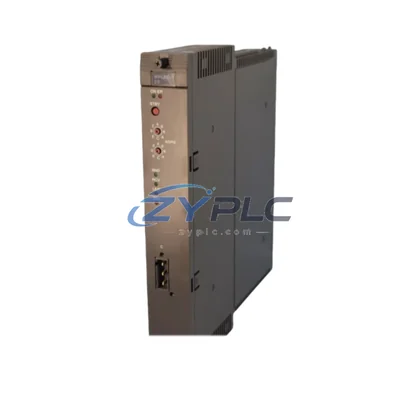
Honeywell 2MLI-CPUH-CC CPU for Safety Manager: Compatibility and Replacement Notes
The Honeywell 2MLI-CPUH-CC is a high-integrity central processing unit engineered for deployment within the Honeywell Safety Manager (SM) platform — a dedicated safety instrumented system (SIS) designed to meet IEC 61511 and IEC 61508 functional safety requirements up to SIL 3. Rather than functioning as a standalone component, the 2MLI-CPUH-CC serves as the computational core of a layered, redundant safety architecture, coordinating signal acquisition, logic execution, diagnostic self-checking, and output actuation across every tier of the control system. Understanding its role demands a system-level perspective that spans the control layer, I/O layer, network layer, power layer, human-machine interface layer, and field execution layer simultaneously.
In a fully integrated Safety Manager deployment, the 2MLI-CPUH-CC occupies the apex of the control hierarchy. It receives conditioned process signals from distributed I/O modules — such as the 2MLI-DIOH-CC digital input module and the 2MLI-AIOH-CC analog input module — processes them against pre-validated safety logic, and issues deterministic output commands to field actuators via corresponding output modules including the 2MLI-DOOH-CC digital output module. This signal flow is continuous, cycle-deterministic, and subject to internal watchdog supervision, ensuring that any deviation from expected behavior triggers a safe-state transition before a hazardous condition can develop.
The CPU’s system integration capability allows it to maintain coherent awareness of system-wide states, enabling coordinated responses across multiple safety loops without cross-contamination of logic domains. This is particularly critical in architectures where the Safety Manager operates alongside a Basic Process Control System (BPCS) — such as a Honeywell Experion PKS DCS — where the separation of safety and control functions must be rigorously maintained while still permitting supervised data exchange over a dedicated safety network gateway.
Product Specification Table
| Parameter |
Specification |
| Model / SKU |
2MLI-CPUH-CC |
| Brand |
Honeywell |
| Series |
Safety Manager (SM) |
| System Role |
Safety Instrumented System (SIS) Central Processing Unit |
| Safety Integrity Level |
SIL 3 (IEC 61508 / IEC 61511) |
| Architecture Type |
Redundant / Fault-Tolerant CPU |
| Communication Capability |
Modbus, OPC, Ethernet-based safety network |
| Backplane Compatibility |
Safety Manager chassis / rack system |
| Diagnostic Coverage |
High — internal self-diagnostics with safe-state failover |
| Operating Temperature |
0°C to 60°C (typical industrial range) |
| Power Supply Compatibility |
Safety Manager redundant power supply modules |
| system integration |
Yes — coordinated multi-loop safety logic execution |
| Origin |
United States |
| Warranty |
warranty terms confirmed during quotation |
| Condition |
New / Tested Surplus |
System Compatibility Notes
The 2MLI-CPUH-CC achieves its full operational value only when integrated within a coherent Safety Manager rack assembly. The backplane chassis provides the physical and electrical backbone through which the CPU communicates with all co-resident modules. A typical high-availability configuration pairs the 2MLI-CPUH-CC with a redundant CPU counterpart, ensuring bumpless switchover in the event of a primary processor fault — a design principle that eliminates single points of failure at the most critical layer of the safety architecture.
Power integrity is maintained through dedicated Safety Manager redundant power supply modules, which provide isolated, monitored DC rails to the CPU and I/O subsystems. Any power anomaly detected by the CPU’s internal power monitoring circuit initiates a controlled diagnostic sequence rather than an uncontrolled shutdown, preserving process state data and enabling rapid recovery. This power-layer coordination is essential in continuous-process industries where unplanned shutdowns carry significant safety and economic consequences.
At the I/O layer, the 2MLI-CPUH-CC interfaces with a range of signal conditioning modules. Digital input modules capture discrete field signals from pressure switches, level switches, and emergency shutdown (ESD) pushbuttons. Analog input modules process 4–20 mA signals from transmitters monitoring temperature, pressure, flow, and level. Corresponding output modules drive solenoid valves, motor starters, and alarm annunciators based on CPU logic decisions. The integrity of this I/O chain is continuously verified through the CPU’s diagnostic engine, which performs channel-level fault detection and reports anomalies to the operator interface without interrupting safe-state logic execution.
Network-layer integration is achieved through a dedicated safety network gateway module that bridges the Safety Manager’s internal communication bus to plant-wide networks including Modbus TCP, OPC DA/UA, and Honeywell’s proprietary FTE (Fault Tolerant Ethernet) infrastructure. This gateway enables the Experion PKS operator station and historian to receive real-time safety system status data, supporting both operational visibility and regulatory compliance reporting. The 2MLI-CPUH-CC’s system integration architecture ensures that data shared across this boundary is read-only from the BPCS perspective, preserving the independence of the safety function.
At the human-machine interface layer, operator workstations running Honeywell’s Safety Builder engineering software provide the primary configuration, download, and diagnostic environment for the 2MLI-CPUH-CC. Logic changes undergo formal validation workflows before download, and the CPU enforces version-controlled execution to prevent unauthorized modification. Field engineers can also connect portable diagnostic terminals directly to the CPU’s local communication port for on-site commissioning and fault investigation without disrupting live safety logic execution.
Industrial Application Notes
The 2MLI-CPUH-CC is deployed across a broad spectrum of process industries where functional safety is a regulatory and operational imperative. In oil and gas upstream and midstream facilities, it serves as the core processor for wellhead ESD systems, pipeline isolation logic, and compressor protection sequences. Its SIL 3 capability satisfies the requirements of IEC 61511 safety lifecycle assessments, and its redundant architecture supports the high-demand mode of operation typical of these environments.
In petrochemical and refinery applications, the Safety Manager platform anchored by the 2MLI-CPUH-CC manages burner management systems (BMS), high-integrity pressure protection systems (HIPPS), and reactor emergency shutdown sequences. The CPU’s deterministic scan cycle and high diagnostic coverage ensure that safety functions are executed within the required response time even under maximum I/O loading conditions.
Power generation facilities — including thermal, combined-cycle, and nuclear auxiliary systems — rely on the 2MLI-CPUH-CC for turbine protection, boiler safety interlocks, and electrical switchgear control. The module’s ability to maintain safe-state outputs during CPU redundancy switchover is particularly valued in these applications, where even momentary output interruptions can trigger cascading protective actions.
Water and wastewater treatment plants deploy the Safety Manager system for chlorine dosing safety interlocks, pump protection, and overflow prevention logic. Mining and minerals processing operations use it for conveyor emergency stop systems, crusher protection, and ventilation safety control. In each of these environments, the 2MLI-CPUH-CC’s combination of high diagnostic coverage, redundant architecture, and system integration capability delivers the system consistency, expandability, and long-term maintainability that industrial operators require.
Product Compatibility FAQ
Q1: Is the 2MLI-CPUH-CC compatible with existing Safety Manager chassis and I/O modules already installed in my facility?
The 2MLI-CPUH-CC is designed for direct installation into the standard Safety Manager backplane chassis. It is compatible with the full range of Safety Manager I/O modules, including digital input, digital output, analog input, and analog output variants, provided the system firmware versions are aligned. Before installation, verify the CPU firmware revision against your existing I/O module firmware using Honeywell’s Safety Builder compatibility matrix. In most brownfield upgrade scenarios, a firmware update to the I/O modules is sufficient to achieve full compatibility without hardware replacement.
Q2: How does the redundant CPU architecture function during a primary CPU fault, and what is the impact on running safety logic?
In a redundant Safety Manager configuration, the 2MLI-CPUH-CC operates in a primary-secondary pair. Both CPUs execute the same safety logic synchronously, with the secondary continuously tracking the primary’s execution state. Upon detection of a primary CPU fault — whether hardware, firmware, or communication-related — the secondary assumes control within the system’s defined switchover time, typically without any interruption to output states. This bumpless transfer is a fundamental design requirement of the Safety Manager redundancy architecture and is verified during factory acceptance testing (FAT) and site acceptance testing (SAT).
Q3: What warranty terms are confirmed during quotation, and what support is available for long-term maintenance of the 2MLI-CPUH-CC?
The warranty terms confirmed during quotation covers manufacturing defects and functional failures under normal operating conditions from the date of shipment. During the warranty period, defective units are repaired or replaced at no charge. For long-term maintenance, we recommend planning spare-part availability through RFQ review 2MLI-CPUH-CC in your critical spares inventory, given the extended lead times associated with OEM procurement of safety-certified CPU modules. Our technical team provides pre-shipment functional testing documentation for every unit, supporting your incoming inspection and validation procedures. Post-warranty repair and exchange services are also available to extend the operational life of your Safety Manager investment.