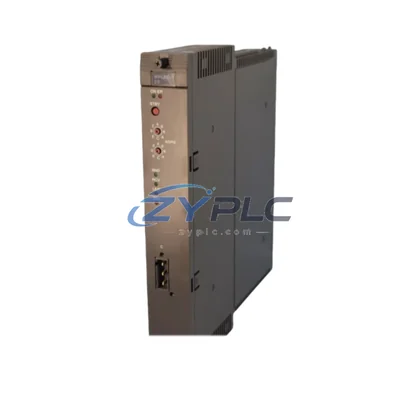
Honeywell 2MLI-CPUS CPU Module for 2MLI: Compatibility and Replacement Notes
The Honeywell 2MLI-CPUS is a central processing unit module engineered for deployment within the Honeywell 2MLI Series distributed control system (DCS) architecture. Rather than functioning as a standalone component, the 2MLI-CPUS serves as the computational backbone of a layered automation hierarchy — coordinating signal acquisition, logic execution, inter-module communication, and supervisory data exchange across every tier of the control system. Understanding its role requires examining how it integrates with the control layer, I/O layer, network layer, power layer, human-machine interface layer, and field execution layer simultaneously.
In modern industrial automation, the CPU module is not merely a processor — it is the architectural anchor that determines system consistency, scalability, redundancy capability, and long-term maintainability. The 2MLI-CPUS is designed to fulfill this role within Honeywell’s 2MLI platform, providing deterministic scan cycle execution, structured memory management, and robust inter-rack communication that keeps every downstream module synchronized with the control strategy.
Product Specification Table
| Parameter |
Specification |
| Model / SKU |
2MLI-CPUS |
| Brand |
Honeywell |
| Series |
2MLI Series DCS Platform |
| Module Type |
DCS CPU / Controller Module |
| System Role |
Central Processing Unit — Control Layer |
| Architecture Layer |
Control Layer (Primary CPU) |
| Backplane Compatibility |
2MLI Series Rack / Backplane |
| Communication Capability |
Peer-to-peer controller link, supervisory network interface |
| Redundancy Support |
Hot-standby CPU redundancy (paired with redundant CPU module) |
| Power Supply Compatibility |
2MLI Series Power Supply Module |
| Operating Temperature |
0°C to 60°C (typical industrial DCS range) |
| Mounting |
DIN rail / rack-mount via 2MLI backplane |
| Electrical Interface |
Backplane bus — no direct field wiring |
| Programming Environment |
Honeywell DCS engineering workstation / configuration tool |
| system integration |
Full system integration within 2MLI control architecture |
| Warranty |
warranty terms confirmed during quotation |
| Condition |
Tested, inspected, ready for system deployment |
| Origin |
United States |
System Compatibility Notes
The 2MLI-CPUS does not operate in isolation. Its value is realized only when it is correctly positioned within a complete 2MLI system rack and coordinated with the full suite of platform-compatible modules. In a typical 2MLI control cabinet, the CPU module occupies the primary controller slot on the 2MLI Series backplane, from which it communicates with every I/O module installed in the same rack or in remote expansion racks connected via the controller link bus.
On the power layer, the 2MLI-CPUS depends on a dedicated 2MLI Series Power Supply Module to maintain stable DC bus voltage across the backplane. Power supply redundancy — achieved by installing a second power supply module in parallel — ensures that a single power unit failure does not interrupt CPU operation or cause a control system shutdown. This is a critical design consideration in continuous process industries where unplanned downtime carries significant operational and safety consequences.
On the I/O layer, the CPU module manages scan cycle communication with analog input modules, analog output modules, digital input modules, and digital output modules installed across the rack. In larger architectures, 2MLI Series Remote I/O Expansion Modules extend the I/O capacity beyond the local rack, with the CPU maintaining deterministic communication with all remote nodes through the backplane bus and controller link interface. This allows a single 2MLI-CPUS to govern hundreds of field signal points distributed across a process unit.
On the network layer, the 2MLI-CPUS interfaces with the plant supervisory network through a 2MLI Series Communication Gateway Module or equivalent network interface card, enabling data exchange with SCADA systems, historian servers, and engineering workstations. This supervisory connectivity allows operators to monitor real-time process variables, download updated control strategies, and retrieve diagnostic data without interrupting live control execution. In facilities using Modbus TCP, PROFIBUS, or Honeywell’s proprietary controller link protocol, the communication gateway module serves as the translation layer between the CPU’s internal data model and the plant network.
On the redundancy layer, the 2MLI-CPUS supports hot-standby CPU redundancy when paired with a second 2MLI-CPUS Redundant Controller Module. In this configuration, the primary CPU continuously synchronizes its memory image and I/O state to the standby unit. Upon detection of a primary CPU fault, the standby module assumes control within milliseconds — a switchover time imperceptible to field devices and process variables. This redundancy architecture is mandatory in safety-critical applications such as power generation, petrochemical processing, and water treatment, where control continuity is a regulatory and operational requirement.
On the human-machine interface layer, operator stations and engineering workstations connect to the 2MLI control network to provide real-time visualization of process data managed by the 2MLI-CPUS. Honeywell HMI Operator Stations compatible with the 2MLI platform display live tag values, alarm states, and trend data sourced directly from the CPU’s process image. Configuration changes, control strategy downloads, and diagnostic queries are all routed through the engineering workstation interface, making the CPU module the central node in the system’s information architecture.
On the execution layer, the 2MLI-CPUS drives field actuators — control valves, variable frequency drives, motor starters, and relay output modules — through the I/O modules it governs. 2MLI Series Relay Output Modules and Analog Output Modules translate the CPU’s computed control signals into physical electrical outputs that position actuators, regulate flow rates, and control motor speeds. The accuracy and repeatability of this signal chain depends on the CPU’s scan cycle consistency, which the 2MLI-CPUS maintains through its deterministic execution architecture.
Terminal modules and marshalling components — including 2MLI Series Terminal Blocks and field junction boxes — complete the signal path from field instruments to the I/O modules and ultimately to the CPU. Proper marshalling design ensures that field wiring is organized, labeled, and maintainable, reducing troubleshooting time during commissioning and subsequent maintenance cycles.
Industrial Application Notes
The Honeywell 2MLI-CPUS finds application across a broad range of process industries where layered automation architecture, system reliability, and long-term maintainability are engineering priorities.
In power generation facilities — including thermal, hydroelectric, and combined-cycle plants — the 2MLI-CPUS manages turbine control sequences, boiler combustion logic, and auxiliary system interlocks. The CPU’s redundancy capability and deterministic scan cycle make it suitable for applications where control interruption could trigger turbine trips or grid instability events.
In petrochemical and refinery operations, the 2MLI-CPUS governs distillation column control, reactor temperature regulation, and compressor sequencing. The ability to manage large I/O counts across remote expansion racks allows a single CPU module to control an entire process unit, reducing the number of controllers required and simplifying the overall system architecture.
In water and wastewater treatment plants, the 2MLI-CPUS coordinates pump sequencing, chemical dosing control, and filtration process management. The module’s compatibility with communication gateway modules enables integration with SCADA systems used for remote monitoring of distributed treatment facilities.
In mining and mineral processing operations, the 2MLI-CPUS manages conveyor sequencing, crusher control, and flotation cell regulation. The module’s industrial temperature rating and rack-mount installation make it suitable for deployment in control rooms adjacent to harsh processing environments.
In metallurgical and steel production facilities, the 2MLI-CPUS controls rolling mill sequences, furnace temperature profiles, and cooling system interlocks. The hot-standby redundancy architecture ensures that a CPU fault does not interrupt continuous casting or rolling operations, where process interruption results in significant material waste and equipment risk.
In packaging and discrete manufacturing lines, the 2MLI-CPUS manages machine sequencing, reject logic, and production counting across multi-station production lines. Integration with HMI operator stations provides line operators with real-time production data and alarm management capability.
Product Compatibility FAQ
Q1: Is the Honeywell 2MLI-CPUS compatible with existing 2MLI Series racks and I/O modules already installed in my facility?
The 2MLI-CPUS is designed for installation within the 2MLI Series backplane and is architecturally compatible with 2MLI Series I/O modules, power supply modules, and communication gateway modules. Before installation, verify the firmware revision of the replacement CPU against the existing system configuration to ensure compatibility with the control strategy currently loaded on the system. Our technical team can assist with firmware verification and pre-installation compatibility assessment as part of the warranty terms confirmed during quotation support service.
Q2: Can the 2MLI-CPUS be installed in a hot-standby redundant configuration without modifying the existing control strategy?
Hot-standby CPU redundancy in the 2MLI architecture requires that both the primary and standby CPU modules are of the same model and firmware revision, and that the system rack includes the appropriate redundancy backplane or redundancy link module. In most cases, enabling redundancy requires a configuration change in the engineering workstation to activate the redundancy mode and define the switchover parameters. This is a planned engineering activity that should be performed during a scheduled maintenance window. Our team provides pre-shipment testing of redundant CPU pairs to confirm synchronization capability before delivery.
Q3: What does the warranty terms confirmed during quotation cover for the Honeywell 2MLI-CPUS, and what support is available during the warranty period?
The warranty terms confirmed during quotation covers manufacturing defects, component failures, and functional performance issues identified under normal operating conditions consistent with the module’s rated specifications. Warranty support includes technical consultation for installation and commissioning questions, failure analysis for returned modules, and priority replacement processing for confirmed warranty claims. Modules are tested prior to shipment using functional test procedures that verify CPU initialization, backplane communication, and memory integrity. For warranty claims or technical support, contact our team at +86 19859288691 or plc.sales@zyplc.com.